All species › Swifts › Hummingbirds › Mexican Violetear
Mexican Violetear | Colibri thalassinus
Mexicaanse violetoorkolibrie | Colibrí orejivioleta mexicano
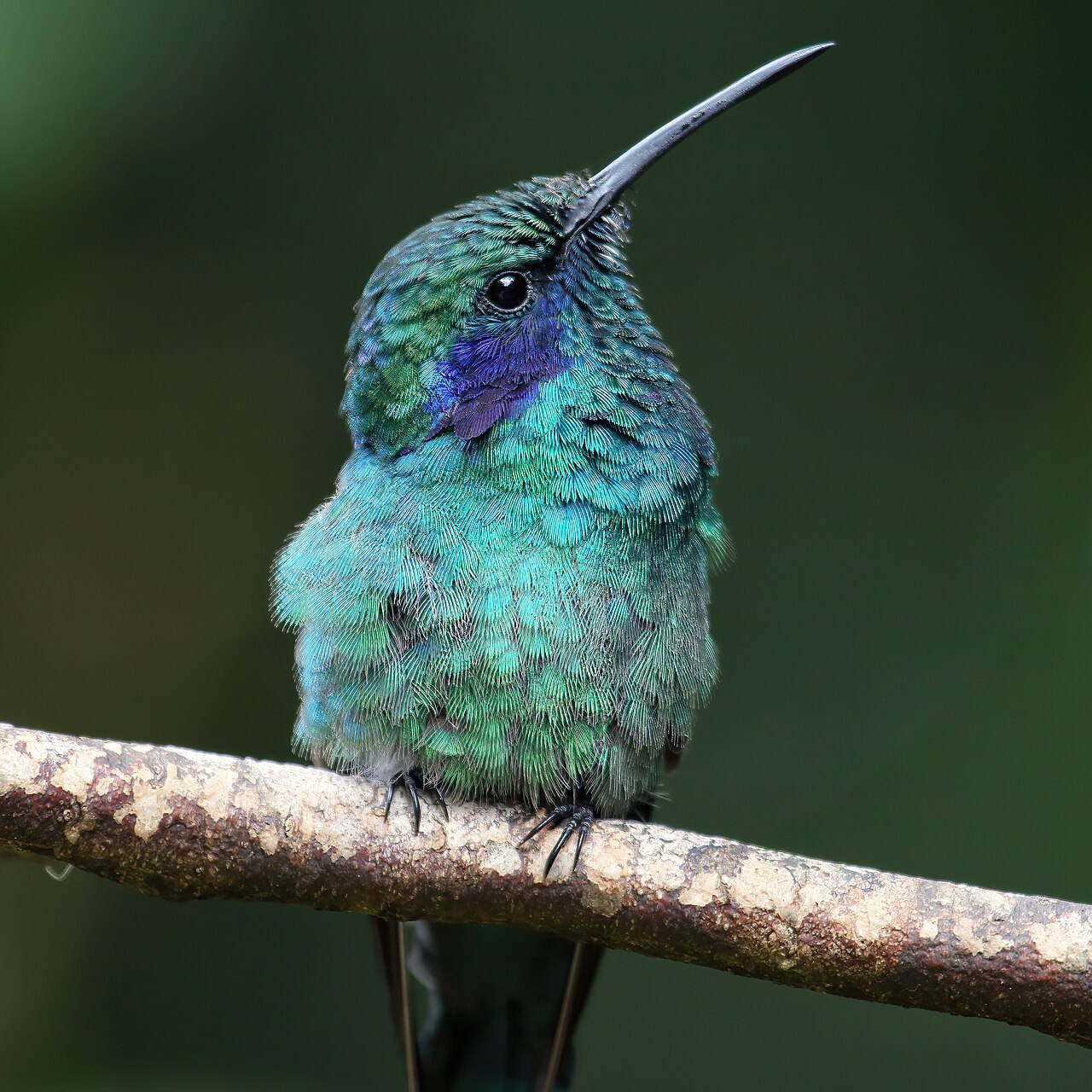
The Mexican Violetear is a brilliant green hummingbird of humid mountain forest from Mexico to Nicaragua, with a broad, glittering violet 'ear patch' on each side of the head that flashes in good light and looks almost black in shade. Outside the breeding season a few birds wander north, and a handful turn up in Texas every year.
Voice
The male repeats, for hours on end from an open twig within his territory, a dry, sharp chip roughly once a second, with no melody at all. Where most hummingbirds limit themselves to a few call notes, this species sings this way for most of the day, which makes voice the easiest way to locate one in dense mountain forest before you ever see it. When excited or facing an intruder, the series speeds up into a short, rattling chatter.
No freely licensed recording has been found for this species yet; what to listen for is described below.
Identification
It is a medium-sized hummingbird with a straight black bill and a moderately forked tail. The crown, back and underparts are glossy green, and a broad violet-blue 'ear patch' stands out on the side of the head and neck, appearing almost black against the light. The throat and breast carry a darker, blue-green sheen, and the tail is metallic blue-green with a broad dark terminal band. Males and females look very similar; young birds are duller green and lack the full brilliance of the ear patch.
Confusion species
In Texas it is most often confused with the Buff-bellied Hummingbird, which is likewise green and heavy-bodied but has a red bill with a yellow base and a buffy, not solid green, belly. The White-eared Hummingbird, found in the same Mexican mountain forests, has a narrow white rather than violet ear stripe and a red-based bill. Females and immatures of Rivoli's Hummingbird and the Blue-throated Mountain-gem are larger and greyer below, and lack any coloured ear patch at all.
Habitat
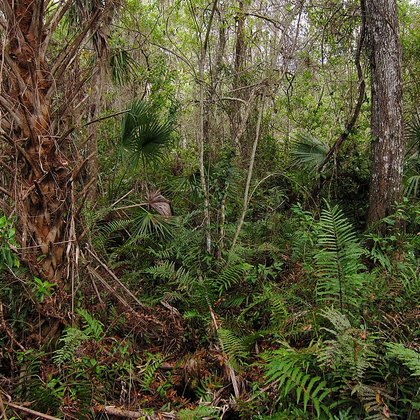
It favours the edge and canopy of humid mountain forest and cloud forest, mostly between 1,200 and 2,300 metres, and is found there among flowering shrubs along forest trails, in second growth and in gardens planted with flowering bushes. It avoids open farmland and dry lowland vegetation; what it needs is a stretch of moist mountainside with flowers available year-round. At the edge of its range it will also use lower scrub when on the move.
Where the bird is most often found, arranged by the USNVC — the vegetation classification of the United States and Canada — and CMECS for sea and coast.


Range and movements
It breeds in the humid mountains of southern Mexico, through Central America, to northern Nicaragua, and mostly stays there year-round. Every year a small number of birds, probably mainly young ones, move north after the breeding season and reach southern and central Texas; a few have even been reported as far as Canada. It maintains no established population in the United States.
- Resident
- Breeding (summer)
- Winter
- dark = core range, pale = thinly spread
Where and when to look
Look for it in autumn and winter at a sugar-water feeder in the Texas Hill Country, where it can linger for weeks among the far more numerous Ruby-throated Hummingbirds. In its Mexican mountain forest it is more often given away by its monotonous ticking from a bare twig than by its colour, which barely shows in the shaded canopy.
Conservation
No current Red List assessment exists for this species; it is considered common through most of its range. Loss of mountain forest to logging and conversion to coffee plantations is the main threat, though the species tolerates shade-grown coffee reasonably well.
Scientific name
Colibri thalassinus | (Swainson, 1827)
Swainson described the species in 1827 as Trochilus thalassinus, in the then catch-all genus for hummingbirds; it has since been moved to another genus, which is why author and year stand in parentheses. The genus Colibri is the French word for hummingbird, borrowed from a Caribbean language. thalassinus is Greek-derived Latin for 'sea-green', after the glossy sea-green upperparts. The type locality is Temascaltepec, in the present-day Mexican state of México.