All species › Swifts › Swifts › Mariana Swiftlet
Mariana Swiftlet | Aerodramus bartschi
Marianensalangaan | Salangana de Guam
Mariana Swiftlet is the only bird in this guide that finds its way through total darkness using echolocation, just like a bat. It breeds only in limestone caves on Guam and a handful of neighbouring islands in the Northern Marianas, far out in the Pacific and well outside the guide's usual area — but Guam is United States territory, which makes the species as much a part of the North American avifauna as a cardinal in an Ohio backyard. Of a once-numerous bird, an accidentally introduced snake has left only a fraction.
Voice
In flight and over the forest it gives a light, rattling twittering and chirping, not fundamentally different from other small swiftlets. Inside the total darkness of the breeding cave it also produces a series of audible clicks, which bounce off the cave ceiling like a kind of sonar and guide the bird back to its own nest. Of all the world's birds only a handful of cave-dwelling swiftlets and the Oilbird of South America use this trick.
No recording with a suitable Creative Commons licence has been found for this species yet; what to listen for is described below.
Identification
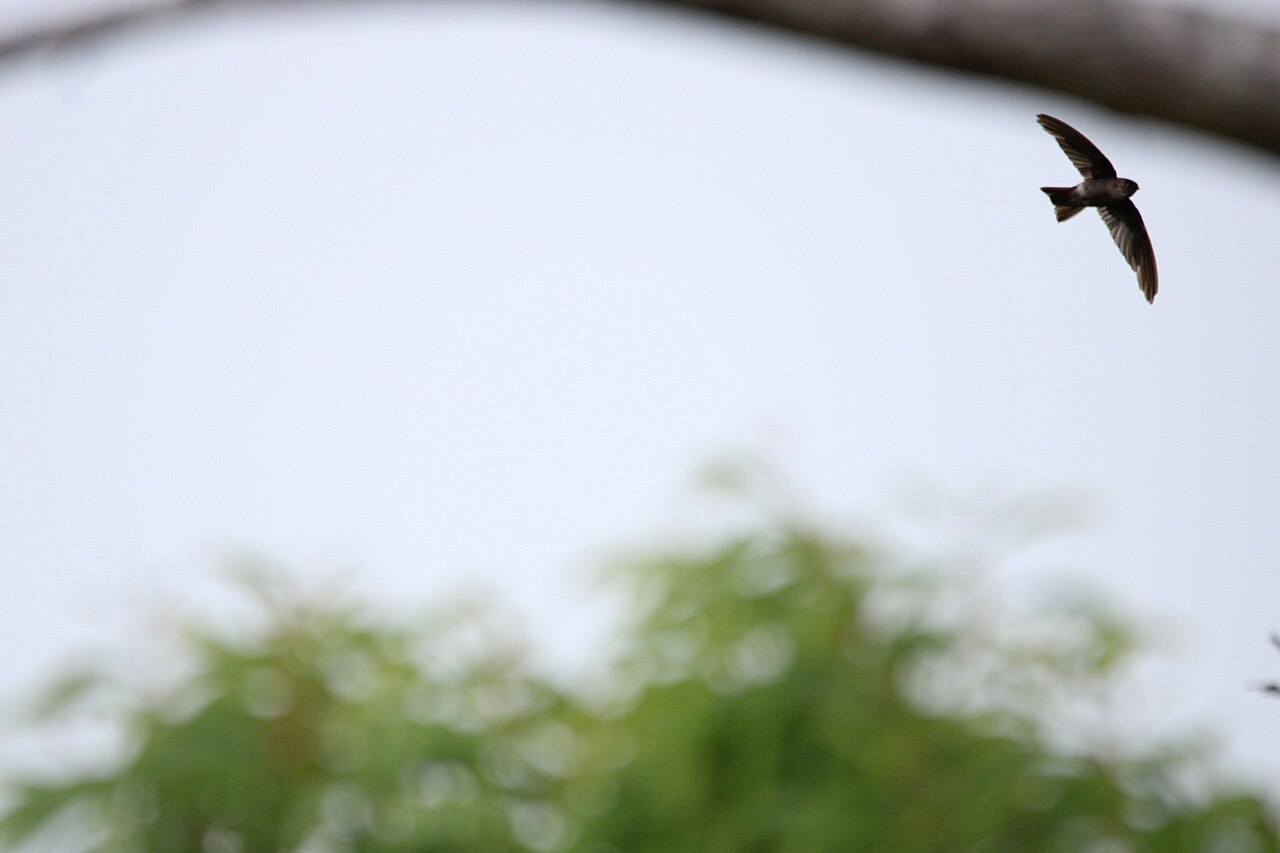
A small, dark bird with dull grey-brown upperparts lacking any gloss, a pale grey throat and upper breast, and slightly darker grey on the rest of the underparts. The tail is shallowly forked, the wings narrow, and the flight fast and agile, with short glides between bursts of flapping. Outside the cave, in the open air over the forest, the species is barely distinguishable from a swift seen at a distance; it is the combination of cave, sound and place that makes the identification certain.
Confusion species
On the Marianas there is no other swift to confuse it with; the swifts elsewhere in the guide live thousands of kilometres away and moreover have sharply contrasting white underparts that Mariana Swiftlet entirely lacks. Locally, on Guam and the Marianas, there is little risk of confusion either: the islands have no other resident aerial-hunting species of similar size and dark colour, and it is above all the flight in and out of a cave that gives the species away at once.
Habitat
Limestone caves only, where the bird builds its nest high against the ceiling or wall, in colonies of a few to several hundred pairs. Outside the cave it hunts insects over the surrounding forest and over clearings and village edges on Guam and the Marianas. Caves visited by people, or where conditions change, are avoided or abandoned; the number of suitable caves is naturally limited on these small islands to begin with.
Where the bird is most often found, arranged by the USNVC — the vegetation classification of the United States and Canada — and CMECS for sea and coast.


Range and movements
Found only on Guam and, in the Northern Marianas, on Saipan and Aguijan; on Rota and Tinian the species is locally extinct. Only a small, introduced population exists outside this area: a group released in the 1960s established itself on Oʻahu, Hawaii. Because the Marianas lie far west of the guide area, no seasonal map has been drawn for this species; the entire population is resident, with no meaningful migration.
- Resident
Where and when to look
On Guam, look for one of the few still-occupied breeding caves — local conservation staff and the Guam National Wildlife Refuge can say which are accessible at any given time — and watch at dusk for birds flying in and out; outside the island itself the species cannot be seen anywhere else in the world on its natural breeding grounds, apart from the small established group on Oʻahu.
Conservation
The species is listed as Vulnerable (VU). Since the Second World War the brown tree snake, accidentally carried in on cargo ships, has been responsible for wiping out almost all of Guam's native forest birds; Mariana Swiftlet survived only because it breeds in inaccessible caves. Around the mid-2000s Guam still held about nine hundred birds, Saipan just over five thousand, and Aguijan a few hundred. Management focuses on keeping snakes out of caves, protecting colonies from disturbance, and attempts at reintroduction on islands where the species has disappeared.
Scientific name
Aerodramus bartschi | (Mearns, 1909)
Mearns described the species in 1909 as Collocalia bartschi, while working as an army surgeon and naturalist for the United States military in the recently conquered Philippines and the Pacific; it has since been moved to another genus, hence the parentheses around author and year. Oberholser introduced the current genus Aerodramus in 1906, from the Greek aer, 'air', and dromos, 'runner' — an 'air runner'. The epithet bartschi honours Paul Bartsch, a Smithsonian researcher on expedition in the Philippines and the Marianas in the same years. The type locality is Guam.