All species › Woodpeckers and allies › Woodpeckers › Hairy Woodpecker
Hairy Woodpecker | Leuconotopicus villosus
Haarspecht | Pico velloso
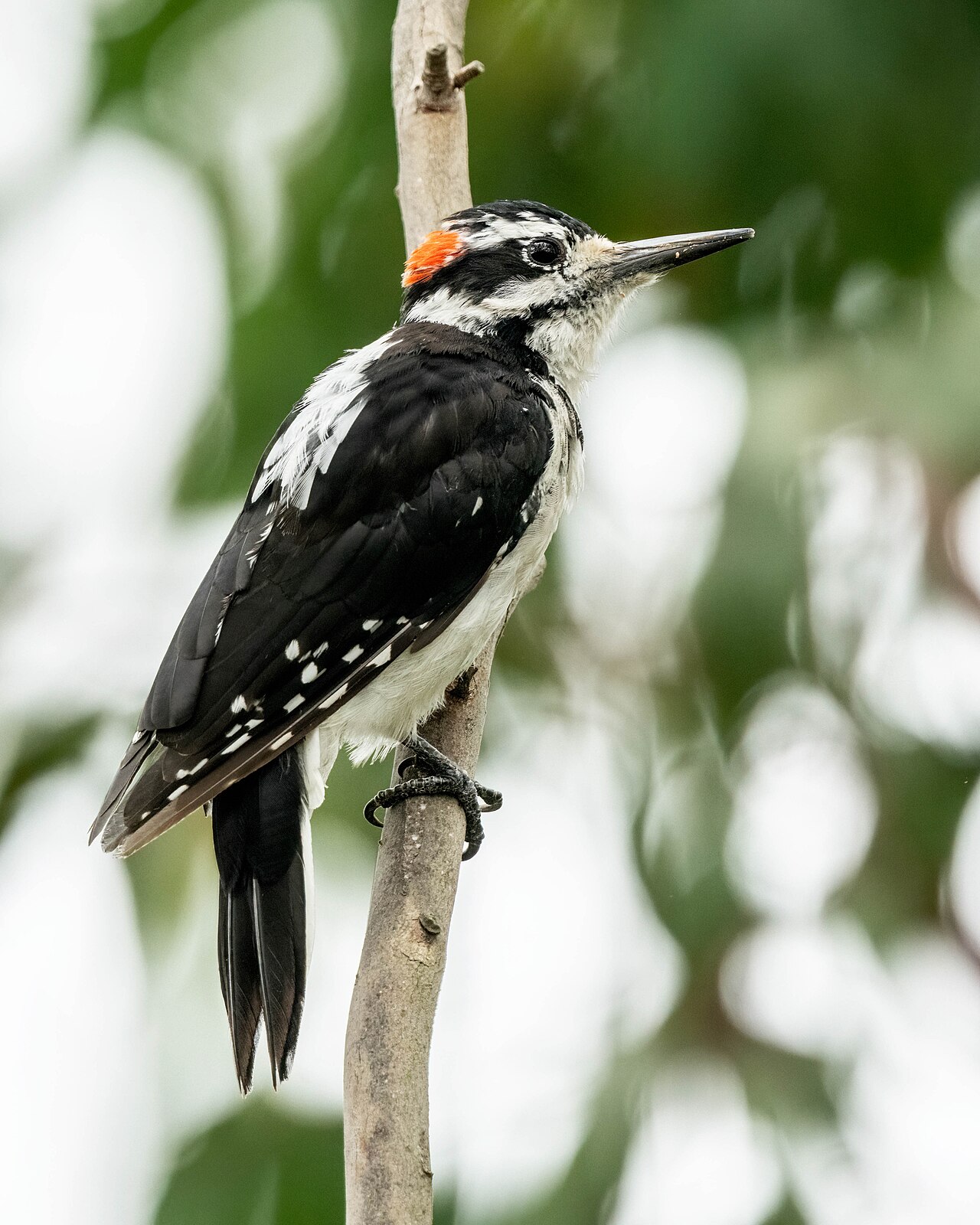
The Hairy Woodpecker is the large double of the Downy Woodpecker: black and white, with a broad white stripe down the centre of the back and a powerful bill almost as long as the head. It ranges from the boreal forests of Alaska to the mountains of Panama and can be found in almost any woodland with sizeable trees. The male has a red patch on the nape; the female has an entirely black-and-white head.
Voice
The call is a sharp, loud peek!, clearly stronger and higher than the soft pik of the Downy Woodpecker. When excited it follows this with a fast, ringing rattle that stays on one pitch, whereas the Downy's descends at the end. The drum is a loud, rapid roll, faster than the Downy's, with which pairs mark their territory and seek each other out in late winter.
Recording: Valerie Heemstra — CC BY-NC-SA 4.0 · Wells Township (near Escanaba), Delta County, Michigan, United States · xeno-canto
Identification
A medium-sized woodpecker of 18 to 26 centimetres, with black upperparts, a broad white back stripe and white spots on the black wings. The head is black with a white supercilium and a white stripe below the eye; the underside is white, and the outer tail feathers are pure white, without black spots. The bill is long and dagger-shaped. The male has a red nape patch; young birds often show red or orange on the crown. Western birds have fewer white wing spots, birds of the Pacific coast and Central America a greyish-brown tinge to the underside.
Confusion species
Downy Woodpecker is practically a small copy, but has a short, thin bill no more than a third of the head length, black spots or bars on the white outer tail feathers and a softer call; it also forages on thin twigs and weed stems, which the Hairy rarely does. American Three-toed Woodpecker has a barred back and flanks and, in the male, a yellow crown; Black-backed Woodpecker has an entirely black back. Nuttall's Woodpecker and Ladder-backed Woodpecker have a barred black-and-white rather than a white back.
Habitat
Mature deciduous, coniferous and mixed forest with medium to large trees, from the lowlands up into the mountains; in Mexico and Central America mainly highland pine-oak forest. It also occurs in woodlots, leafy suburbs and parks, and turns up quickly in freshly burned forest or during bark-beetle outbreaks. Unlike the Downy it keeps to trunks and thick branches, and for its nest cavity it usually chooses a dead trunk or a dead limb of a living tree.
Where the bird is most often found, arranged by the USNVC — the vegetation classification of the United States and Canada — and CMECS for sea and coast.



Range and movements
One of the most widespread woodpeckers on the continent: from central Alaska and the Canadian tree line south through almost the entire United States, and on through the mountains of Mexico and Central America to western Panama; also in the northern Bahamas. Over most of its range it is resident; birds from the far north move south to a limited extent in winter. Seventeen subspecies are recognised, becoming smaller and darker from north to south.
- Resident
- Breeding (summer)
- Winter
- Passage
- dark = core range, pale = thinly spread
Where and when to look
If you see a black-and-white woodpecker at a suet feeder, compare bill and head first: in the Hairy almost equally long, in the Downy much shorter. The sharp peek! is often heard before the bird is seen. In woodland, Hairy Woodpeckers regularly check fresh excavations made by the Pileated Woodpecker for leftover larvae and ants.
Conservation
The IUCN rates the species as Least Concern (LC). Partners in Flight puts the world population at about 8.9 million breeding birds, and according to the Breeding Bird Survey numbers rose by about 0.7 per cent a year between 1966 and 2019. Forest fragmentation and competition for nest cavities with the introduced European Starling could affect the species in the longer term. As a consumer of beetle larvae and of the European corn borer it is regarded as a useful controller of insect pests in woodland and orchards.
Scientific name
Leuconotopicus villosus | (Linnaeus, 1766)
Linnaeus described the species in 1766 as Picus villosus, partly on the basis of Mark Catesby's illustration; he gave its origin as North America, mentioning Raccoon in New Jersey. Because the species now stands in another genus, author and year are in parentheses. Leuconotopicus, introduced by Alfred Malherbe in 1845, is from Greek leukos 'white' and nōtos 'back' with Latin picus 'woodpecker'; villosus is Latin for 'hairy', after the long, hair-like feathers of the white back stripe.