All species › Woodpeckers and allies › Woodpeckers › White-headed Woodpecker
White-headed Woodpecker | Leuconotopicus albolarvatus
Witkopspecht | Pico cabeciblanco
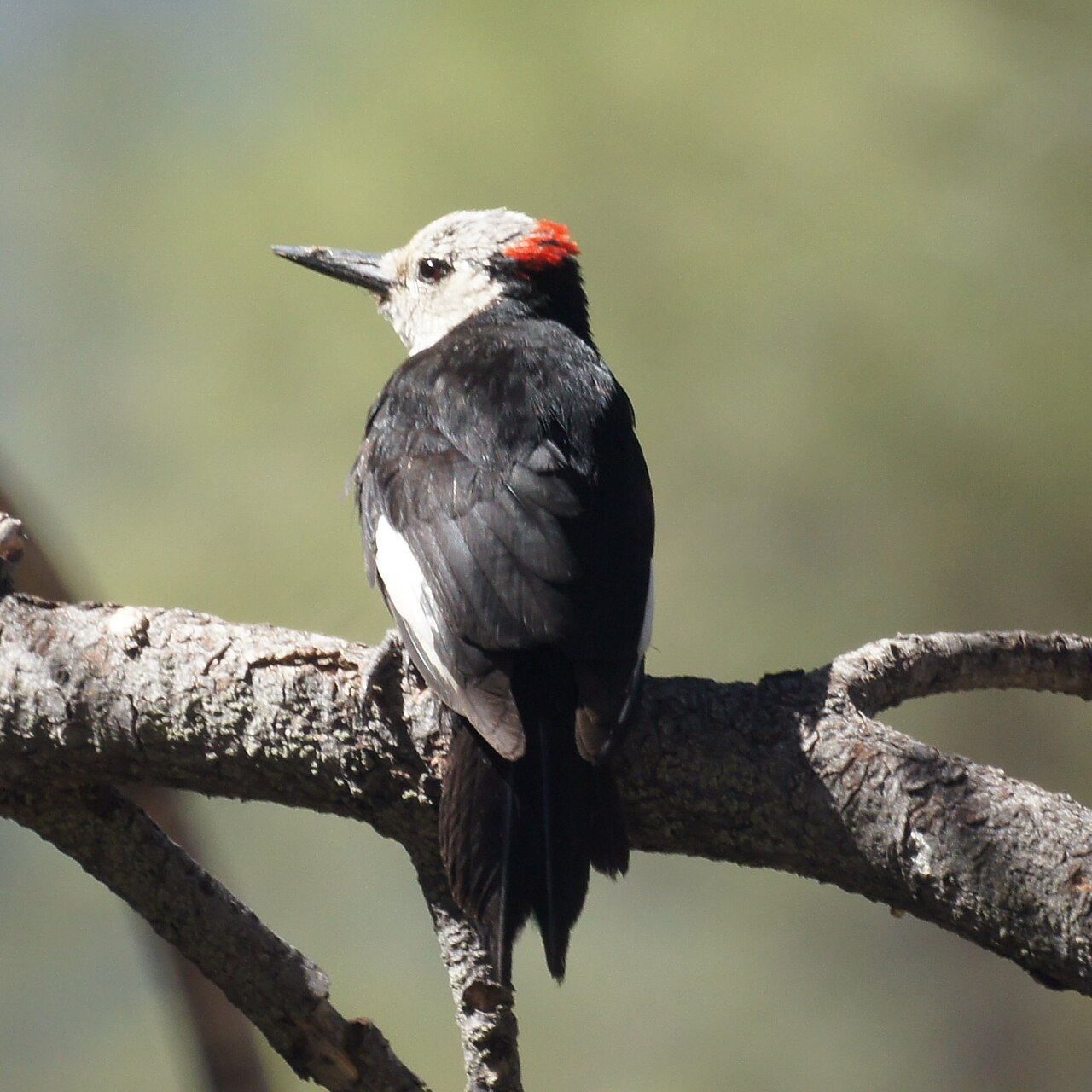
The White-headed Woodpecker is a woodpecker of the west: an entirely black bird with a snow-white head and throat, the male with a small red spot on the nape. It inhabits the open pine forests of the mountains, from southern British Columbia to southern California, and in winter lives mainly on pine seeds that it prises from the cones. That makes it one of the few North American woodpeckers that depend largely on plant food.
Voice
The usual call is a sharp, two-syllabled pee-dink or pitik, somewhat reminiscent of the call of Hairy Woodpecker but more often repeated in series; when excited this turns into a rapid rattle, pitikitikitik. Both sexes drum, in rolls of even speed, mainly in spring when pairs mark out their territory. While it is feeding, the tapping and prising at pine cones can often be heard before the bird is seen.
Recording: Greg Irving — CC BY-NC-SA 4.0 · Wenas Campground, WA, United States · xeno-canto
Identification
A medium-sized woodpecker with a uniformly black body, a snow-white head and throat and a narrow black stripe behind the eye running to the nape. The male has a small red patch on the back of the head, the female does not. On the closed wing a white patch shows at the base of the primaries, which in flight becomes a white crescent. The tail is black. Birds of the southern subspecies gravirostris in the mountains of southern California have a longer bill and tail, especially the males.
Confusion species
Within its range it is hardly confusable. Acorn Woodpecker, which in California often shares the same forest, also has much white in the face, but a black and red crown, pale eyes and a white rump and belly. Very occasionally partly white, leucistic individuals of other woodpeckers cause confusion; these, however, rarely have such a sharply defined white head on a plain black body and lack the white crescent in the wing.
Habitat
Open mountain forest dominated by pines with large cones: ponderosa pine, sugar pine and Jeffrey pine, and in the south Coulter pine, usually with an open canopy, little undergrowth and many old trees and standing dead trunks. It largely avoids pines with small cones, such as lodgepole pine. Recently burned forests are also used. It excavates its nest cavity in dead conifers and stumps, often only a few metres up. In summer it eats many ants, beetles and other insects; it also occasionally drills sap wells.
Where the bird is most often found, arranged by the USNVC — the vegetation classification of the United States and Canada — and CMECS for sea and coast.


Range and movements
It inhabits the mountains of the west: the southern Okanagan in British Columbia, eastern Washington, northern Idaho, the Cascades and Blue Mountains of Oregon, western Nevada and, in California, the Sierra Nevada, the Klamath Mountains and the Transverse and Peninsular Ranges into San Diego County. The nominate form occupies almost the entire range; gravirostris lives on the mountaintops from the San Gabriel Mountains to San Diego County, with intermediates on Mount Pinos. It is a resident that at most moves a little lower outside the breeding season.
- Resident
- Breeding (summer)
- dark = core range, pale = thinly spread
Where and when to look
Look for it in an open forest of old ponderosa or sugar pines and watch for a black woodpecker working cones at the tips of branches or pressed against a trunk; the white head then stands out at once. In the Sierra Nevada good places are around Yosemite and Lake Tahoe. Listen for the two-syllabled pee-dink: it is often the first sign of its presence. Because it nests low in a dead trunk, breeding in May and June can sometimes be followed well.
Conservation
The IUCN rates the species as Least Concern (LC). Partners in Flight estimates the breeding population at about 240,000 birds, and according to the Breeding Bird Survey numbers increased by about 1.1 per cent a year between 1968 and 2015. Even so, it is locally vulnerable: logging of old pines, removal of dead trunks and the suppression of forest fires, which lets forests grow dense, all reduce its habitat. In Canada, where only a small population breeds, it is legally listed as endangered.
Scientific name
Leuconotopicus albolarvatus | (Cassin, 1850)
John Cassin described the species in 1850 as Leuconerpes albolarvatus; the type locality is Oregon Canyon in El Dorado County, California, in the gold-rush country of the Sierra Nevada. Because the species has since been moved to another genus, author and year stand in parentheses. Leuconotopicus, introduced by Alfred Malherbe in 1845, means 'white-backed woodpecker', from the Greek leukos 'white', nōton 'back' and pikos 'woodpecker' — ironic for a species with a black back. Albolarvatus is Latin for 'white-masked', after the white head.