All species › Passerines › Tyrant flycatchers and allies › Hammond's Flycatcher
Hammond's Flycatcher | Empidonax hammondii
Sparrenfeetiran | Mosquero de Hammond
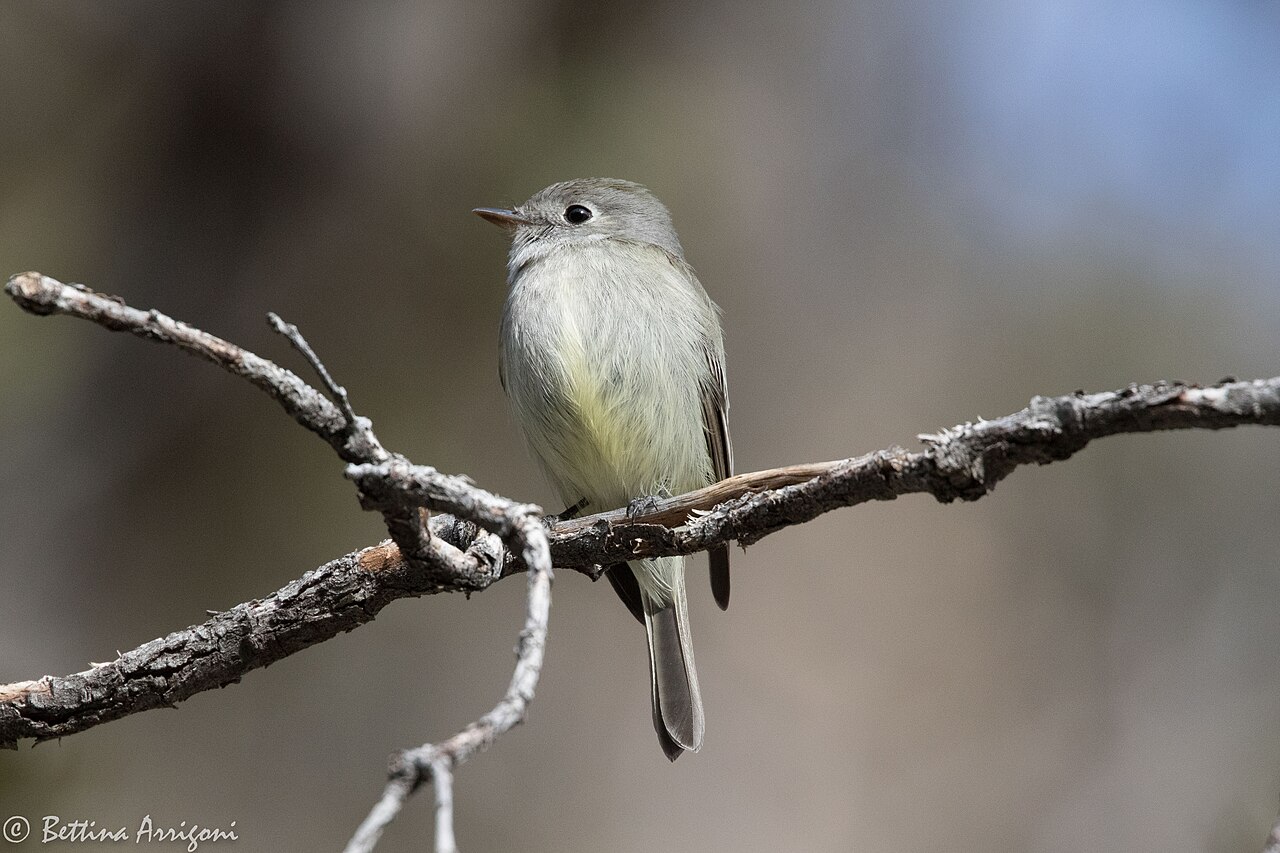
Hammond's Flycatcher is a small empid of the old coniferous forest of western North America. It breeds high in Douglas-fir, true fir and larch, from southeastern Alaska to the mountains of Arizona, and winters in montane forest in Mexico and Central America. Like every Empidonax, it is barely pinned down on plumage; the short three-parted song does pin it down.
Voice
The song has three short, hoarse parts, delivered in varying order: a rising se-pit, a husky tsurrp and a low, rough grrrk. That last part stays low and burry — this is where it differs from Dusky Flycatcher, which ends on a clear, high pseet. The call is a sharp, high peek, about the pitch of a Pygmy Nuthatch, and is given year round, including on migration. Males sing most often and at the highest pitch early in the breeding season; from early July the song falls away sharply.
No freely licensed recording has been found for this species yet; what to listen for is described below.
Identification
Small, short-tailed and large-headed, with a long wing point: the primaries project well beyond the tertials. The bill is small and narrow and mostly dark, including the lower mandible. Head and breast are grey, the back olive, the belly pale yellow; the white eyering is broad and often drawn out into a teardrop behind the eye. The bird flicks wings and tail in a quick, upward movement. Plumage narrows this group to a handful of candidates at best: a silent empid often cannot be named in the field, and only song and call give a reliable identification.
Confusion species
Against Dusky Flycatcher the voice carries the most weight: the call here is a sharp, high peek, there a dry whit; the song ends here on a low, burry note, there on a clear high pseet. In support: Hammond's has a longer primary projection, a smaller and darker bill, and sings from the canopy of tall, closed conifer forest, while Dusky occupies the shrub layer and the open brushy slopes below. Least Flycatcher sings an emphatic, rapidly repeated che-BEK and calls whit, and breeds in eastern deciduous woodland. Gray Flycatcher moves its tail slowly downward rather than up, sings a two-parted chu-wip … cheep, and has a long bill with a clean orange lower mandible; it lives in sagebrush and juniper, not in tall conifer forest. Buff-breasted Flycatcher sings chee-lick and has a warm buff breast.
Habitat
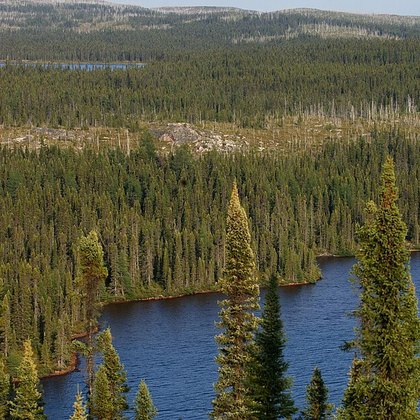
Mature and old-growth coniferous and mixed forest with openings in the canopy, mostly above roughly 1000 metres and in the south to above 3000 metres. Douglas-fir, true fir, larch and pine, often with aspen mixed in. It forages and nests higher in the tree than the other empids of the same mountains. On migration it uses almost anything: desert canyons, riparian groves and mountain passes up to treeline. In winter it stays in cool montane pine-oak forest in Mexico and Central America, not in the lowlands.
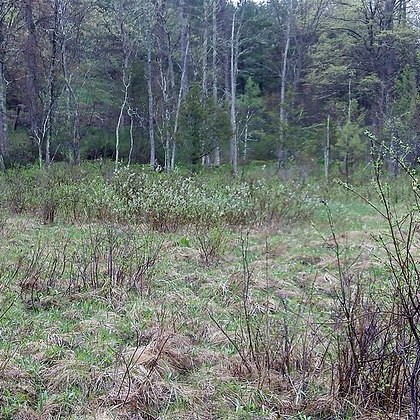
Where the bird is most often found, arranged by the USNVC — the vegetation classification of the United States and Canada — and CMECS for sea and coast.



Range and movements
The breeding range runs from southeastern Alaska and Yukon through British Columbia and Alberta south along the Cascades, the Sierra Nevada and the Rocky Mountains to the mountains of Arizona and New Mexico. Migration is broad across the West; in spring males move on average earlier than females. It winters in the highlands of Mexico, from Sonora and Chihuahua southward, and on into Guatemala, El Salvador, Honduras and Nicaragua.
- Resident
- Breeding (summer)
- Winter
- Passage
- dark = core range, pale = thinly spread
Where and when to look
Look for it in May and June, when males sing from a branch halfway up the crown of an old Douglas-fir; after early July the song largely stops and identification becomes much harder. Let the voice lead you: the sharp peek is given outside the breeding season too, when the bird turns up on migration in desert scrub or on a high pass.
Conservation
Partners in Flight puts the world population at about 20 million birds and gives the species 10 out of 20 on the Continental Concern Score. The Breeding Bird Survey indicated an increase of about 0.8 percent a year between 1968 and 2015. It breeds mainly in forest eighty years and older and in stands of at least ten hectares, which makes logging in the Northwest the main pressure; deforestation of Central American montane forest affects it in winter.
Scientific name
Empidonax hammondii | (Xántus, 1858)
Xántus described the species in 1858 as Tyrannula hammondii, from material taken at Fort Tejon, California; because it was later moved to another genus, author and year stand in parentheses. The species name honours William Alexander Hammond, army surgeon and collector, who supplied Xántus with specimens. The genus Empidonax was introduced in 1855 by Cabanis, from Greek empis, empidos 'gnat' and anax 'ruler' — 'gnat ruler'. The Dutch name refers to the conifer forest in which it breeds.