All species › Passerines › Crows, jays and magpies › Island Scrub-Jay
Island Scrub-Jay | Aphelocoma insularis
Eilandstruikgaai | Chara de Santa Cruz
The Island Scrub-Jay lives on one island: Santa Cruz, the largest of California's Channel Islands, some 30 kilometres off the coast near Santa Barbara. It is the only bird species confined to a single California island, and with a range of about 250 square kilometres it has the smallest distribution of any North American bird.
Voice
The standard call is a harsh, rasping shreep, often in series of three to five and rising at the end. There is also a dry rattle, faster and higher in the female than in the male. Birds from pine-dominated areas give that rattle measurably faster and higher than birds from oak areas; those differences run parallel to the difference in bill shape between the same two groups. Within the territory pairs use soft whistles and short contact notes.
Recording: Sue Riffe — CC BY-NC-SA 4.0 · Santa Cruz Island (near Ventura), Santa Barbara Co., California, United States · xeno-canto
Identification
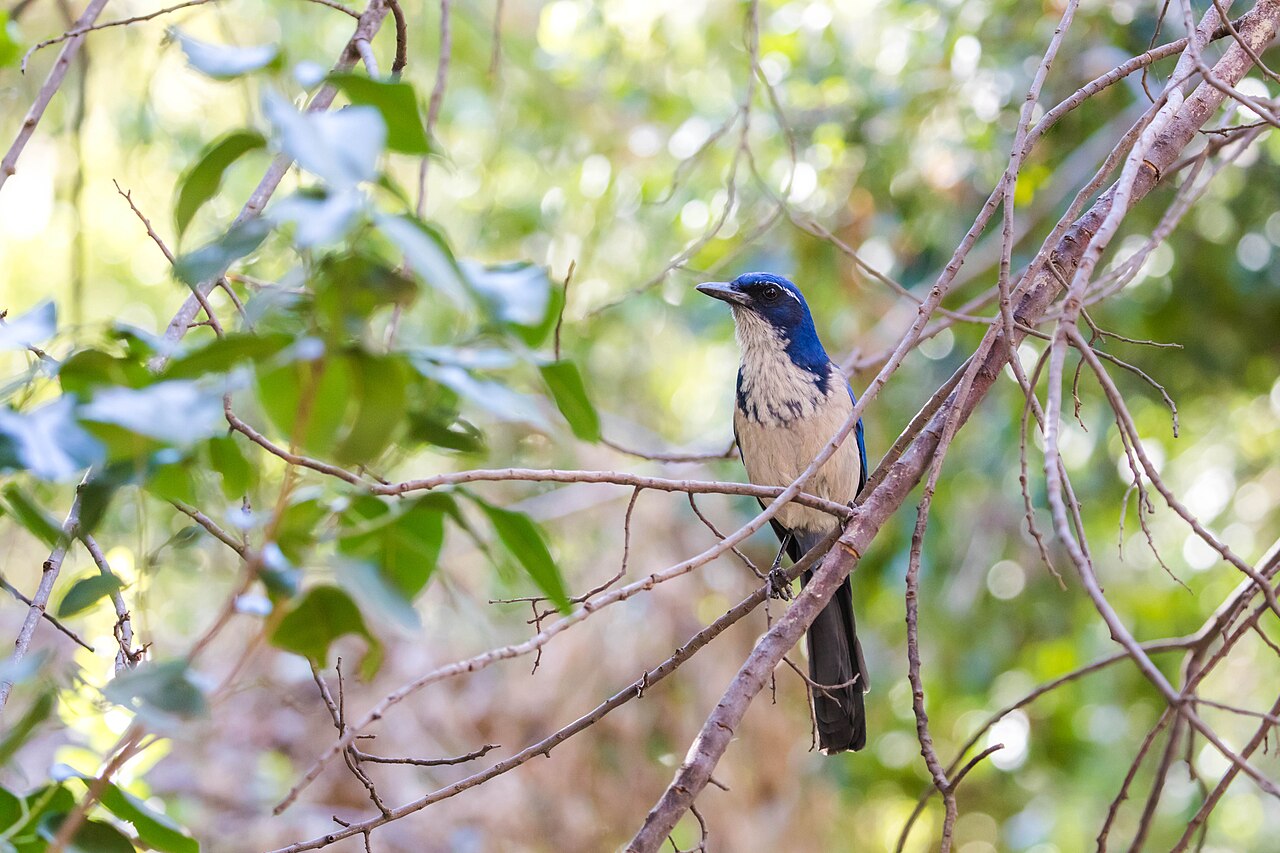
A large, crestless jay: deep blue on head, wings and tail, grey-brown on the back, pale grey below, with a white eyebrow and a dark mask through the eye. A broken blue band crosses the breast. Compared with the mainland California Scrub-Jay it is about fifteen per cent longer, forty per cent heavier and deeper blue, and the bill is about a fifth longer and distinctly heavier. Bill shape varies within the island: birds in pine woodland have a longer, shallower bill than birds in oak woodland, and that difference is heritable.
Confusion species
On Santa Cruz Island there is no other jay, so confusion is mainly a matter for the books. The mainland California Scrub-Jay — treated until 2016 together with this species and with Woodhouse's Scrub-Jay as a single Western Scrub-Jay — is smaller, paler blue and shorter-billed, and does not occur on the Channel Islands. Woodhouse's Scrub-Jay is paler still, has barely any breast band, and lives far to the east in the Great Basin and the Rocky Mountains. Steller's Jay has a crest and a black head. American Crows on the island are larger and all black.
Habitat
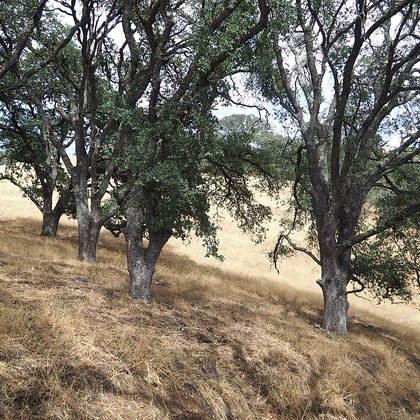
Scrub oak woodland and chaparral (dense, hard-leaved scrub of California's Mediterranean climate) on the slopes, together with stands of bishop pine and riparian woodland in the canyons. It uses both dense shrubs and mature trees: the shrubs for the nest, the oaks for acorns. Grazing by sheep and later by feral pigs kept the shrub layer low for over a century; since those animals were removed from the island the shrub layer has been closing in again.
Where the bird is most often found, arranged by the USNVC — the vegetation classification of the United States and Canada — and CMECS for sea and coast.




Range and movements
Santa Cruz Island only, year-round. Fossil remains have been found on San Miguel Island and Santa Rosa Island, and there is a single record from Santa Rosa in 1892; the species is gone from both. The channel between the island and the mainland is not crossed: there is no exchange with the California Scrub-Jay. DNA work indicates a separation from mainland birds on the order of hundreds of thousands of years; the most recent analysis arrives at about one million years.
- Resident
- dark = core range, pale = thinly spread
Where and when to look
The island is reached by boat from Ventura; around the landings at Prisoners Harbor and Scorpion Ranch birds sit in the oaks close to the trails. They keep little distance from people and come up to picnic tables and parked cars. A single day visit in spring normally produces several birds; listen first for the harsh shreep and then search the oak crowns.
Conservation
Surveys in 2008 and 2009 arrived at 1,700 to 2,300 birds, making this one of the smallest songbird populations in the United States. It is listed as Vulnerable (VU), on range size alone. West Nile virus, established in southern California since 2003, is the largest threat: a single outbreak could strike a large part of the population, and corvids are particularly susceptible. An island-wide fire could do the same. Part of the population was vaccinated against the virus in 2015. The island is owned by the Nature Conservancy and the National Park Service; the thickening shrub layer following removal of sheep and pigs increases the nesting habitat available.
Scientific name
Aphelocoma insularis | Henshaw, 1886
Henry Wetherbee Henshaw described the species in 1886 as Aphelocoma insularis, from a specimen taken on Santa Cruz Island; author and year stand without parentheses because the genus has not changed since. Aphelocoma comes from Greek apheles 'simple, smooth' and komē 'head of hair', after the unstreaked, plain plumage, as against the barred feathers of other jays. The species name insularis is Latin for 'of the island'. Over the intervening century the bird has been treated alternately as a subspecies of the mainland scrub-jay and as a separate species; species status has held again since 1995.