All species › Passerines › Cardinals and allies › Lazuli Bunting
Lazuli Bunting | Passerina amoena
Lazuligors | Colorín aliblanco
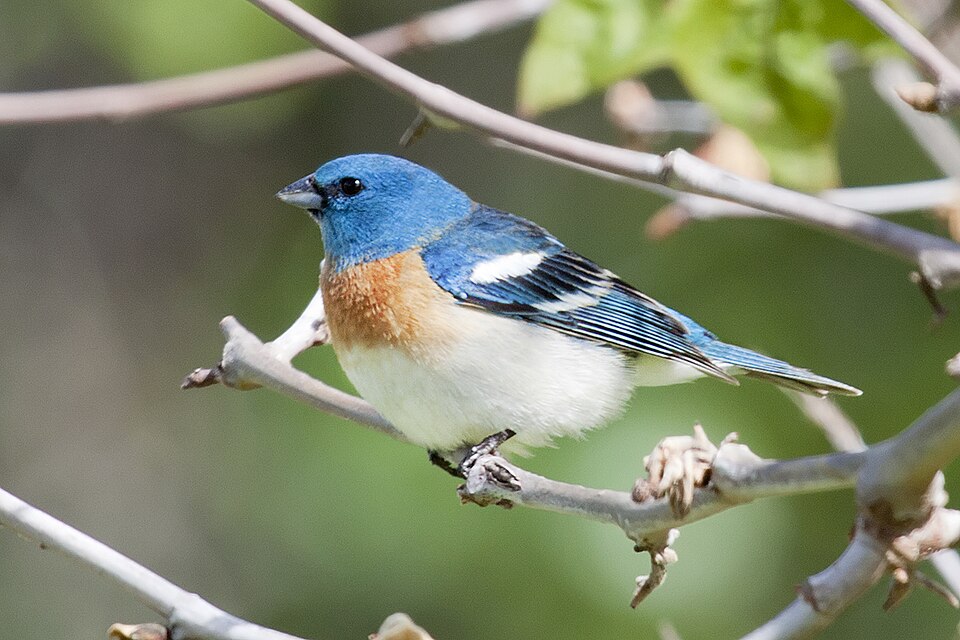
The Lazuli Bunting is the western counterpart of the Indigo Bunting: the male has a light blue head and back, an orange-brown breast, a white belly and two broad white wingbars. It breeds on dry brushy slopes and along streams in western North America, and moults on its way south in the monsoon belt of Arizona and Sonora.
Voice
The song is a high, rapid, slightly buzzy warble, longer than that of Indigo Bunting and with less repetition of the same syllable. In his first summer each male builds a phrase of his own by rearranging fragments taken from several neighbours; that phrase then stays fixed for life. Males of the same song neighbourhood therefore sound much alike and respond more strongly to a stranger's phrase than to a neighbour's. The call is a dry pit.
Recording: Ed Pandolfino — CC BY-NC-SA 4.0 · Elk Mtn Rd, Lake County, California, United States · xeno-canto
Identification
The breeding male has head, neck and back turquoise blue, an orange-brown band across the breast, a white belly and two white wingbars, the upper one the broader. The female is grey-brown above, with an unstreaked, faintly buff breast, a pale throat and two narrow pale wingbars. First-summer males show a mixture of brown and blue. The bill is short and conical with a pale lower mandible.
Confusion species
The male Indigo Bunting is blue over the whole body, without orange breast band, white belly or white wingbars. Blue Grosbeak is larger, with a much heavier bill and chestnut rather than white wingbars. Females are the hard part: a female Lazuli is unstreaked on the breast and has clear pale wingbars, against the fine streaking and fainter wingbars of a female Indigo. In the zone of overlap on the Great Plains, hybrids occur with a blue head and a partial orange breast band.
Habitat
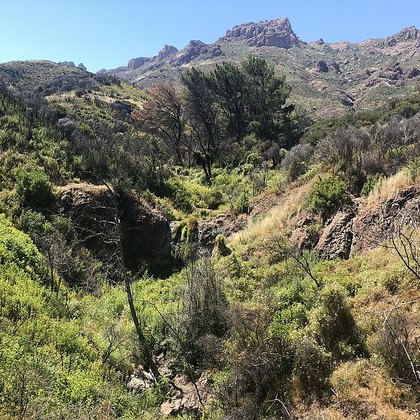
Dry brushy hillsides, chaparral (dense, hard-leaved scrub of California's Mediterranean climate), rank growth along streams and rivers, open pine and oak woodland with a dense shrub layer, and gardens at the edge of settlement. From sea level to well over 2900 metres. Recently burned slopes with young regrowth are occupied quickly; heavily logged closed forest is avoided. In winter it uses overgrown fields, thorn forest and second-growth pine-oak woodland in western Mexico.
Where the bird is most often found, arranged by the USNVC — the vegetation classification of the United States and Canada — and CMECS for sea and coast.




Range and movements
A breeder of western North America, roughly west of the hundredth meridian, from southern British Columbia, Alberta and southwestern Saskatchewan to southern California, central Arizona, central New Mexico, western Texas and the extreme northwest of Baja California. After breeding the birds move to southern Arizona, southern New Mexico and northern Sonora, where they stay one to two months in the monsoon rains to moult. Migration then continues to the wintering range on the western side of Mexico, from Sinaloa and Durango south to Oaxaca.
- Resident
- Breeding (summer)
- Winter
- Passage
- dark = core range, pale = thinly spread
Where and when to look
Look for it from late April to July on a brushy slope or along a stream, where males sing from the top of a bush; a burned or recently cut slope with young regrowth gives the highest density. With brown birds, check the wingbars and the unstreaked breast before thinking of Indigo Bunting.
Conservation
Partners in Flight puts the breeding population at about 5.6 million birds, with a score of 9 out of 20 on the Continental Concern Score and a status of Least Concern (LC). The trend was fairly stable between 1966 and 2015. Most of the population spends part of the year in the United States and almost all of it passes some time in Mexico; about one bird in seven breeds in Canada. Loss of rank streamside growth in the dry west and the clearing of scrub are the main pressures.
Scientific name
Passerina amoena | (Say, 1822)
Thomas Say described the species in 1822 as Emberiza amoena; because it later moved to Passerina, author and year stand in parentheses. The genus Passerina was introduced by Vieillot in 1816, from Latin passer 'sparrow'. The species name amoena is Latin for 'charming'. The specimen described came from the Rocky Mountains at the source of the Arkansas, later fixed as the neighbourhood of Cañon City, Colorado. The name lazuli refers to lapis lazuli, the blue stone; the Spanish name colorín aliblanco names the white wingbars instead.