All species › Passerines › Cardinals and allies › Indigo Bunting
Indigo Bunting | Passerina cyanea
Indigogors | Azulillo índigo
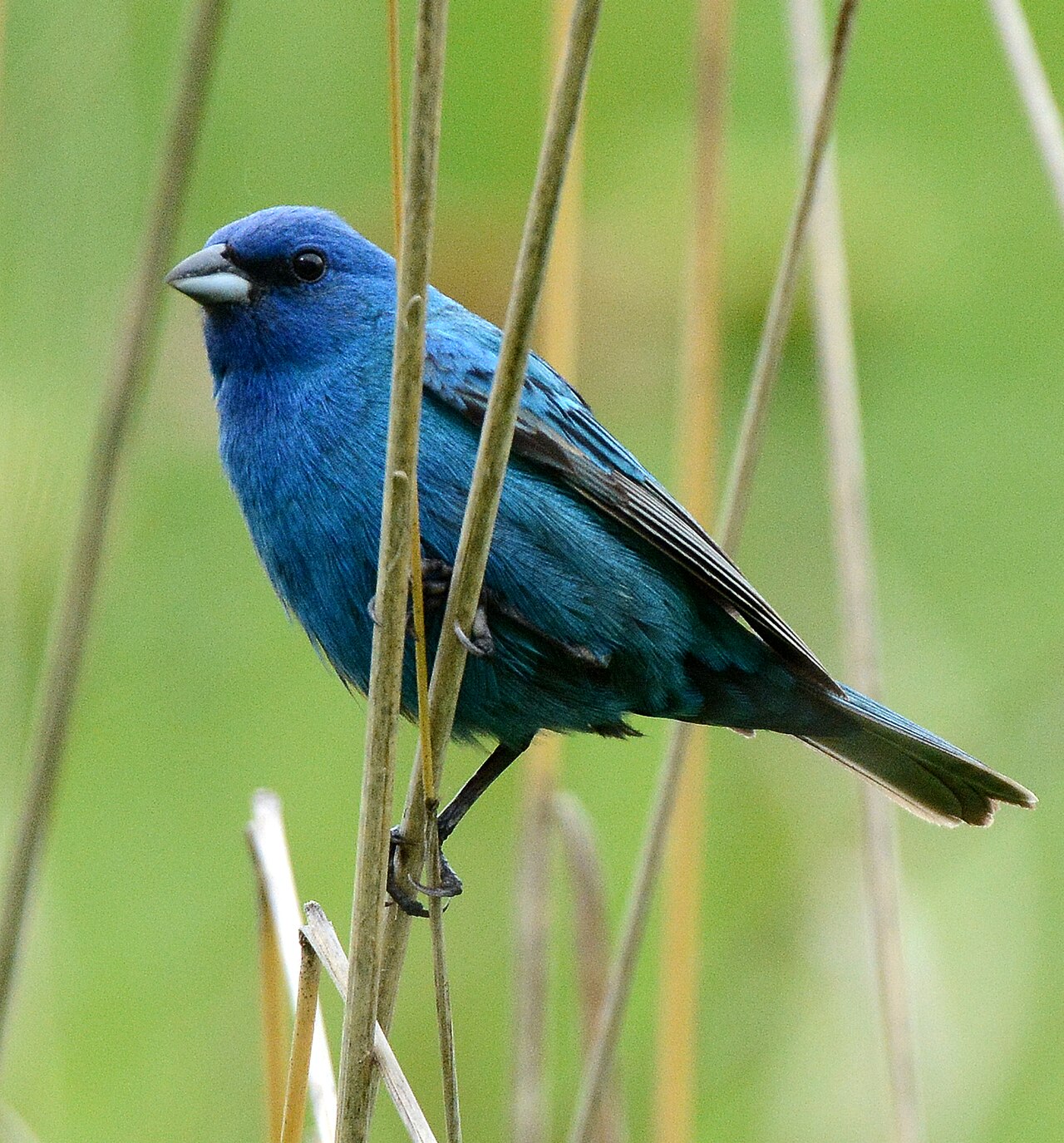
The Indigo Bunting is the blue seed-eater of overgrown woodland edges across the eastern United States. The male is blue over the whole body in summer and the female plain brown; in winter brown feather edges make the male look largely like the female. It is a night migrant that navigates by the stars and winters in Central America and the Caribbean.
Voice
The song is a series of clear, slightly buzzy notes delivered mostly in pairs: sweet-sweet chew-chew sweet-sweet, two to four seconds long, from a wire, a post or the top of a bush. Males in the same area often share almost the same phrase, so that local song neighbourhoods arise and persist for years. The call is a sharp chip; in flight a high, thin zeeep, given at night on migration as well.
Recording: Jonathon Jongsma — CC BY-SA 3.0 · Richardson Nature Center, Hennepin, Minnesota, United States · xeno-canto
Identification
The breeding male is blue over the whole body, deepest on the head, with black wings and tail whose feather edges are blue. Wingbars are absent. The blue comes from feather structure and not from a pigment: against the light the bird looks dark grey to black. The female is warm brown above and paler brown below, with faint fine streaking on the breast and two indistinct pale wingbars. The bill is short, conical and two-toned: dark upper mandible, pale lower. In autumn and winter the male is brown with blue patches, often on rump and bend of wing.
Confusion species
Blue Grosbeak is larger, darker blue, with a much heavier bill and two chestnut wingbars. Lazuli Bunting, with which it hybridises on the Great Plains, has an orange-brown breast, a white belly and broad white wingbars in the male. Females of Indigo and Lazuli are much alike: a female Lazuli is unstreaked on the breast and has clear pale wingbars, a female Indigo is finely streaked with fainter wingbars. Hybrids show intermediate features and cannot always be named.
Habitat
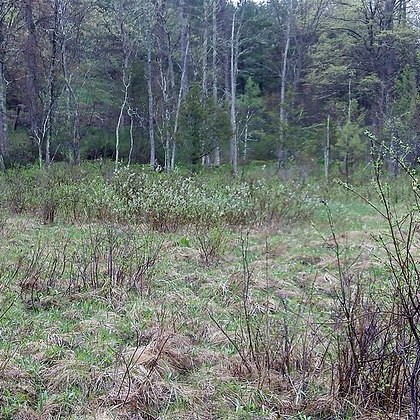
Overgrown woodland edges, clear-cuts, young regrowth, roadsides, hedgerows and abandoned fields — anywhere scrub and herb layer meet standing timber. Closed forest and bare arable land are avoided; forest regrowth and fragmentation of the landscape have created more suitable edge than existed naturally. On migration and in winter it uses grassland, rice fields, weedy fields and scrub edges.
Where the bird is most often found, arranged by the USNVC — the vegetation classification of the United States and Canada — and CMECS for sea and coast.




Range and movements
A breeder of southern Canada and the eastern and central United States, from Maine and southern Ontario to northern Florida and eastern Texas, west to the Great Plains and locally on to New Mexico, Arizona and southern Nevada. Migration runs in April and May and again in September and October, partly straight across the Gulf of Mexico. Wintering takes place in southern Florida, in the Greater and Lesser Antilles, along both coasts of Mexico, in Central America and on into Colombia and Venezuela.
- Resident
- Breeding (summer)
- Winter
- Passage
- dark = core range, pale = thinly spread
Where and when to look
Look for it in May and June along a woodland-edge road: the song carries through the whole day, including the midday hours when most other songbirds fall silent. For the colour, put the sun behind you — from the other side a singing male is a silhouette. On autumn migration the sharp chip betrays the brown birds in weedy edges.
Conservation
Partners in Flight puts the breeding population at about 77 million birds and the species counts as of low concern. The Breeding Bird Survey shows a decline of roughly 0.6 percent per year since 1966, without any contraction of the range. Pressures are agricultural intensification, roadside mowing in the breeding season, collisions with vehicles and towers during night migration, and the trapping of wintering birds for the cage-bird trade in Mexico.
Scientific name
Passerina cyanea | (Linnaeus, 1766)
Linnaeus described the species in 1766 as Tanagra cyanea; because it later moved to another genus, author and year stand in parentheses. The genus Passerina was introduced in 1816 by Vieillot, from Latin passer 'sparrow', for small seed-eaters of sparrow-like build. The species name cyanea means 'blue', after the male's plumage. The specimen described came from Carolina, later restricted to South Carolina. 'Indigo' refers to the blue dye of that name, and recurs in the Dutch, English and Spanish names.