All species › Passerines › Cardinals and allies › Blue Bunting
Blue Bunting | Cyanocompsa parellina
Azuurbisschop | Picogrueso azul
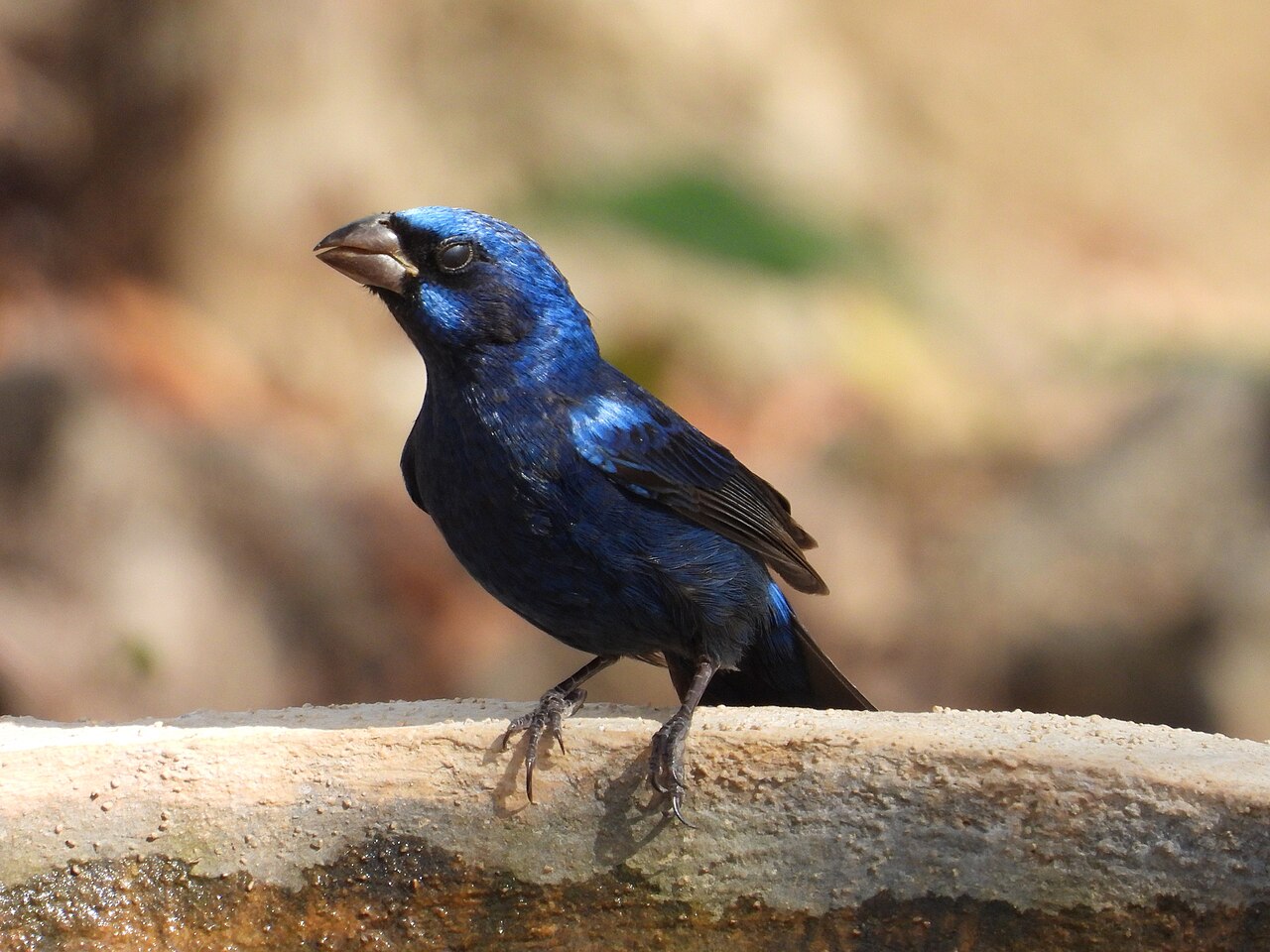
The Blue Bunting is a stocky seed-eater of Mexico and northern Central America, with a short, heavy conical bill whose upper edge is clearly curved. The male is dark blue throughout, with paler blue patches on forehead, cheek, shoulder and rump; the female is plain warm brown. In the United States it appears only as an irregular winter visitor to the far south of Texas.
Voice
The song is a short, flowing warble of clear notes that drops slightly at the end; it is usually delivered from cover rather than from an open perch. The call is a hard, metallic chink, short and dry, and in dense scrub it is often the only sign that the bird is there. Males sing mainly in spring and early summer; outside the breeding season only the call is heard.
Recording: Aziza Cooper — CC BY-NC-SA 4.0 · Yelapa, Cabo Corrientes, Jalisco, Mexico · xeno-canto
Identification
The male is dark cobalt blue over the whole body, with distinctly paler sky blue on the forehead and brow, the cheek, the bend of the wing and the rump. Wingbars are absent. The bill is short, deep and heavy, with a curved upper edge, and so looks blunter than that of the other blue seed-eaters. The female is uniform warm brown, slightly redder on the belly, without streaking and without wingbars. In shade the male looks black; only in direct light do the shades of blue separate.
Confusion species
The male Indigo Bunting is a lighter and more even blue, without the paler patches on head and rump, and has a smaller, straighter bill. Blue Grosbeak is clearly larger, with a heavy silver-grey bill and two chestnut wingbars. Among females the bill shape is the key: a female Blue Bunting is unstreaked and lacks wingbars, while a female Indigo shows fine streaking on the breast and faint pale wingbars, and a female Blue Grosbeak has broad buff wingbars.
Habitat
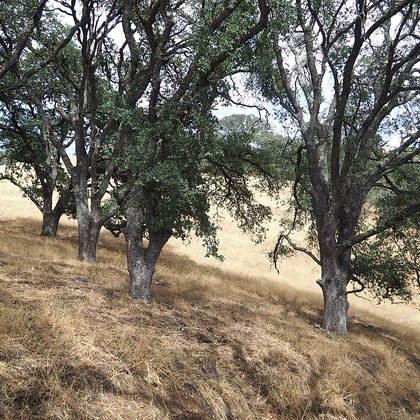
Dense scrub, understorey and forest edge in tropical deciduous woodland, second growth and overgrown plantation margins. It stays low and largely within cover, and avoids open country. In Mexico it occurs up to about 1800 metres, in Guatemala to about 900 metres. Overgrown garden edges and hedges near villages are used as well, as long as a dense shrub layer is present.
Where the bird is most often found, arranged by the USNVC — the vegetation classification of the United States and Canada — and CMECS for sea and coast.



Range and movements
A resident of Mexico and northern Central America. On the Pacific slope the range runs from Sinaloa and Nayarit south to Oaxaca and Chiapas, on the Gulf slope from Nuevo León, Tamaulipas and San Luis Potosí through Veracruz to Tabasco, and on across the Yucatán Peninsula. To the south it reaches Belize, Guatemala, Honduras, El Salvador and Nicaragua. In the United States it is a rare and irregular winter visitor to the Lower Rio Grande Valley of southern Texas, with a few records farther north along the coast and one from Louisiana.
- Resident
- Breeding (summer)
- Winter
- Passage
- dark = core range, pale = thinly spread
Where and when to look
In Texas the window from November to March is the only chance, and nearly always at a feeding station in the Lower Rio Grande Valley — Bentsen-Rio Grande Valley State Park, Santa Ana and Estero Llano Grande hold most of the records. Listen for the hard chink from the thicket and wait until the bird moves into sun: in shade the blue cannot be told from black.
Conservation
The species is listed as Least Concern (LC) and is fairly common over much of its range. It tolerates moderate modification of its habitat and holds on in second growth and overgrown edges, so deforestation affects it less than species of closed forest. Birds are locally trapped for the cage-bird trade. No data point to a range-wide decline; systematic surveys are lacking across most of the range.
Scientific name
Cyanocompsa parellina | (Bonaparte, 1850)
Bonaparte described the species in 1850 as Cyanoloxia parellina; because it was later moved to another genus, author and year stand in parentheses. The genus Cyanocompsa was introduced in 1861 by Jean Cabanis, from Greek kuanos 'dark blue' and kompsos 'neat, refined'. The species name parellina refers to parella, the medieval name of a lichen from which a blue-violet dye was obtained. The specimen described came from Alvarado in Veracruz. The Dutch name combines 'azure' with 'bishop', the group name used for several blue members of this family.