All species › Waders, gulls and terns › Sandpipers and allies › Long-toed Stint
Long-toed Stint | Calidris subminuta
Taigastrandloper | Correlimos dedilargo
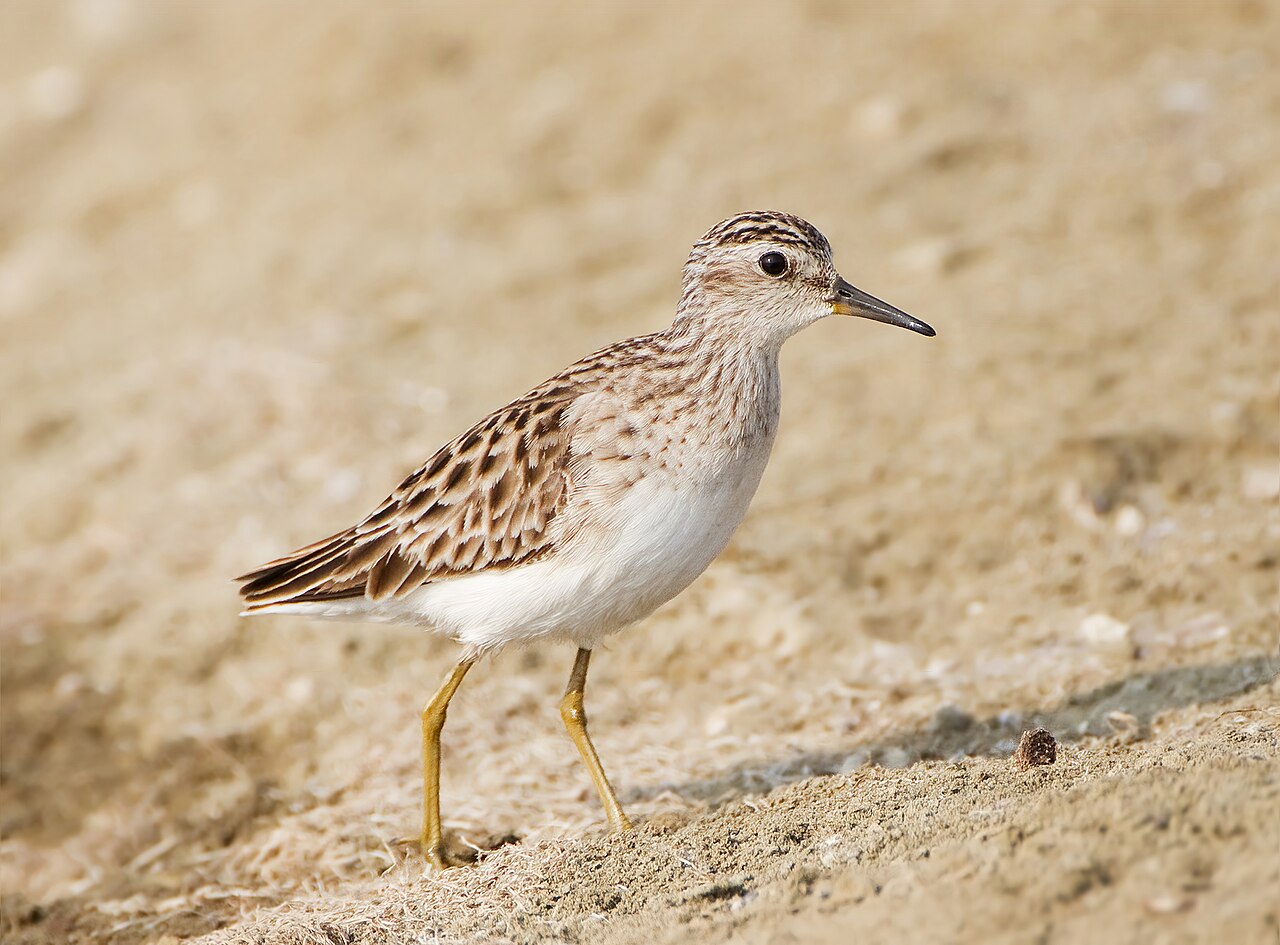
The Long-toed Stint is the midget sandpiper with the long toes: the middle toe is longer than the bill and projects beyond the tail in flight. It breeds in the peat bogs of eastern Siberia and in North America is to be expected only in the far west of Alaska. Its upright stance on long yellow legs suggests a miniature yellowlegs rather than a stint.
Voice
The call is a soft, rolling prrt or chulip, fuller and lower than the sharp kreet of Least Sandpiper. An uneasy bird adds a quick series of short tik-tik-tik notes, as if two pebbles were being tapped together. The song over the breeding grounds is a slowly repeated kroo-er, delivered in a fluttering display flight. In the Aleutians the call is often what prompts a closer look at a small sandpiper.
Recording: Ray Tsu 诸仁 — CC BY-NC-SA 4.0 · Jiuduansha Wetland National Nature Reserve, Shanghai, China · xeno-canto
Identification
A small sandpiper that stands tall, with a long neck, a small head and an upright posture. The legs are yellow to greenish-yellow, and the middle toe is clearly longer than in related species. In breeding and juvenile plumage the upperparts are warm rufous with black feather centres and bright pale fringes, with white lines across the mantle and scapulars; the breast is finely streaked on a buff ground. The forehead is dark right to the bill, so the white eyebrows do not meet above the bill base. In winter plumage it is duller grey-brown, but build, carriage and leg colour remain recognisable.
Confusion species
Least Sandpiper (Calidris minutilla) is the main confusion species: also yellow-legged, but lower-slung and more horizontal, with shorter toes, a paler forehead and a finer bill that droops at the tip. Temminck's Stint (C. temminckii) likewise has yellow legs but is plain grey-brown, shorter-legged and shows white outer tail feathers. Black-legged species — Semipalmated Sandpiper (C. pusilla) and Little Stint (C. minuta) — can be ruled out on leg colour, though dried mud can deceive. In flight, the toes projecting beyond the tail are the most useful mark of all.
Habitat
It likes fresh water with vegetated edges: wet sedge meadows, flooded grassland, bog pools, rice fields and settling ponds. It makes almost no use of bare tidal mud; in the Aleutians the birds are usually found at a grassy pool or a boggy ditch near a village. It feeds by walking and picking along the waterline, alone or with a few other small sandpipers, and rarely in dense flocks. The breeding grounds are marshes and wet openings in the taiga and mountain tundra of eastern Siberia.
Where the bird is most often found, arranged by the USNVC — the vegetation classification of the United States and Canada — and CMECS for sea and coast.




Range and movements
The breeding range is fragmented, running from Chukotka and the Koryak highlands through the Kuril and Commander Islands to the marshes around the Sea of Okhotsk and the Siberian river plains. Migration goes down through eastern Asia to India, Sri Lanka, Southeast Asia, the Philippines, New Guinea and Australia. In North America it is a rare but almost annual migrant on the western Aleutians, the Pribilofs and St. Lawrence Island, with the occasional record further south along the Pacific coast. There is no evidence that it breeds on the continent.
Where and when to look
The windows are narrow: late May into early June on Attu, Shemya, Adak or St. Paul, and to a lesser extent late August. Search grassy pools rather than open mudflats, and look first at the carriage — a tiny sandpiper standing upright like a miniature yellowlegs is immediately suspicious. If the bird flies, watch the feet: in this species the toes project beyond the tail, in Least Sandpiper they do not.
Conservation
The world population is estimated at more than twenty-five thousand birds, but the figure is old and uncertain and the breeding range has hardly been surveyed. The IUCN lists the species as Least Concern (LC). It does share its flyway with the other waders of eastern Asia, however, and the loss of tidal flats and freshwater wetlands along that route almost certainly affects it too. For North America it is a matter of a handful of birds a year on the outermost islands.
Scientific name
Calidris subminuta | (Middendorff, 1853)
Alexander von Middendorff described the species in 1853 as Tringa subminuta; because it was later placed in Calidris, author and year stand in parentheses. subminuta means 'nearly minuta': the Latin sub ('below', 'almost') added to the species name of Little Stint, which the new bird closely resembled. The genus name Calidris goes back to kalidris, the word Aristotle used for a grey waterside bird. The described specimen came from the western slopes of the Stanovoy Mountains and the mouth of the Uda, in eastern Siberia, where Middendorff travelled in the 1840s.