All species › Waders, gulls and terns › Sandpipers and allies › Temminck's Stint
Temminck's Stint | Calidris temminckii
Temmincks strandloper | Correlimos de Temminck
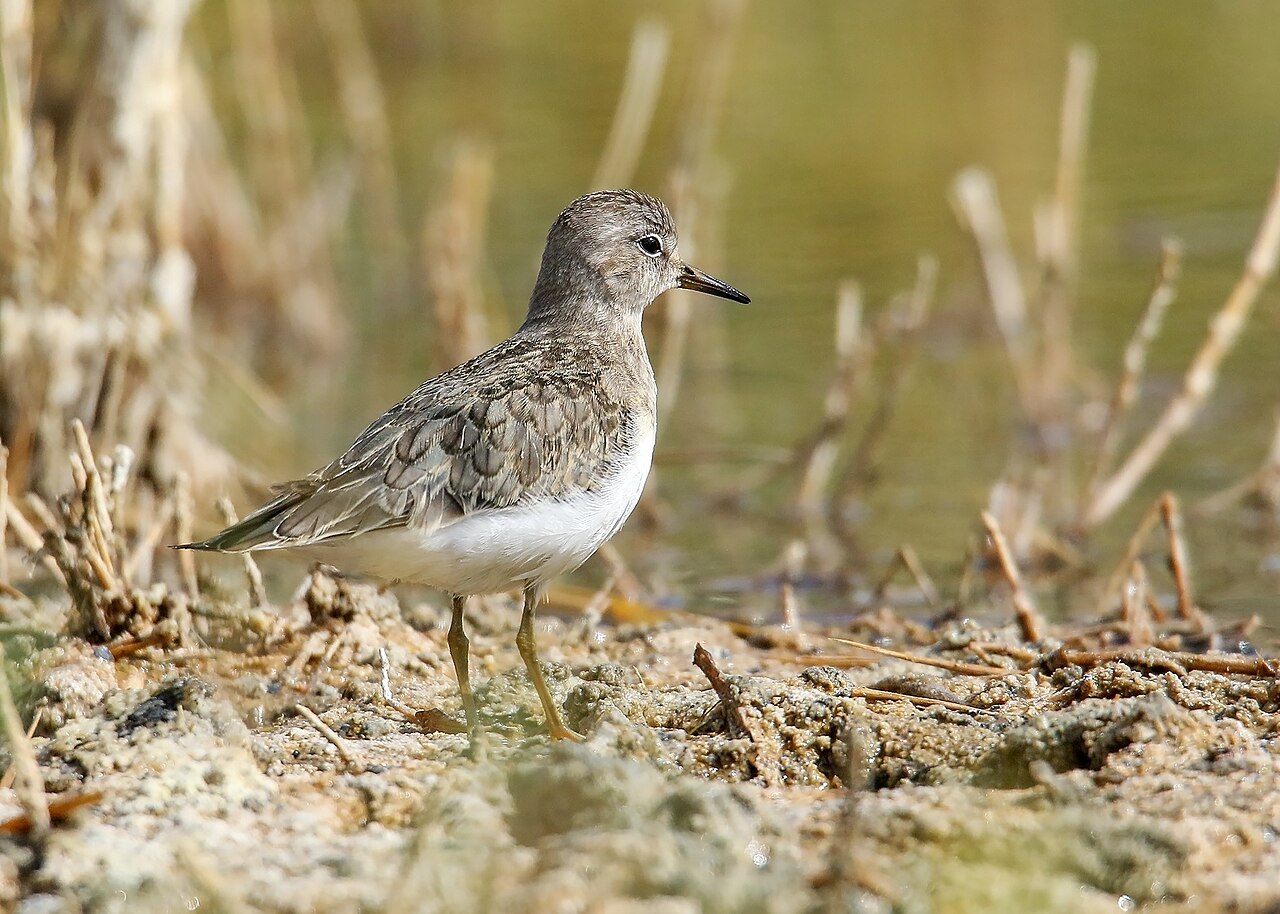
In North America Temminck's Stint is a rare guest from Eurasia: a handful of birds a year in the Aleutians and on the Bering Sea islands, and next to nothing beyond that. It is an inconspicuous grey-brown midget on yellow legs that presses itself silently into waterside vegetation. As it takes off, white outer tail feathers and a cricket-like trill give it away at once.
Voice
The flight call is a dry, rattling tirrr, rapidly repeated or drawn out into tirrr-r-r-r — a cricket sound no other small sandpiper makes. In Alaska that call is often the first and sometimes the only feature by which the species is identified. Over the breeding grounds the male sings a rising and falling, continuous trill for minutes on end, hanging in the air with its wings raised in a V shape. Otherwise it is a silent bird, more likely to crouch than to call.
Recording: Stanislas Wroza — CC BY-NC-SA 4.0 · Karigasniemi, Finland · xeno-canto
Identification
A small, compact sandpiper with short yellow to greenish-yellow legs, a short dark bill and a horizontal, creeping posture. The plumage is monotonous: grey-brown on head, breast and upperparts, sharply cut off against the white belly, with no eyebrow worth the name. In breeding plumage scattered black and rusty feathers appear on the mantle and scapulars, but the overall effect stays dull. The tail projects beyond the wingtips at rest, and in flight the white outer tail feathers are decisive. When flushed it does not slip away low but climbs steeply into the air, rattling as it goes.
Confusion species
Least Sandpiper (Calidris minutilla) also has yellow legs, but is browner and far more strongly marked, with a clear pale eyebrow and dark outer tail feathers. Long-toed Stint (C. subminuta) likewise has yellow legs but stands upright on long legs, has a long middle toe and a far more contrasting plumage. Little Stint (C. minuta) and Semipalmated Sandpiper (C. pusilla) are black-legged, though dried mud can make leg colour deceptive. Where colour does not settle it, the plain breast, the horizontal carriage and the rattling call will.
Habitat
It avoids open tidal flats. What it wants is sheltered, vegetated edges: ditch banks, wet meadows, flooded grassland, the margins of small pools and settling beds, where it creeps away among the plants. In Alaska, accordingly, most birds are found not on a mudflat but at a grassy pond or a boggy ditch beside a village. On the breeding grounds it uses tundra and peat bog with dwarf scrub, usually close to water, from Scandinavia to Chukotka.
Where the bird is most often found, arranged by the USNVC — the vegetation classification of the United States and Canada — and CMECS for sea and coast.





Range and movements
The range runs in a broad belt across northern Eurasia, from Norway and Sweden east to the Chukotka Peninsula, that is to within sight of Alaska. It winters from the Mediterranean and the Sahel to India, southern China and Japan, almost always at inland fresh water and seldom on the coast. In North America it is a rare migrant in western Alaska, chiefly in late spring on the western Aleutians, the Pribilofs and St. Lawrence Island. Records away from Alaska are exceptional, and there is no evidence that it breeds on the continent.
Where and when to look
Go in the last week of May or the first of June to a grassy pool on Attu, Adak or St. Paul, and listen first: the cricket trill betrays the bird before you see it. Walk the vegetated margins rather than the open mud, and do not press it — a flushed Temminck's Stint towers away into the sky and rarely returns to the same spot. Anyone who finds one does well to film the flight: the white outer tail feathers can then be captured on video.
Conservation
Estimates differ widely, from two hundred thousand to well over a million birds, which mainly shows how poorly numbers are known in the Siberian part of the range. The IUCN lists the species as Least Concern (LC). In the southern, Fennoscandian part of the European breeding range numbers have fallen as suitable shorelines have grown over and been drained. For North America all of this means little: here it is a matter of a few birds a year at the edge of the continent.
Scientific name
Calidris temminckii | (Leisler, 1812)
Johann Philipp Achilles Leisler described the species in 1812 as Tringa Temminckii; because it was later placed in Calidris, author and year stand in parentheses. The name honours Coenraad Jacob Temminck (1778–1858), the Amsterdam-born ornithologist who became the first director of the natural history museum in Leiden. The genus name Calidris goes back to kalidris, the word Aristotle used for a grey waterside bird. The described specimen came not from the tundra but from Hanau am Main in Germany, where Leisler lived and collected the bird on migration.