All species › Passerines › New World warblers › Magnolia Warbler
Magnolia Warbler | Setophaga magnolia
Magnoliazanger | Reinita de magnolia
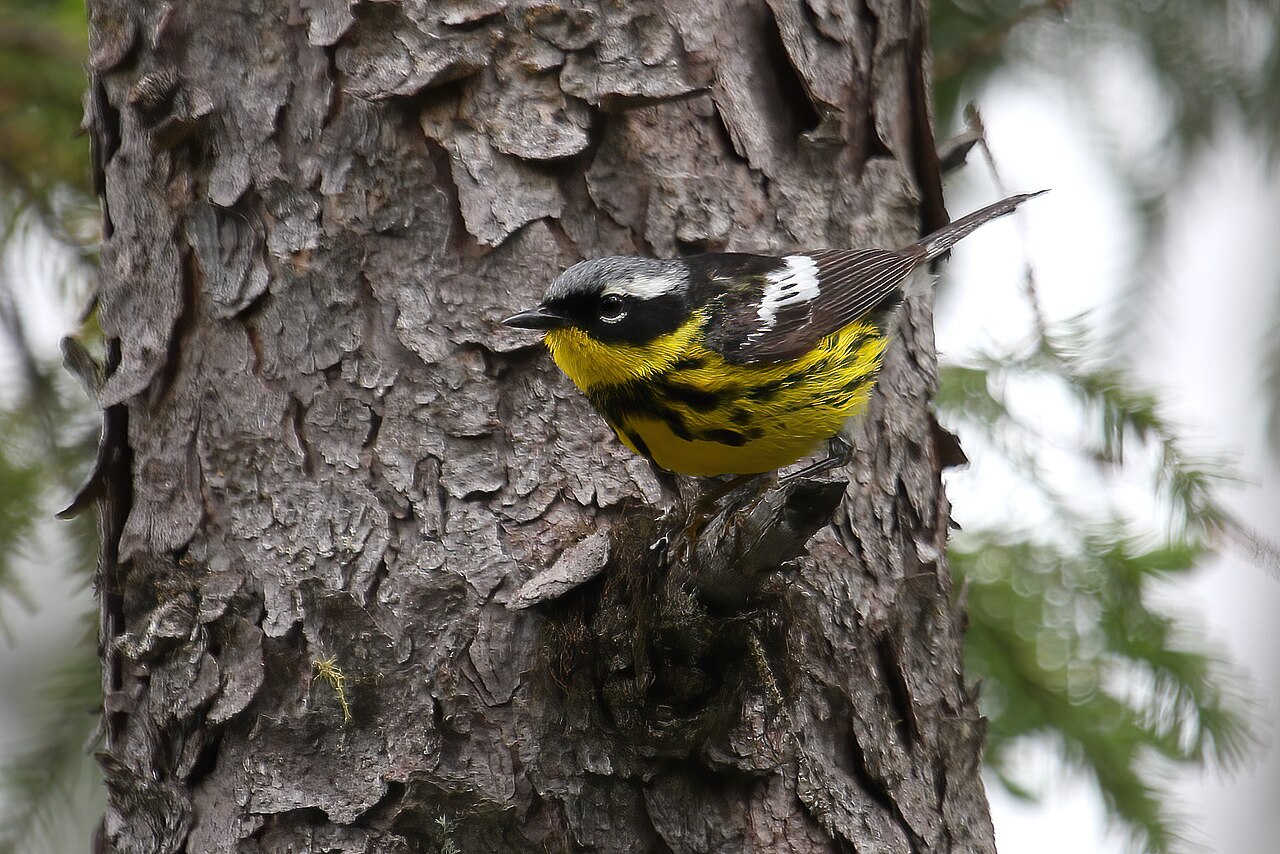
The Magnolia Warbler is a small warbler of dense young conifers, with yellow underparts, a black necklace of streaks and a white band straight across the middle of the tail. It breeds from northeastern British Columbia to Newfoundland and south along the Appalachians, and winters from southern Mexico to Panama and in the Antilles.
Voice
The song is short and clear: three to five syllables sounding like weeta weeta weetsee, with the stress at the end. Males have two versions, an accented one ending on a rising note used to attract a female and a flatter, unaccented form used against neighbouring males. The call is a nasal, slightly husky tzhep, lower and fuller than the thin sip of most relatives. On migration a short, thin flight note can be heard at night.
Recording: Scott Olmstead — CC BY-NC-SA 4.0 · Trudeau Rd, Bethlehem, Grafton County, New Hampshire, United States · xeno-canto
Identification
The breeding male has a grey crown, a black mask with a white brow above it, a black back and a large white wing panel. The underparts are yellow with heavy black streaks that gather into a necklace on the breast; the rump is yellow and the undertail coverts white. The clinching mark is in the tail: seen from below it is white with a broad black tip, because a white band runs straight across the middle. That band is visible all year and is arranged this way in no relative. In autumn plumage head and back are grey-green, the yellow on belly and rump remains, and what stands out is a narrow grey band across the breast with a thin white eye-ring.
Confusion species
In autumn it resembles other grey-green warblers, but the tail band separates it from all of them. Black-throated Green and Yellow-rumped Warblers have white undertail coverts without that crossband and lack either the yellow belly or the breast streaking. Canada Warbler also has a necklace, but a plain blue-grey back, a yellow eye-ring and no white in the tail. Cape May Warbler shares the yellow and the breast streaking, but has a streaked rump, a chestnut ear patch in the male and a finer streak pattern.
Habitat
Breeds in dense stands of young conifers: spruce regrowth in the north, hemlock on southern slopes, often in cutovers, forest edges and along streams. It keeps low in the tree, usually below six metres, unlike most relatives that forage higher. On migration it turns up in almost any woodland, in hedgerows and in parks. In winter it occupies scrub, forest edge, shaded cacao and coffee plantings and second growth from sea level to about 1500 metres.
Where the bird is most often found, arranged by the USNVC — the vegetation classification of the United States and Canada — and CMECS for sea and coast.





Range and movements
The breeding range runs from northeastern British Columbia and the Northwest Territories east across boreal Canada to Newfoundland, and in the United States through the northern Great Lakes states, New England and the Appalachians to West Virginia and Virginia. Migration crosses the east and centre of the continent, west to Kansas and Oklahoma. It winters in southern Mexico, Belize, Guatemala, Honduras and Nicaragua, and on Cuba, Jamaica, Hispaniola and the Bahamas, with the bulk on the Central American mainland.
- Breeding (summer)
- Winter
- Passage
- dark = core range, pale = thinly spread
Where and when to look
In May it is one of the commonest warblers on passage in eastern city parks, and it then forages low enough to watch without craning at the canopy. Look at the tail from below: the white band with black tip can be read on a backlit bird and in autumn plumage, when head and back colour say little.
Conservation
The species is listed as Least Concern (LC). Partners in Flight puts the breeding population at about 39 million birds and gives the species a score of 8 out of 20, the lowest concern category. The Breeding Bird Survey shows an increase of nearly one per cent per year between 1966 and 2019; the species profits from clearcutting and fire, which keep producing young conifer regrowth. Collisions with buildings and towers during nocturnal migration kill many birds each year, and the winter range is shrinking through deforestation in Central America.
Scientific name
Setophaga magnolia | (Wilson, 1811)
Alexander Wilson described the species in 1811 as Sylvia magnolia, after the magnolia trees in which he shot the first specimen near Fort Adams, Mississippi; he had intended Black-and-yellow Warbler as the English name, but the scientific epithet held and later became the common name too. Because the species has since moved to another genus, author and year stand in parentheses. The genus Setophaga was introduced in 1827 by William Swainson, from Greek ses 'moth' and phagos 'eating': moth-eater, after a diet of caterpillars and moths.