All species › Passerines › New World warblers › Tropical Parula
Tropical Parula | Setophaga pitiayumi
Maskerparulazanger | Parula pitiayumí
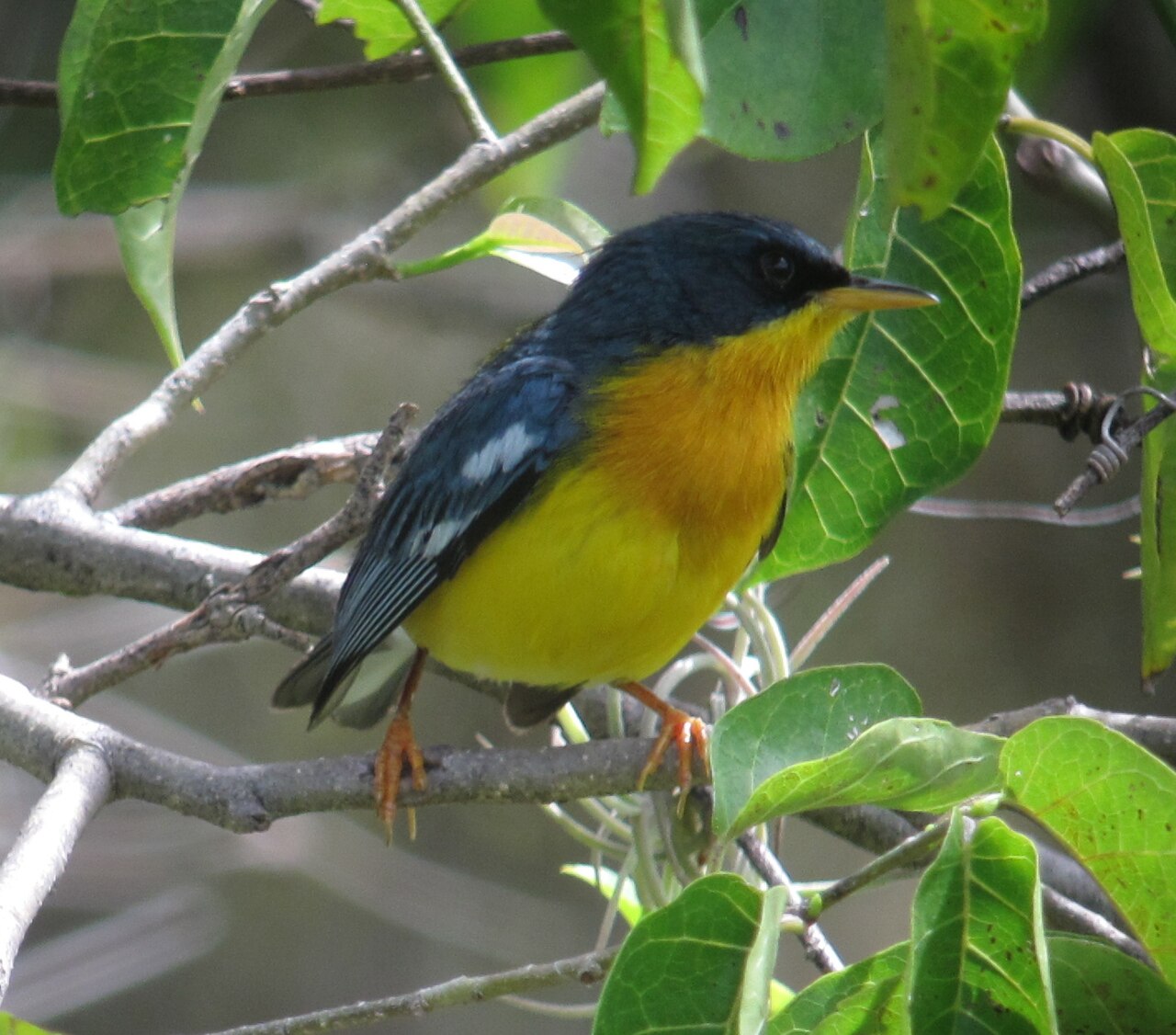
The Tropical Parula is the tropical counterpart of the Northern Parula: just as small, blue-grey with a green back patch, but with a black mask around the eye instead of white eye crescents, and with yellow running on down onto the belly. Within the guide area southern and western Texas is the northern edge of a range that reaches Argentina.
Voice
The song of northern birds is a rising, accelerating trill that climbs in pitch and ends without a sharp finish; it resembles that of Northern Parula but lacks the pinched final note. Southern populations sing a longer, more varied run of rapid bright notes that passes into a thin, high trill. The call is a sharp, high chip, the same in both sexes. Singing comes mainly in the early morning, high in a tree.
Recording: Juan Freile — CC BY-NC-SA 4.0 · sendero a Cruz Wambula, Archidona, Napo, Ecuador · xeno-canto
Identification
Blue-grey above with an olive-green patch on the mantle and two white wing bars. Throat, breast and belly are yellow; across the breast the male carries an orange wash that fades towards the flanks. A blackish patch runs around the eye and across the lores, darkening the face; white eye crescents are absent. The female is duller, with less orange and a vaguer mask. Like Northern Parula it forages hanging and climbing in the outer twigs and among epiphytes.
Confusion species
Northern Parula is the only real confusion species at the north of the range: it has a white crescent above and below the eye, a white belly below the yellow breast shield, and in the male a rufous and blue-black breast band. In Tropical Parula the yellow runs unbroken from throat to lower belly and the face is dark. Where the two meet in south Texas intermediates occur, with facial patterns in between; such birds cannot be named with certainty in the field.
Habitat
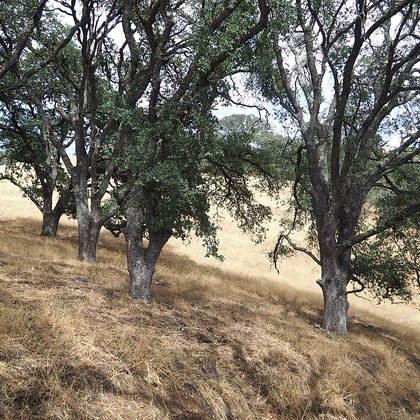
Woodland and open tree growth carrying many epiphytes. In Texas this means tall stands of live oak, cedar elm, Mexican ash and sugar hackberry with dense growths of bromeliads and Spanish moss, along the Rio Grande, in the canyons of the southern Edwards Plateau and the Devils River, and in the Davis Mountains. In Mexico it occupies a wide span from semi-arid thorn forest to humid montane and pine-oak woodland; very humid tropical lowland rainforest it avoids. The nest is built inside a hanging bundle of epiphytes.
Where the bird is most often found, arranged by the USNVC — the vegetation classification of the United States and Canada — and CMECS for sea and coast.





Range and movements
Resident across most of its range. Within the guide area it means south Texas, the coastal strip north to about Calhoun and Victoria, the southern Edwards Plateau and west Texas, and beyond that both Sierra Madres of Mexico: nigrilora along the Sierra Madre Oriental from Tamaulipas, pulchra along the Sierra Madre Occidental from Chihuahua and southern Sonora, both south to Oaxaca and Chiapas and on into Guatemala, Honduras and Nicaragua. In Texas the species was confined to Cameron and Hidalgo until the 1970s and then spread north and west; Texas birds arrive in March and leave in September, though part of the population stays through the winter in the Rio Grande delta.
- Resident
- Breeding (summer)
- Winter
- Passage
- dark = core range, pale = thinly spread
Where and when to look
In the United States the best chance comes in April and May in the Spanish-moss oak woods of the lower Rio Grande, for instance Santa Ana or Sabal Palm, and in the canyons of the Devils River. Look for the bird not on the trunk but in the hanging moss bundles at the outer branches, and check the face on every parula: dark mask or white crescents settles the matter.
Conservation
On the Red List, under the broader species concept it still follows, the species stands as Least Concern (LC), with a population of more than twenty million mature birds and a large continuous range in Latin America. In Texas it is rare, amounting to a few hundred pairs; occurrence there is tied to the presence of epiphytes, which are sensitive to frost, drought and the clearing of old riverside woodland. The northward spread since 1974 does not point to decline at the edge of the range.
Scientific name
Setophaga pitiayumi | (Vieillot, 1817)
Vieillot described the species in 1817 as Sylvia pitiayumi, from material from Paraguay; its later placement in Setophaga puts author and year in parentheses. The species name goes back to pitiayumí, the Guaraní name recorded by Félix de Azara in his account of the birds of Paraguay, and is thus neither Latin nor Greek. The genus Setophaga comes from Ancient Greek ses 'moth' and phagos 'eating'. The Dutch name names the black mask, the English name the tropical range and the Spanish name the original indigenous word.