All species › Passerines › New World warblers › Northern Parula
Northern Parula | Setophaga americana
Brilparulazanger | Parula norteña
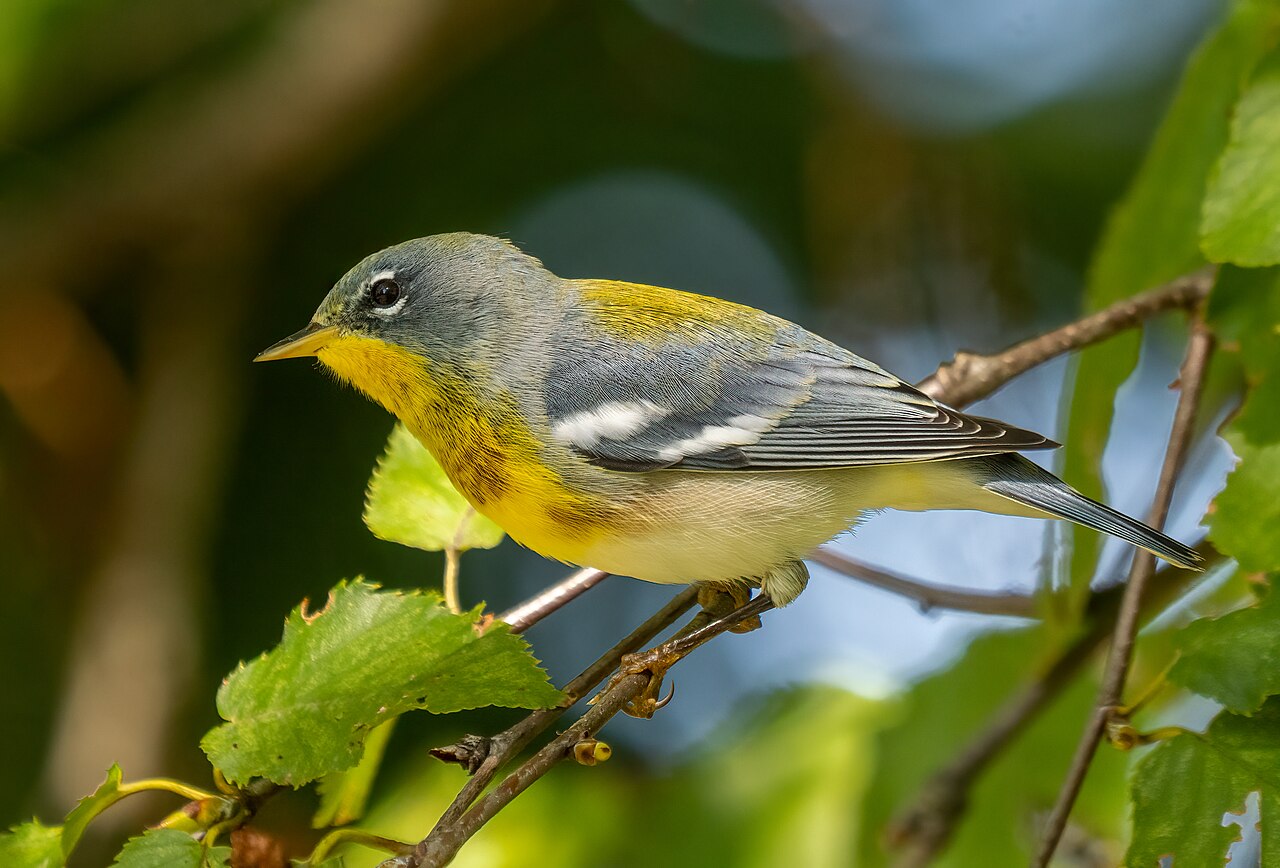
The Northern Parula is the smallest warbler of eastern North America: blue-grey with a green patch in the middle of the back, a yellow throat and two white crescents around the eye. Where it breeds, beard lichen or Spanish moss hangs from the branches, for that is what it builds its nest in.
Voice
The song is a rising, buzzy trill that breaks off abruptly on a pinched upward final note: zeeeeeee-up. A second song type is a series of short, stuttering buzzes rising and falling in steps, without a clear ending. The sound almost always comes from high in the canopy and is thin. The call is a soft, sharp chip; on nocturnal migration a high, rising tseet.
Recording: Mario Reyes Jr — CC BY-NC-SA 4.0 · Raven Run, Fayette County, Kentucky, United States · xeno-canto
Identification
Blue-grey above with a triangular yellow-green patch on the mantle, two broad white wing bars and white spots in the tail corners. Throat and breast are yellow, the belly white. The male has a rufous and a blue-black band across the upper breast that read as one dark patch at a distance; the female lacks it or shows it only faintly. Both sexes have a broken white eyering, a white crescent above and below the eye, to which the Dutch name refers. The lower mandible is pale, almost orange-yellow. It often hangs upside down at the tips of branches, like a tit.
Confusion species
Tropical Parula is the closest comparison: it lacks the white eye crescents, has a dark mask around the eye, and its yellow throat runs on across the whole belly without a white lower belly. Yellow-throated Warbler is larger, with a black face side, a white supercilium and streaked flanks. Canada Warbler has a blue-grey back but no wing bars and a black necklace across the breast. Birds in autumn plumage lose the breast band and then look more like the southern species.
Habitat
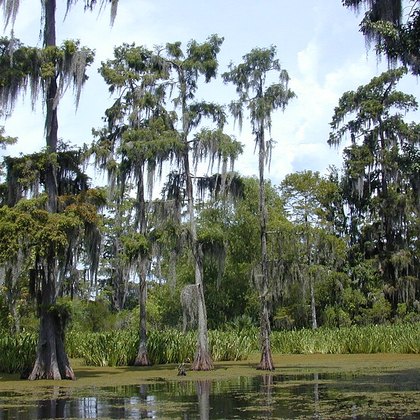
Moist mature forest along streams, swamps and floodplains, where epiphytes hang from the branches: in the north conifer and mixed forest with beard lichen, in the south swamp forest and cypress swamp with Spanish moss. Where those growths are missing, the bird is usually missing too. In winter it is far less particular and uses forest, scrub, mangrove and coffee, cacao and citrus plantations.
Where the bird is most often found, arranged by the USNVC — the vegetation classification of the United States and Canada — and CMECS for sea and coast.





Range and movements
A breeding bird of eastern North America, from southern Manitoba, Ontario and Newfoundland to the Gulf coast and Florida. It disappeared from large parts of the Midwest and the northeast during the twentieth century, which has been linked to the retreat of beard lichen under air pollution; in part of that area it is returning. It winters in southern Florida, in the Bahamas and the Greater Antilles, and from eastern and southern Mexico to Nicaragua. Arrival in the south is already in March, in the north in May.
- Resident
- Breeding (summer)
- Winter
- Passage
- dark = core range, pale = thinly spread
Where and when to look
Follow a stream valley with mature deciduous forest in April and May and keep watching the upper branches; the rising trill with its pinched ending gives the bird away before the eye does. In the south every hank of Spanish moss is a likely spot — look at the underside of the bundle, where the nest hangs and the bird feeds.
Conservation
Partners in Flight puts the breeding population at about 18 million birds. Between 1966 and 2019 numbers rose by more than one per cent a year, some 47 per cent in total, and the species scores 8 out of 20 on the concern index, hence low. The historic loss in the Midwest went with clearcutting, the draining of bogs, and the sensitivity of beard lichen to sulphur dioxide; with cleaner air that lichen cover is recovering locally. Keeping swamp forest and streamside woodland is the main measure on the breeding grounds.
Scientific name
Setophaga americana | (Linnaeus, 1758)
Linnaeus described the species in 1758 as Parus americanus, that is, as a tit; its placement in Setophaga puts author and year in parentheses. From that first arrangement comes the name Parula, a diminutive of Parus: 'little tit'. Bonaparte introduced Parula as a genus name in 1838; the genus was later merged into Setophaga, from Ancient Greek ses 'moth' and phagos 'eating'. The species name americana means 'American'. The Dutch element 'bril', spectacles, refers to the white eye crescents. The type locality was later restricted to South Carolina.