All species › Tubenoses › Petrels, shearwaters and diving petrels › Manx Shearwater
Manx Shearwater | Puffinus puffinus
Noordse pijlstormvogel | Pardela pichoneta
Manx Shearwater is a small, sharply black-and-white shearwater that skims low over the water, flashing dark and pale as it banks. Its world population breeds almost entirely on the European side of the North Atlantic, but since the 1970s a small number has also bred on an island off Newfoundland, the species' first established breeding site in North America.
Voice
At sea the species is silent. At the breeding colony, visited only at night, a hoarse series of croons, howls and screams comes from the burrows, with a clearer, more piercing tone from the male against a harsher one from the female; that nocturnal chorus earned the species nicknames such as 'devil bird' in parts of Europe.
Recording: Anthony McGeehan — CC BY-NC-SA 4.0 · Ards and North Down, Northern Ireland, United Kingdom · xeno-canto
Identification
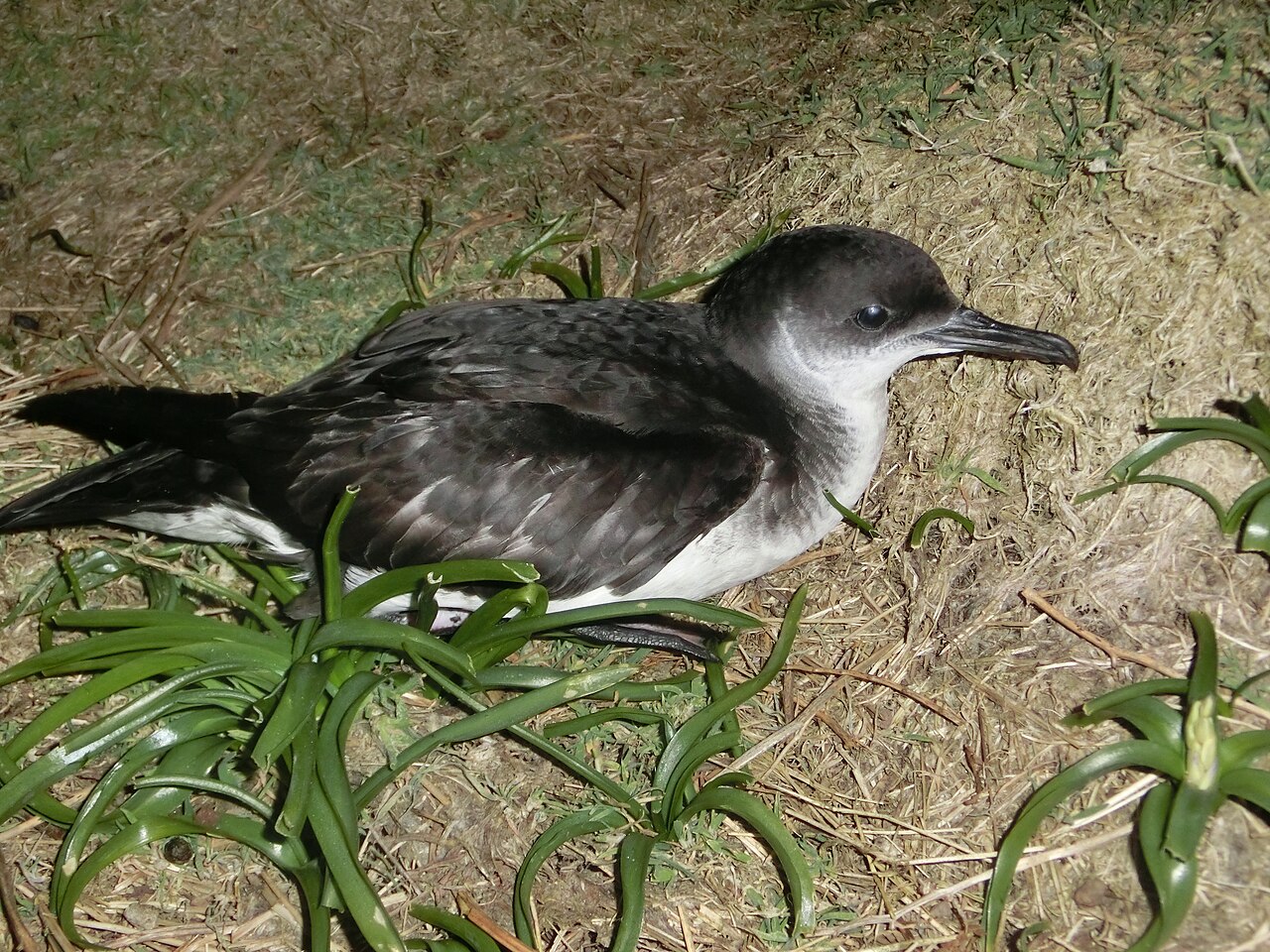
Sharply patterned: black to blackish-brown above, white below, with a white face curving up behind the dark ear patch. In flight dark and pale sides alternate rapidly as the bird banks from side to side low over the waves, in short bursts of fast, stiff wingbeats broken by glides just above the surface. The bill is thin and dark, the legs pink.
Confusion species
Sargasso Shearwater is distinctly smaller, with a longer tail, more dark under the tail and less white under the wing than this species. Sooty Shearwater and Great Shearwater are both considerably larger and lack the sharp black-and-white contrast; Sooty Shearwater is, moreover, entirely dark below. At a distance the small size combined with the strong contrast and the low, banking flight with short glides is the most useful clue.
Habitat
At sea the species forages over and along the edge of the continental shelf, feeding at the surface and also diving a few metres down after small schooling fish. It breeds in burrows dug by the bird itself or taken over from rabbits in the grassy soil of small, predator-free islands, and visits the colony only in darkness, to avoid predatory birds.
Where the bird is most often found, arranged by the USNVC — the vegetation classification of the United States and Canada — and CMECS for sea and coast.
Range and movements
The bulk of the world population breeds on islands around the United Kingdom, Ireland, Iceland, the Faroes and Madeira, far outside the guide area. Within the guide area a small, largely unsuccessful colony has bred since its discovery in 1977 on Middle Lawn Island off the south coast of Newfoundland; the colony has not grown since and consists mostly of young, inexperienced birds. Apart from that colony, the species is a regular, mostly scarce presence along the American east coast from spring into autumn, including off Massachusetts and on Gulf Stream pelagic trips off North Carolina, while the main population moves in the northern winter to the waters off Brazil and Argentina, far outside the guide area.
- Resident
- Breeding (summer)
- Winter
- Passage
- dark = core range, pale = thinly spread
Where and when to look
Watch from a high seawatch point on Cape Cod in late summer, or join a Gulf Stream trip off Hatteras, North Carolina: look for a small, fast, black-and-white bird skimming low over the water, seeming to change colour with every turn.
Conservation
Least Concern (LC) globally, with a European population of well over three hundred thousand pairs, approaching four hundred thousand, that is declining slightly but not fast enough to threaten the species. The small Newfoundland colony has stayed just as small and precarious for decades; artificial light that disorients fledglings leaving the nest, introduced predators on breeding islands, and an annual, legal harvest of several thousand chicks in the Faroe Islands remain the main threats.
Scientific name
Puffinus puffinus | (Brünnich, 1764)
Danish zoologist Morten Thrane Brünnich described the species in 1764 as Procellaria puffinus; it has since been placed in the genus Puffinus, already introduced by Brisson in 1760, hence the parentheses around author and year. The name puffinus goes back to an English name for the salt-cured, traded chick of this species, in use since at least 1337; only around 1678 did that same name, 'puffin', become mistakenly attached to the puffin, an entirely unrelated auk. The English name 'Manx', first recorded in 1835, refers to the Isle of Man, where a large colony already existed on the Calf of Man in the seventeenth century. The type locality lies at the Faroes and Norway.