All species › Passerines › New World warblers › Mourning Warbler
Mourning Warbler | Geothlypis philadelphia
Grijskopzanger | Reinita plañidera
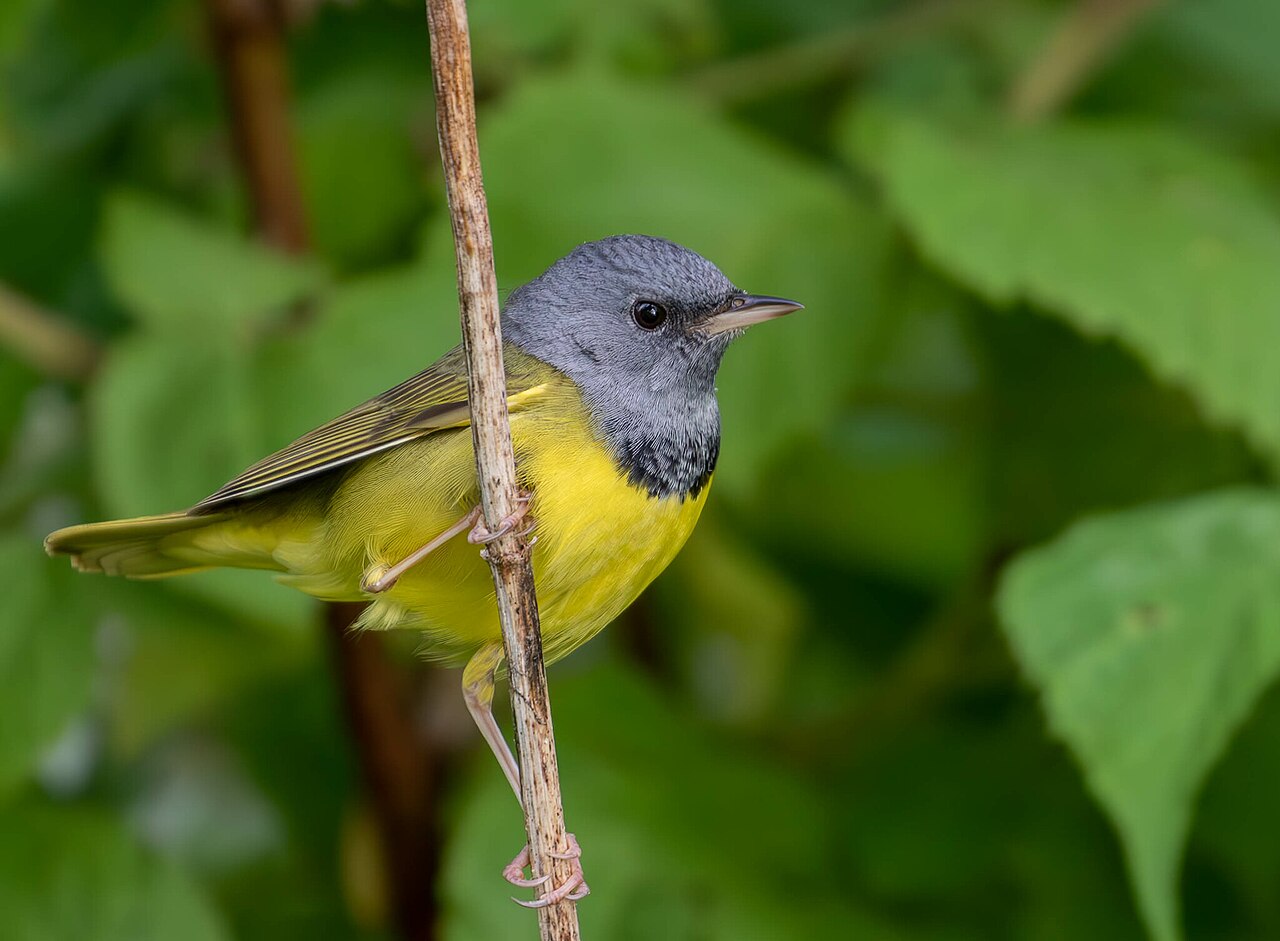
The Mourning Warbler is a warbler of dense young regrowth, with a grey hood, an olive-green back and a yellow belly, and it keeps almost always low in the vegetation. It breeds in cutover and weedy openings of the boreal forest and the Appalachians, and winters from Nicaragua to northwestern South America.
Voice
The song is a short, burry series of rolling syllables, often rendered churry churry churry chorry chorry, with a lower and faster ending. The last two or three syllables drop in pitch, which separates it from MacGillivray's Warbler. Song forms differ clearly by region; separate variants have been described from Newfoundland, Nova Scotia and the eastern and western mainland. The call is a hard, dry chek. Males also sing at dusk during a short flight display.
Recording: Stanislas Wroza — CC BY-NC-SA 4.0 · Stationnement des dunes (near Tadoussac), Côte-Nord, Québec, Canada · xeno-canto
Identification
The male has a grey hood over head, throat and upper breast, and below that hood a mottled black bib that reads as an irregular dark breast band. The back is olive-green, the belly yellow, the legs pink. An eye-ring is usually absent; some males show two thin white arcs. The female is duller, with a grey-brown hood without black and a faintly yellow throat. Young birds are brown above and yellow below. It hops through the understorey and stays almost always below two metres.
Confusion species
Connecticut Warbler is larger and stockier, has a complete white eye-ring, much longer undertail coverts and walks on the ground rather than hopping. MacGillivray's Warbler has two clear white arcs before and behind the eye and a darker, even grey hood without a black bib; the breeding ranges of the two barely overlap. Nashville Warbler is smaller, with a complete eye-ring and a yellow throat. First-year birds of all three closely resemble one another; then use the length of the undertail coverts and the colour of the throat.
Habitat
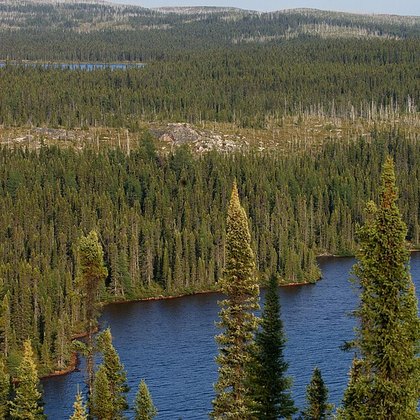
Dense young scrub with bramble, raspberry and regrowing birch and aspen on cutover, burns, powerline corridors and abandoned pasture, usually within the boreal forest or the montane forest of the Appalachians. Such scrub stays usable for only about seven years: after that the vegetation grows too tall and too closed and the species drops out again. The rough edge along streams and forest roads is also used. In winter it keeps to the understorey of tropical forest and to shrubby forest edges.
Where the bird is most often found, arranged by the USNVC — the vegetation classification of the United States and Canada — and CMECS for sea and coast.




Range and movements
The breeding range runs from northeastern British Columbia and Alberta east through the boreal zone to Quebec, the Maritimes and Newfoundland, and south to Minnesota, Wisconsin, Michigan, New York, New England and along the Appalachians to West Virginia. Spring migration passes largely through the centre and east of the continent and across the Gulf of Mexico; in autumn it follows the Gulf coast and the Mexican lowlands. It winters in the understorey of tropical forest from Nicaragua south to Colombia, Venezuela and Ecuador; within the guide area only the northernmost edge of that range falls inside.
- Breeding (summer)
- Winter
- Passage
- dark = core range, pale = thinly spread
Where and when to look
Look for it in late May or early June in a young cutover in the north and use the song: the bird sings from a low branch but drops into the scrub when approached. On migration a bramble patch along a woodland edge early in the morning is the best place; wait for the moment a bird climbs briefly to the top.
Conservation
The species is listed as Least Concern (LC) and the world population is put at about fourteen million breeding birds, but a decline of roughly forty per cent over fifty years has been measured. Because it lives off young succession it depends on logging, fire and other disturbance that keep producing fresh scrub; where forest matures unbroken, or where scrub is converted to farmland, it disappears. In Ontario prescribed burns and rerouted trails are used to maintain breeding habitat.
Scientific name
Geothlypis philadelphia | (Wilson, 1810)
Alexander Wilson described the species in 1810 as Sylvia Philadelphia, from a bird he collected a few miles outside Philadelphia, Pennsylvania; because it was later moved to another genus, author and year stand in parentheses. The species name therefore refers to where the first specimen was found. The genus Geothlypis comes from Greek geō- 'earth, ground' and thlypis, a name for a small bird, after its low way of life. The English name refers to the grey hood, which was likened to a mourning veil.