All species › Passerines › New World warblers › MacGillivray's Warbler
MacGillivray's Warbler | Geothlypis tolmiei
Rouwkopzanger | Reinita de Tolmie
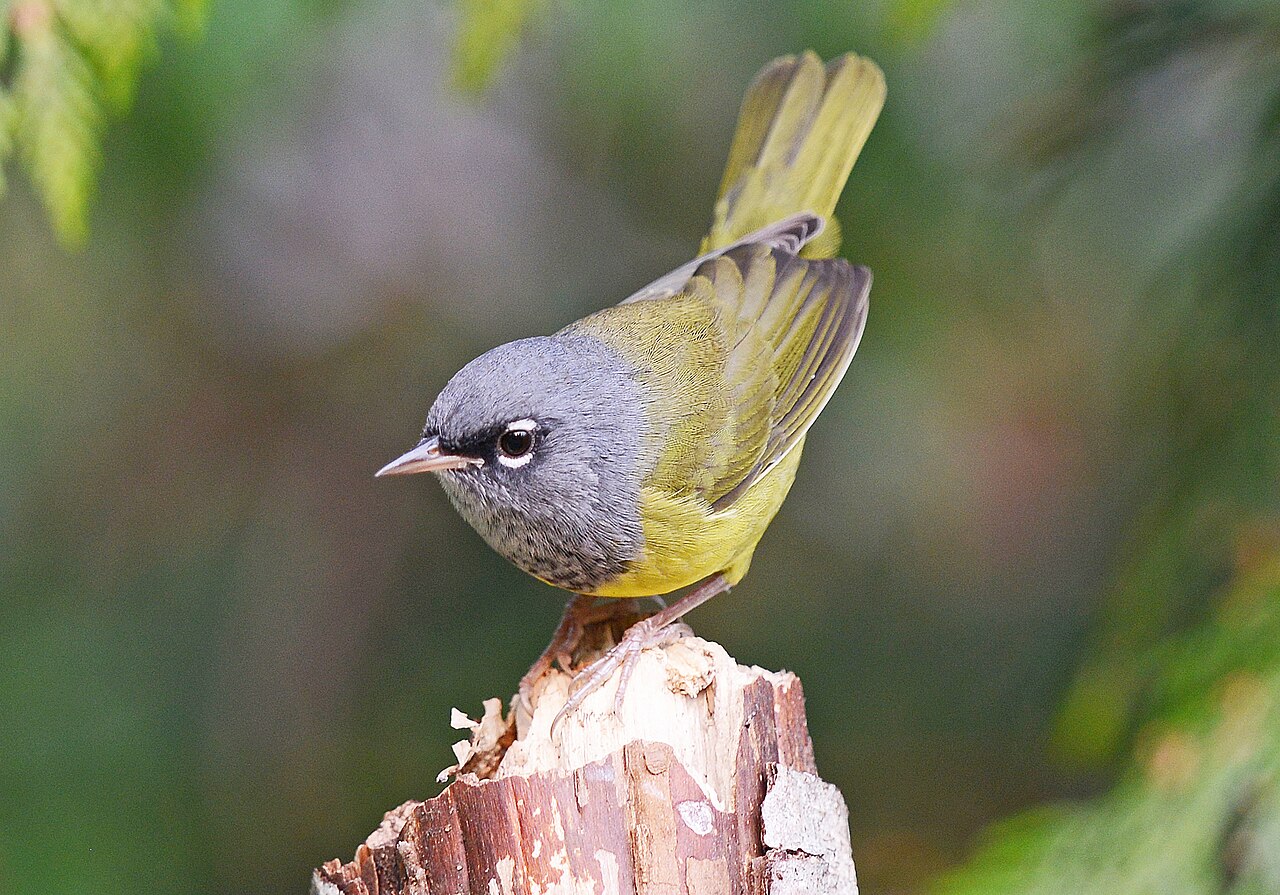
MacGillivray's Warbler is the western counterpart of the Mourning Warbler: a bird of dense low scrub with a complete grey hood and two short white arcs around the eye. It breeds from southeastern Alaska to New Mexico and keeps almost entirely to the lowest two metres of the vegetation.
Voice
The song is a short, hurried series of three to five rough, rolling syllables followed by two or three lower, rapidly thrown-away notes: churry-churry-churry-choo-choo. The tone is drier and harder than in most American warblers and the ending drops clearly. The call is a sharp, hard chik with a metallic edge; in dense scrub that is often the only thing that gives a bird away. Males also sing on migration, sometimes hundreds of kilometres from the breeding range.
No freely licensed recording has been found for this species yet; what to listen for is described below.
Identification
Olive-green above and yellow below, with a grey hood covering head, neck, throat and upper breast completely. In the male that hood is darker and the lower throat carries a blackish wash; in the female it is paler and browner grey. What matters are the two short, sharply cut white arcs above and below the eye, broken at the front and the rear — not a continuous ring. The legs are flesh-coloured. First-year birds have a brownish hood and a pale throat, but the eye arcs remain visible.
Confusion species
Mourning Warbler as a rule has no eye arcs at all, at most a faint thin ring, and the two ranges meet only in a narrow band in the Canadian Rockies. Connecticut Warbler has a full, continuous white eye ring, is larger and heavier, walks on the ground, and has strikingly long undertail coverts reaching almost to the tail tip. Common Yellowthroat never has a grey hood: the male wears a black mask, the female has an olive head and a white rather than yellow belly.
Habitat
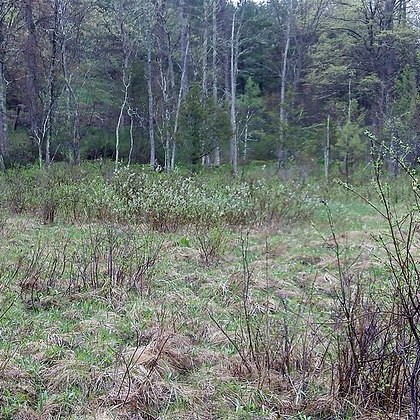
Dense low scrub: willow and alder growth along streams, clear-cuts and burns with regenerating broadleaf saplings, forest edges, and gullies with raspberry, ceanothus and ferns, in the mountains to above 3000 metres. It avoids closed forest without a shrub layer, and conifer plantations with bare ground hold none. In winter it uses comparable dense growth: forest edges, shade coffee and gullies in the montane forest of Central America.
Where the bird is most often found, arranged by the USNVC — the vegetation classification of the United States and Canada — and CMECS for sea and coast.




Range and movements
Breeds from southeastern Alaska and southern Yukon through British Columbia and the coastal and interior ranges to southern California, and east to the Rockies of Montana, Wyoming, Colorado and New Mexico, with an isolated population in the Black Hills. In late summer it moves through the thickets of the Southwest and along the Sierra Madre Occidental to a winter range running from western and southern Mexico through Central America to Panama. Migration is largely overland; it does not make the long sea crossing of many eastern warblers.
- Resident
- Breeding (summer)
- Winter
- Passage
- dark = core range, pale = thinly spread
Where and when to look
Find it by ear rather than by eye. In May and June the male sings from a low branch at the edge of a willow thicket, usually below two metres. Stand at the edge and wait: the bird often works past close by, but rarely shows for more than a few seconds. In August and September the hard chik gives it away in thorn scrub in the desert canyons of Arizona and New Mexico.
Conservation
Partners in Flight puts the breeding population at about 11 million birds and scores the species 12 out of 20 on the Continental Concern Score. The Breeding Bird Survey shows a decline of roughly 56 per cent between 1968 and 2015, about 1.7 per cent a year; the cause has not been established. Locally it increases on clear-cuts and burns where scrub returns, while conifer plantations without a shrub layer remove breeding habitat.
Scientific name
Geothlypis tolmiei | (Townsend, 1839)
Townsend described the species in 1839 as Sylvia Tolmiei, after William Fraser Tolmie, a Hudson's Bay Company surgeon on the Columbia; because the species was later moved to another genus, author and year stand in parentheses. The English name goes back to the Scottish ornithologist William MacGillivray, whom Audubon honoured with this bird. Geothlypis is from Greek geo 'earth, ground' and thlypis, a small bird: 'ground bird', after its low habits. The Dutch name refers to the dark hood, as in the closely related Mourning Warbler.