All species › Waterfowl › Ducks, swans and geese › Nene
Nene | Branta sandvicensis
Hawaiigans | Barnacla hawaiana
The Nene is the goose that walked away from water: it grazes on lava flows and mountain slopes, almost never swims, and has given up part of its foot webbing for it. In the 1950s some thirty birds were left; that there are thousands again is the work of seventy years of captive breeding and release. It is the state bird of Hawaii and lives nowhere else on earth.
Voice
A soft, low moaning, nay-nay, which gave the bird its Hawaiian name nene; it sounds plaintive rather than ringing. There is also a higher, yelping call that recalls the Canada Goose, but quieter and carrying less far. Grazing flocks keep up a continuous low murmur. In flight the wings make a creaking, grating sound that is clearly audible at close range.
Recording: Phoenix Birder — CC BY-NC-SA 4.0 · Hanalei NWR, Kauai County, Hawaii, United States · xeno-canto
Identification
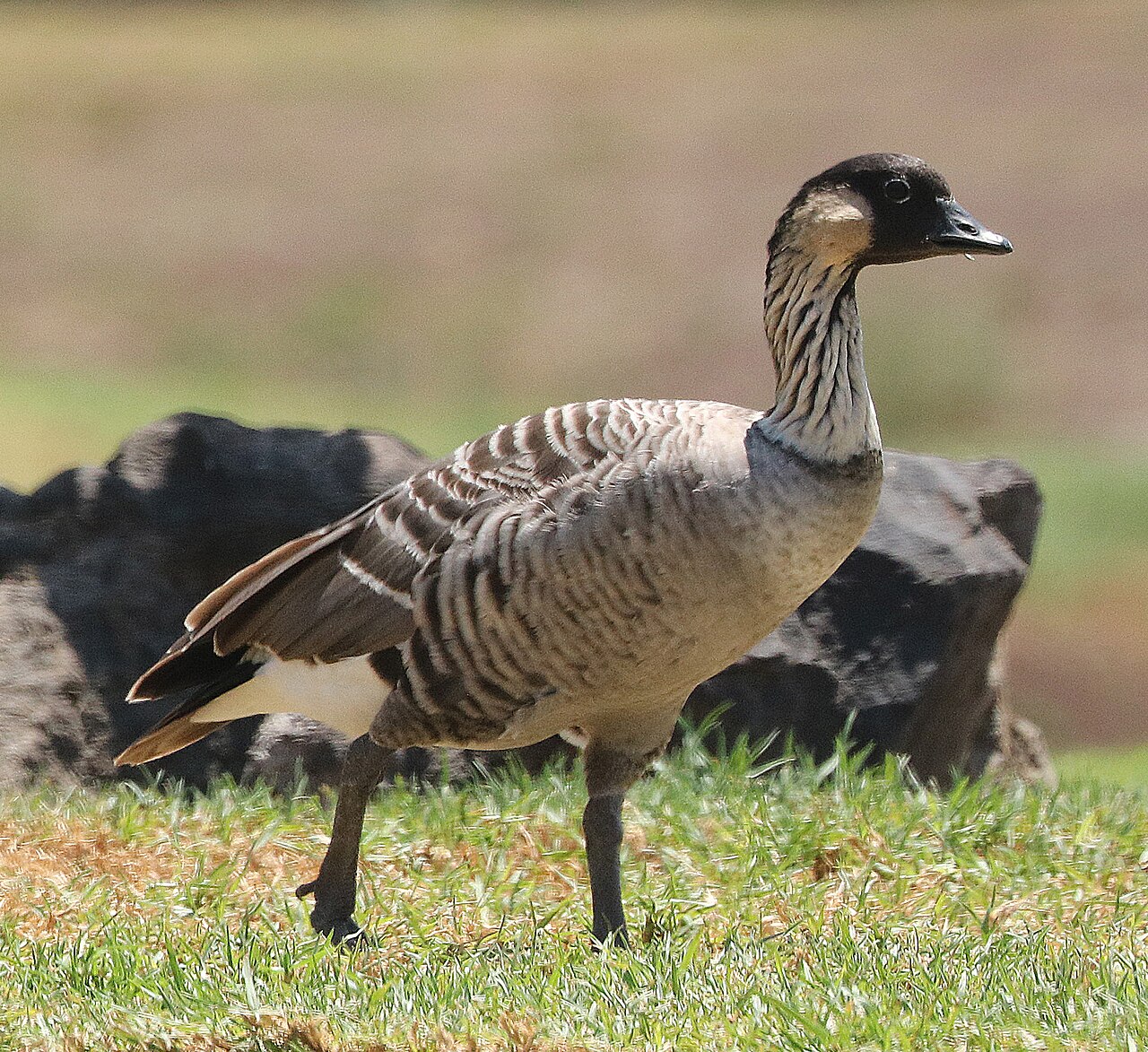
A medium-sized goose with a black head and bill and a large cream-coloured cheek, which passes on the neck into diagonal black stripes formed by deep grooves between the feathers. The body is grey-brown with pale feather edges that read as barring along the flank; rump and tail are black with a white band. The legs are long and strong and carry only half the webbing of other geese, with heavy nails for walking over rough lava. The sexes are alike; the male is larger. Juveniles are duller, with a vaguer cheek patch and without the sharp neck grooves. In flight the wings look small for the body: it flies heavily and low.
Confusion species
There is no other wild goose in Hawaii to confuse it with. What does cause confusion are feral and escaped geese on ponds and golf courses; these lack the sharply bounded cream cheek and the grooved neck. Canada Goose (Branta canadensis) turns up rarely as a vagrant and has a white cheek patch running under the throat instead of a cream-coloured side to the head, and a black neck without grooves.
Habitat
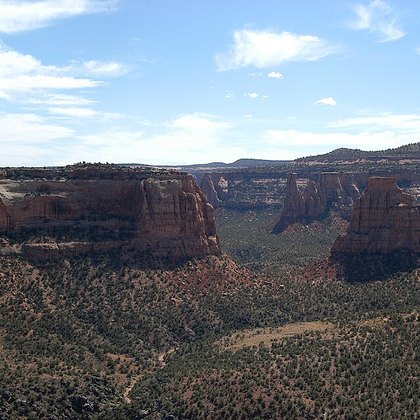
Open, low-growing country: mountain slopes with native shrubs and grass between the lava flows, from sea level to over 2,400 metres. Alongside that, and nowadays above all, short grass of human making — pasture, golf courses, parks and roadsides, where grazing is easy but disturbance and traffic are close at hand. It makes almost no use of water: it drinks and feeds on dry ground and forages on foot. On Kauaʻi, which holds most of the birds, it stays below three hundred metres all year.
Where the bird is most often found, arranged by the USNVC — the vegetation classification of the United States and Canada — and CMECS for sea and coast.




Range and movements
Endemic to the Hawaiian Islands, now breeding on Hawaii, Maui, Molokaʻi and Kauaʻi; Kauaʻi alone holds more than half of all birds. It does not migrate, but shifts with the seasons between lowland and mountain slope and flies regularly from island to island. Before people arrived it lived on all the main islands; by 1900 it was reduced to a remnant on Hawaii, and only after 1960 did releases bring it back to the other islands.
- Resident
Where and when to look
On Kauaʻi families graze quietly on golf courses and pastures early in the morning; on Hawaii and Maui look higher, along the roads through Haleakala and Volcanoes National Park. Keep your distance and do not feed it: growing used to people and cars is one of its main causes of death. In the breeding season, from August to April, the female sits hidden under a shrub and only the watchful male is visible in the open.
Conservation
In 1957 about thirty birds were left in the wild. Captive breeding — on Hawaii and at Slimbridge in England — and the release of more than two thousand birds have brought the species back to several thousand, of which the IUCN counts 1,700 to 2,200 as mature and which is listed as Near Threatened (NT); in 2019 the United States moved it one step down its national list. It still depends on management: introduced mongooses, rats, feral cats and dogs take eggs and goslings, cats also pass on toxoplasmosis, and on Hawaii and Maui many birds are killed by traffic. That Kauaʻi has no mongooses is the main reason most geese are there.
Scientific name
Branta sandvicensis | (Vigors, 1834)
Vigors described the species in 1834 as Bernicla sandvicensis; because it was later placed in Branta, author and year stand in parentheses. The genus Branta was introduced by Scopoli in 1769 and goes back to Old Norse brandgás, 'burnt goose'. sandvicensis means 'of the Sandwich Islands', the name James Cook gave Hawaii in 1778 after the Earl of Sandwich. The type locality is given no more precisely than 'the Hawaiian Islands'. The Hawaiian name nene imitates the bird's call.