All species › Waterfowl › Ducks, swans and geese › Brant
Brant | Branta bernicla
Rotgans | Barnacla carinegra
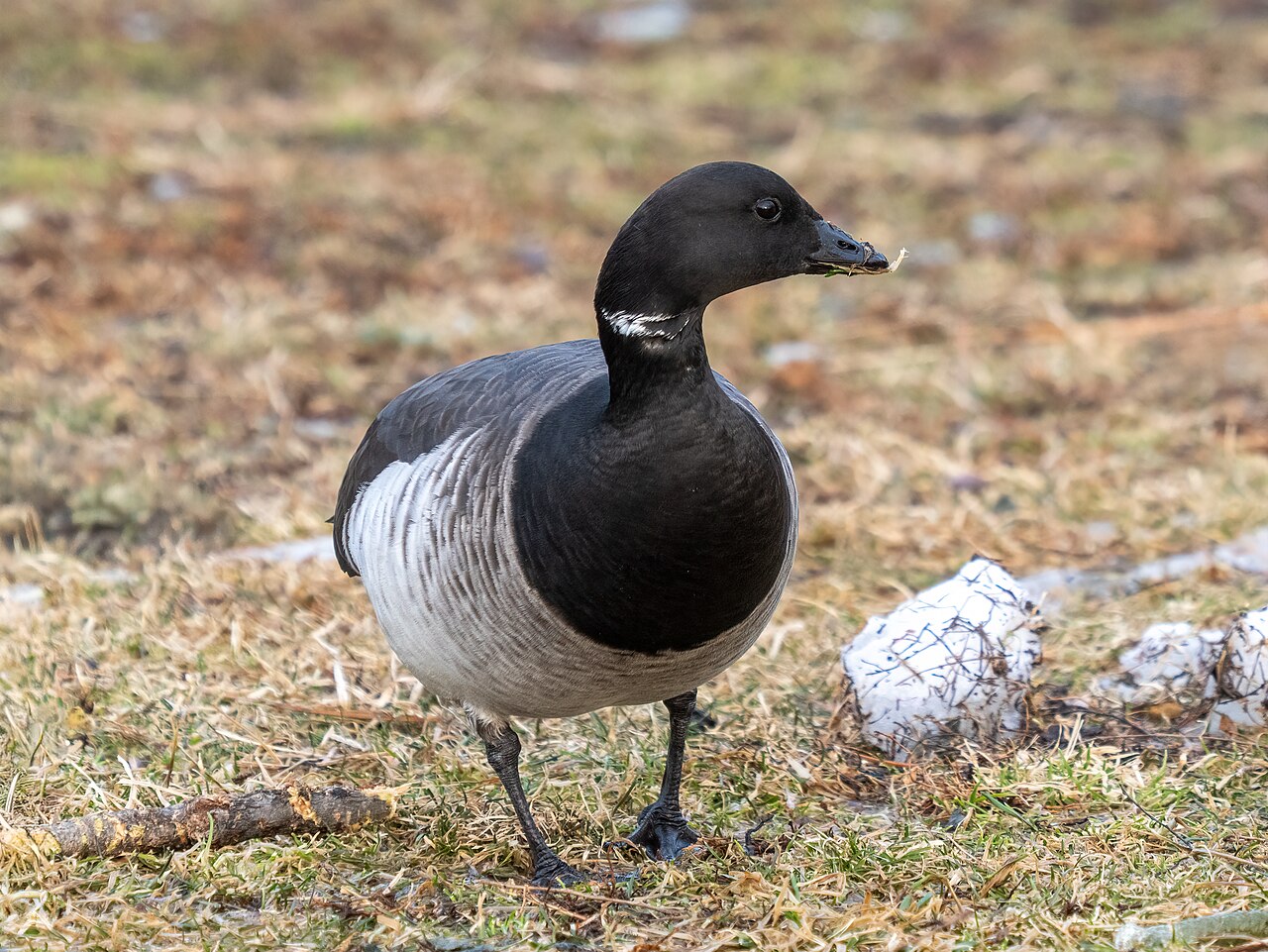
The Brant is the smallest and darkest goose in North America: sooty black on the head, neck and chest, with only a short white neck-flash for relief. From Arctic tundra to the tidal flats of two oceans it spends nearly its whole life within sight of salt water, and its winter turns almost entirely on a single plant: eelgrass.
Voice
The call is a low, rolling croak, rr-onk or rrr-rrr-rrr, which a resting flock on the water keeps up almost continuously and which carries from a distance like an idling engine. In flight birds exchange a shorter, harder version of the same sound, without the two-syllable clamour of the Canada geese. When alarmed the flock stretches its necks and calls in chorus, sharper and faster. On the breeding grounds the Brant is quieter, and a soft grunting between partners is enough.
Recording: Simon Gillings — CC BY-NC-SA 4.0 · Byall Fen, Cambridgeshire, United Kingdom · xeno-canto
Identification
A compact, short-necked goose, smaller than a Canada Goose and with a small, stubby bill. Head, neck and upper breast are wholly sooty black, broken only by a short white patch on each side of the neck that never closes into a ring the way it does on a Barnacle Goose. The western subspecies, Black Brant, has a dark, almost black belly that barely contrasts with the breast; the eastern Brant has a noticeably paler, grey-white belly. Upperparts and flanks are greyish brown with pale feather edges, the tail coverts white. In flight, flocks form no tight V but loose, undulating lines low over the water.
Confusion species
Barnacle Goose has an entirely white face and silver-grey, black-barred upperparts, quite unlike the even black-and-grey of a Brant. Cackling Goose and Canada Goose are both larger, with a sharply defined white cheek patch running under the throat — a mark Brant entirely lacks. At a distance in poor light a flock of Brant on the water is sometimes taken for scoters, but the straight neck and white rear end of a Brant settle the question.
Habitat
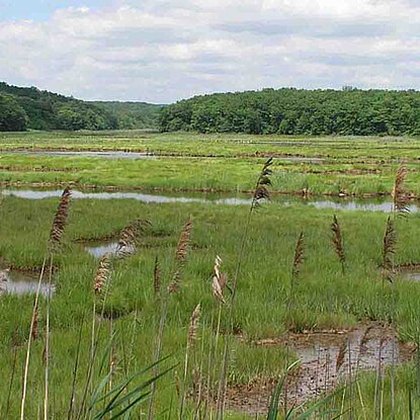
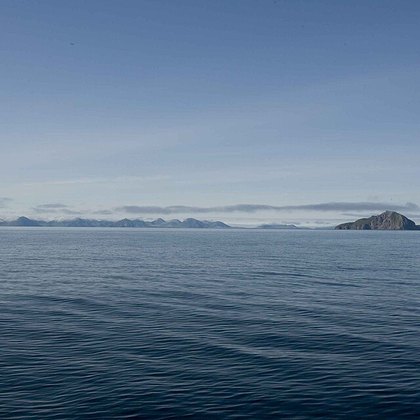
It breeds on wet coastal tundra with sedge hummocks and shallow pools, rarely more than a few kilometres from the sea. Outside the breeding season it is bound almost entirely to salt water: bays, estuaries and mudflats where eelgrass grows are its winter food above all else. Tidal river deltas and sheltered lagoons serve as roosting sites between feeding bouts; cropland and fresh water, which other geese visit daily, it avoids almost completely.
Where the bird is most often found, arranged by the USNVC — the vegetation classification of the United States and Canada — and CMECS for sea and coast.



Range and movements
Two main populations follow separate routes. Eastern Brant breed on the high Arctic islands of Canada and travel down the west side of Hudson Bay before a single long overland flight to the Atlantic coast, where they winter from New Jersey to North Carolina. Western Black Brant breed along the coast of Alaska and the western Canadian Arctic, gather above all in autumn at Izembek Lagoon on the Alaska Peninsula, and winter from California to the lagoons of Baja California. In the 1930s the eastern population collapsed when disease wiped out most of the eelgrass on its wintering grounds; a switch to sea lettuce kept the species going until the eelgrass recovered. Milder winters in recent decades have left more birds wintering farther north than was once usual.
- Resident
- Breeding (summer)
- Winter
- Passage
- dark = core range, pale = thinly spread
Where and when to look
Look for it at low tide in a bay with eelgrass beds — Barnegat Bay in New Jersey and San Francisco Bay are both classic sites — where flocks graze well out into the exposed shallows. The rolling murmur of a resting flock carries far over water and is often heard before the birds are seen.
Conservation
Least Concern (LC), but numbers swing sharply with the availability of eelgrass, on which the species still depends for most of its diet. The western population leans heavily on a single site, Izembek Lagoon, so that disturbance or an oil spill there would carry disproportionate weight. Both populations are hunted under annual quotas and tracked by aerial surveys.
Scientific name
Branta bernicla | (Linnaeus, 1758)
Linnaeus described the species in 1758 as Anas Bernicla, among the ducks; because it was later moved to another genus, author and year stand in parentheses. The genus Branta was introduced by Scopoli in 1769, a Latinised form of Old Norse brandgás, 'burnt goose'. The species name bernicla traces to the medieval legend of the 'barnacle goose': because no one in Europe had ever seen these geese nest — their nests lie far into the Arctic — they were thought to grow from goose barnacles or rotting driftwood. Linnaeus gave the type locality as northern Europe, in practice Sweden, where he knew only wintering birds.