All species › Waterfowl › Ducks, swans and geese › Trumpeter Swan
Trumpeter Swan | Cygnus buccinator
Trompetzwaan | Cisne trompetero
Trumpeter Swan is North America's heaviest waterbird and the largest swan in the world. By about 1930 the species had been reduced in the United States to little more than sixty birds around the Red Rock Lakes in Montana; from there, decades of protection and reintroduction rebuilt the population into the tens of thousands. Its deep, resonant call, which gives the species its name, carries for kilometres over water.
Voice
The call is low, loud and trumpet-like: a single or repeated ko-hoh, produced by an elongated windpipe that coils inside the breastbone and adds extra volume to the sound, much as in a crane. Against the thinner, higher call of Tundra Swan, Trumpeter Swan sounds fuller and less musical, with a brassy edge to the tone. When alarmed or displaying, pairs repeat the call rapidly with head and neck stretched out, and a whole flock lifting off at once produces a sustained, overlapping blare. On the water a soft, low grunting passes between parents and young.
Recording: Jonathon Jongsma — CC BY-SA 4.0 · Rapids Lake Unit, Minnesota Valley NWR, Carver County, Minnesota, United States · xeno-canto
Identification
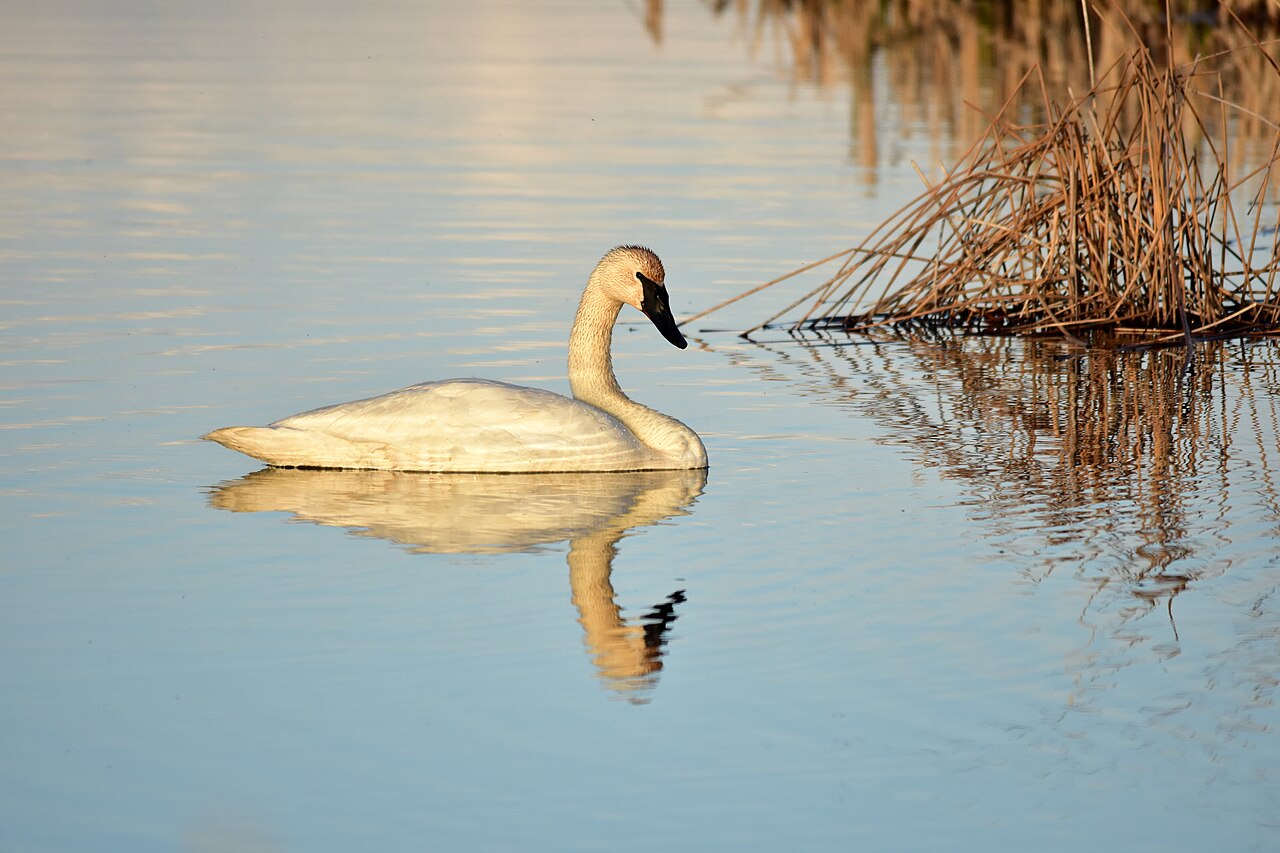
An adult Trumpeter Swan is entirely white with a long, entirely black bill showing no yellow at all; the base of the bill runs straight and gradually into the forehead, without Tundra Swan's kink or Mute Swan's knob, which makes the bill look proportionally longer. At close range a narrow salmon-pink line, often called the 'lipstick', can be seen along the edge of the lower mandible, found in no other swan. The neck is the longest of any North American waterbird and is held straight. The cygnet is greyish-brown with a pink bill with a black base and does not grow into white plumage until its second year; even adults sometimes carry a light rusty stain on head and neck, from foraging in iron-rich water.
Confusion species
Tundra Swan is smaller and almost always shows a small yellow spot in front of the eye, which Trumpeter Swan never has. The most reliable difference is shape: in Tundra Swan the forehead curves concavely into the bill, while in Trumpeter Swan that line runs straight through, making the head look more angular and the bill longer. With experience the call is quicker still: blaring and trumpet-like against thin and whistling. Whooper Swan, a rare vagrant in this region, carries yellow on the bill; Mute Swan has an orange bill with a knob. Where Trumpeter and Tundra Swans winter in the same area, as around the Great Lakes, size in mixed company gives a useful first impression, but bill shape gives the certainty.
Habitat
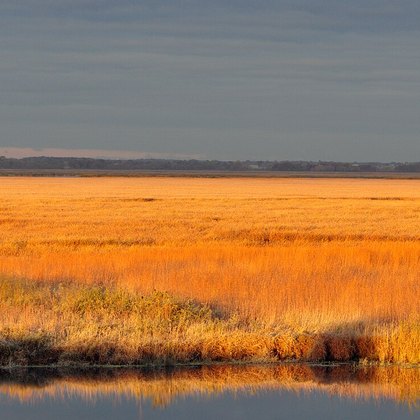
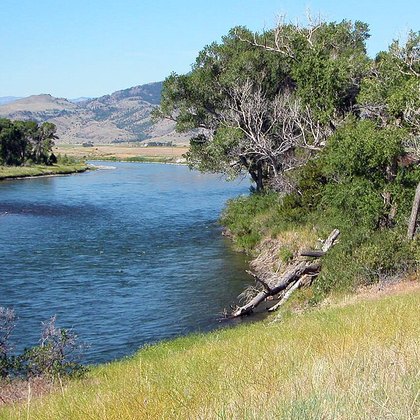
Breeds on shallow lakes, marshes and slow rivers with plenty of bank vegetation, building a floating nest on a muskrat lodge or a small island. In winter it seeks open water that does not freeze over: rivers and lakes kept open by springs or geothermal activity in the Yellowstone region, and sheltered estuaries and bays along the Pacific coast. Flooded farmland and the shallow, weedy edges of lakes it uses year-round to feed. It avoids fast water without bank cover and the open sea.
Where the bird is most often found, arranged by the USNVC — the vegetation classification of the United States and Canada — and CMECS for sea and coast.


Range and movements
Three separate populations recovered after the near-extirpation of around 1930. The Pacific population breeds mostly in Alaska and to a lesser extent the Yukon, and winters along the coast of Washington and British Columbia. The Rocky Mountain population breeds mainly in northern Alberta, British Columbia and the Yukon and winters in the tri-state region of Montana, Idaho and Wyoming, where a small, non-migratory group also stays year-round. The Interior population arose from reintroductions since the 1960s and now spans an area from South Dakota and Nebraska through Minnesota, Wisconsin, Michigan and Ohio to eastern Ontario. Combined, the species now numbers well over twenty thousand birds, against fewer than a hundred in the 1930s.
- Resident
- Breeding (summer)
- Winter
- Passage
- dark = core range, pale = thinly spread
Where and when to look
In winter, the warm-water stretches of Yellowstone and the Madison River are reliable spots, as are the coastal waters of Washington and British Columbia; inland, the reintroduced flocks in Minnesota and Wisconsin are visible year-round and growing. On a group of swans, check the bill shape first: a straight line from forehead to bill tip with no yellow at all points straight to this species.
Conservation
Not threatened and increasing, with well over twenty thousand birds spread across the three populations, against the roughly sixty that remained in the lower forty-eight states in 1932. Reintroduction programmes, including moving eggs and young birds to historical breeding grounds, remain the main reason for the recovery. Lead poisoning from ingesting old shot on lake bottoms is still one of the leading causes of death.
Scientific name
Cygnus buccinator | Richardson, 1832
Richardson described the species directly as Cygnus buccinator in 1832; because it has stayed in the same genus ever since, author and year stand without parentheses. The genus Cygnus was introduced by Bechstein in 1803 and is a Latinisation of Greek kyknos, 'swan'. The species name buccinator is Latin for 'trumpeter', after the resonant call; the same word also gave its name to the buccinator muscle of the face. The type locality is Hudson Bay.