All species › Passerines › New World blackbirds, troupials and allies › Orchard Oriole
Orchard Oriole | Icterus spurius
Tuintroepiaal | Turpial castaño
The Orchard Oriole is the smallest oriole of North America and the only one whose male is chestnut rather than orange or yellow. It breeds in scattered deciduous trees along rivers, in farmyards and orchards across the eastern and central United States, and leaves again for the tropics as early as July.
Voice
The song is a fast, running series of clear whistles with a bouncy phrasing, cut through with harsh, chattering notes; a phrase lasts three to four seconds and is seldom repeated the same way twice. Males sing mainly to attract a female and much less to defend a territory, so song falls away quickly once a pair has formed. The call is a soft chuk, often followed by a short rattle; females and fledged young use a simple, short whistle.
Recording: Étienne Leroy — CC BY-NC-SA 4.0 · La Barra, Santa María Colotepec, Oaxaca, Mexico · xeno-canto
Identification
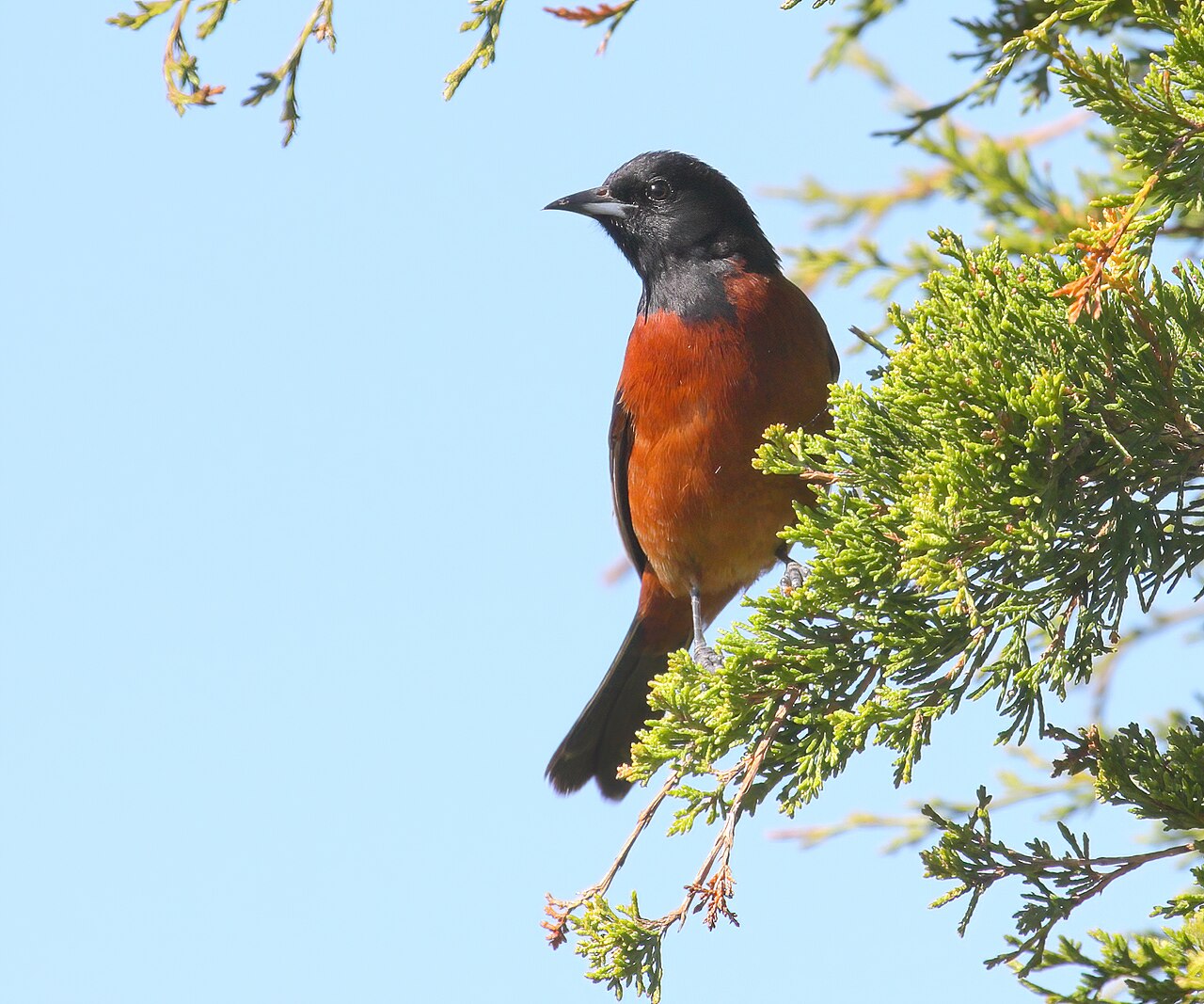
A slim songbird the size of a sparrow, with a pointed, slightly curved bill and a fairly short tail. The adult male is black on head, back, throat, wings and tail, and deep chestnut on breast, belly, rump and shoulder patch. The female is olive-green above and yellow-green below, with two white wingbars and no black. The one-year-old male resembles the female but has a black throat patch and black lores; he breeds in that plumage. The bird forages nimbly in the canopy and regularly hangs upside down while doing so.
Confusion species
The chestnut of the adult male rules out confusion with every other oriole; at a distance or in poor light he looks merely dark, and then the smaller, slimmer build counts. In females and first-year birds the differences are smaller: those of Baltimore and Bullock's Orioles are larger and more orange or buff on breast and tail, while Orchard Oriole is more evenly yellow-green, with a greener back and a shorter tail. A first-year male with a black throat patch can be taken for a Hooded Oriole, but that species has a longer tail, a longer and more clearly curved bill, and occurs almost only in the southwest. The harsh chattering notes in the middle of the song are a good character.
Habitat
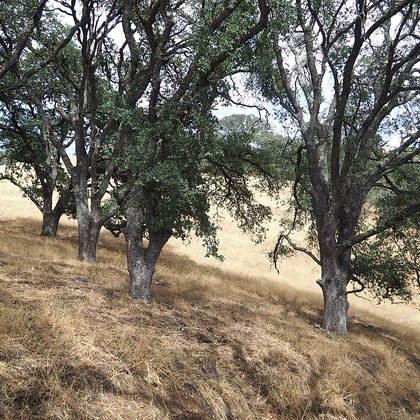
Open deciduous woodland and stands of trees with much edge: riverside woodland, lake and marsh margins, hedgerows, farmyards, parks, orchards and farm gardens with scattered elms, maples, willows and oaks. Closed forest it avoids. The nest is a shallow hanging basket of grass, woven by the female in six days and slung from a thin branch; colony-like concentrations of several pairs in one stand of trees occur. In the wintering area it stays in forest edge, shade plantations and lightly wooded ground.
Where the bird is most often found, arranged by the USNVC — the vegetation classification of the United States and Canada — and CMECS for sea and coast.





Range and movements
A breeder of eastern and central North America, from southern Manitoba and southern Ontario to the Gulf Coast and northern Florida, west to the eastern edge of the Great Plains, and on into northeastern Mexico as far as southern Tamaulipas and Veracruz. It is a long-distance migrant with a short stay in the north: many birds arrive only in May and leave again in July, so the species has largely gone by August. It winters from central Sinaloa and southern Veracruz south through Central America to northern Colombia and northwestern Venezuela, often in parties at flowering trees.
- Resident
- Breeding (summer)
- Winter
- Passage
- dark = core range, pale = thinly spread
Where and when to look
Look for it in May and June in a row of old trees along a river or at the edge of a village, and listen for the fast song shot through with chattering notes. Do not wait for late summer: in many states almost all Orchard Orioles have gone by the end of July. A first-year male singing with a black throat patch in otherwise green-yellow plumage is not a separate species.
Conservation
The species is still common and listed as Least Concern (LC), with a breeding population estimated at about twelve million birds, but the Breeding Bird Survey shows a decline of roughly 46 per cent since 1966. Loss of riverside woodland and hedgerows, the removal of old farmyard trees and the grubbing out of orchards shrink the breeding habitat; in addition Brown-headed Cowbirds regularly lay in the nest. Leaving lines of trees along streams and scattered trees in the landscape keeps the breeding habitat in place.
Scientific name
Icterus spurius | (Linnaeus, 1766)
Linnaeus described the species in 1766 as Oriolus spurius; because it later moved to another genus, author and year stand in parentheses. The genus Icterus comes from Greek ikteros, 'jaundice' and also the name of a yellow bird; in antiquity it was said that seeing that bird cured jaundice. The species name spurius is Latin for 'false' or 'illegitimate', and refers to the original mistake by which the male was taken for a female Baltimore Oriole. The type locality was restricted to South Carolina in 1931.