All species › Passerines › New World blackbirds, troupials and allies › Hooded Oriole
Hooded Oriole | Icterus cucullatus
Maskertroepiaal | Turpial enmascarado
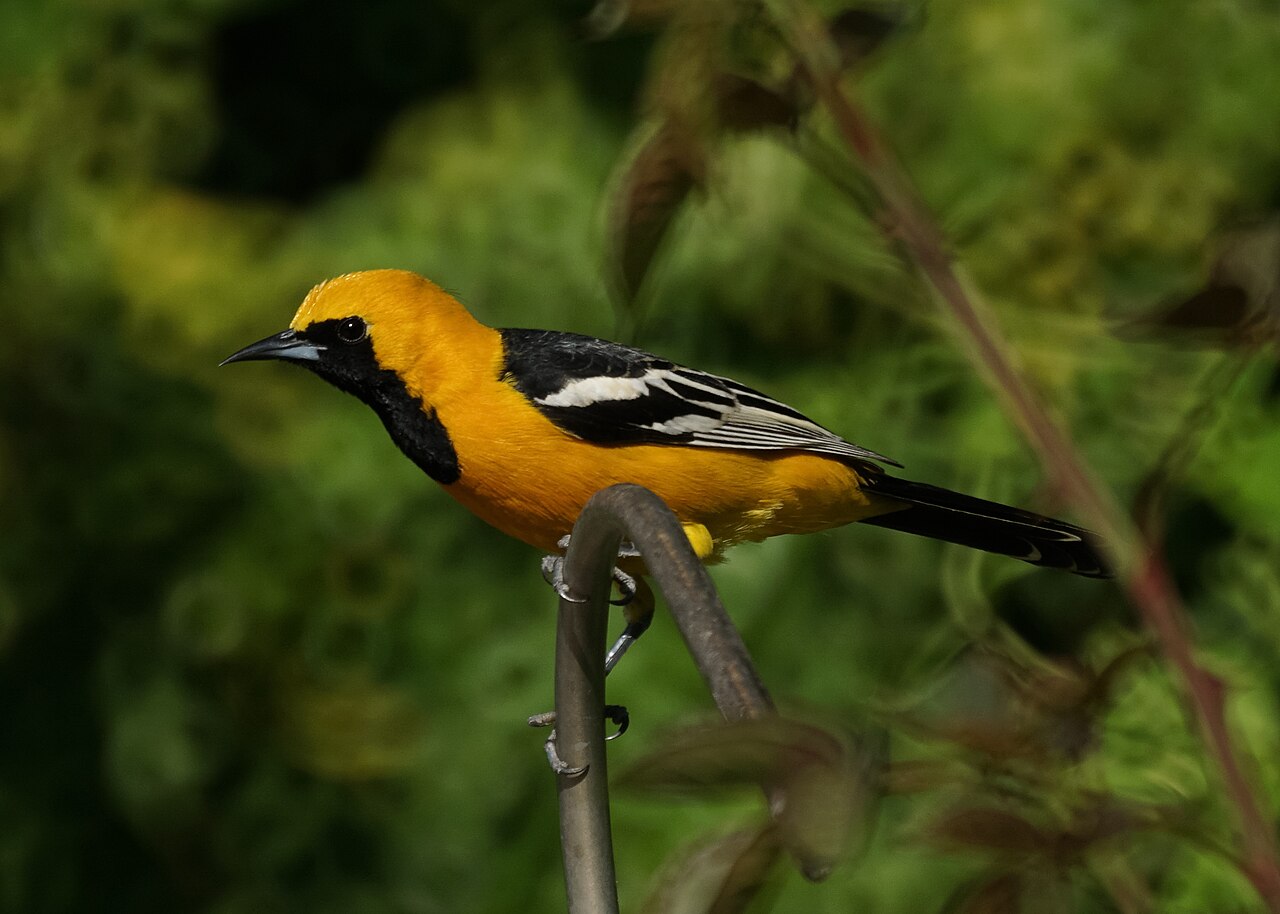
The Hooded Oriole is the slim, long-tailed oriole of the southwestern United States and northern Mexico, with a black mask around bill and throat and a yellow to orange hood. It slings its nest under a palm frond and has spread north with the planting of ornamental palms into coastal California.
Voice
The song is short and abrupt: a hurried, somewhat nasal and whining run of whistles, rattles and squeaks that never settles into a fixed pattern. Birds in Arizona work imitations of neighbouring species into it, among them Gila Woodpecker. The call is a sharp, upslurred wheet or cheek, often repeated from cover, and a dry rattle when the bird is uneasy. In town gardens song and call are usually the first sign the species is present, because the bird keeps to the crown of the palm.
Recording: Richard E. Webster — CC BY-NC-SA 4.0 · Leslie Canyon National Wildlife Refuge, Cochise County, Arizona, United States · xeno-canto
Identification
Slim and elongated, with a long, rounded tail, a long neck and a clearly curved, pointed bill. The male has a black throat and lores running on as a mask around the base of the bill, black wings with two white bars, a black tail, and otherwise a yellow to flame-orange hood, rump and belly; birds of the southwest and northwestern Mexico are yellower, those of south Texas and eastern Mexico more orange. The female is olive-yellow with a greyer back and thin white wingbars, and no black. Young males resemble the female but already acquire a black throat patch. It forages nimbly and often hangs upside down; at flowers it takes nectar by piercing the base of the bloom.
Confusion species
Bullock's Oriole has a black crown and a black eyeline on an orange face rather than a continuous mask, a straighter bill, a shorter tail and a large white wing panel. Streak-backed Oriole is bulkier, has black streaks along mantle and back and a deeper orange head, where Hooded keeps a plain yellow to orange back. Scott's Oriole is black on head, breast and back and lemon yellow on belly and rump. Altamira Oriole of south Texas is larger, with a heavy bill and an orange shoulder patch instead of a white wingbar. Females are the most alike: a female Hooded is longer-tailed and slimmer than the others and has the curved bill.
Habitat
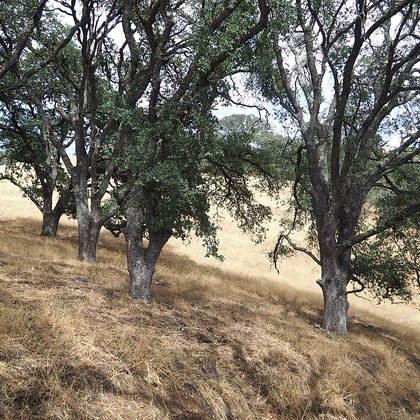
Open, dry ground with scattered trees: riverside strips of cottonwood, willow and sycamore, mesquite woodland, desert palm oases and, increasingly, gardens, parks, campuses and streets with planted fan palms and eucalyptus. The female sews the hanging nest to the underside of a palm frond or a leaf sheath with plant fibres, usually some six metres up; sycamores and eucalyptus are used as well. The nest is deeper than that of related orioles.
Where the bird is most often found, arranged by the USNVC — the vegetation classification of the United States and Canada — and CMECS for sea and coast.






Range and movements
A breeder in California, southern Nevada, Arizona, southwestern New Mexico and western and southern Texas, and in northern Mexico. Over most of the United States range it is a summer bird present from March to September and wintering in Mexico; along the California coast small numbers now stay through the winter at feeders and flowering garden plants. In Mexico it is largely resident, from Baja California Sur and Sonora down both coasts to Oaxaca and Veracruz, with an isolated population reaching Belize. The northward spread in California followed the planting of ornamental palms in residential areas.
- Resident
- Breeding (summer)
- Winter
- Passage
- dark = core range, pale = thinly spread
Where and when to look
Search a street or park with fan palms from April to July and look at the undersides of the fronds: a frayed hole or a grassy basket gives the nest away. Watch the silhouette — the long tail and the curved bill are usable against the light, while the colour ranges from yellow to orange by region. A sugar-water feeder in a garden with palms draws it regularly.
Conservation
Numbers have been stable to slightly increasing since 1966 and the world population is put at about 1.7 million birds; the species is listed as Least Concern (LC). Palm planting in towns has enlarged the range in California. In south Texas the pressure is nest parasitism: Brown-headed and Bronzed Cowbirds lay so heavily in the nests there that the number of fledged young falls sharply, and the species has gone from parts of the lower Rio Grande valley. Loss of riverside woodland plays a part as well.
Scientific name
Icterus cucullatus | Swainson, 1827
Swainson described the species in 1827 already within the genus Icterus, so author and year stand without parentheses; the specimen described came from Temascaltepec in Mexico. Icterus is from Greek ikteros, 'jaundice' and also the name of a yellow bird. The species name cucullatus is Latin for 'hooded', from cucullus 'hood' — after the yellow to orange hood covering crown, nape and sides of the breast. The Dutch and Spanish names point to the black mask, the English name, like the scientific one, to the hood.