All species › Passerines › New World blackbirds, troupials and allies › Streak-backed Oriole
Streak-backed Oriole | Icterus pustulatus
Vlekrugtroepiaal | Turpial de fuego
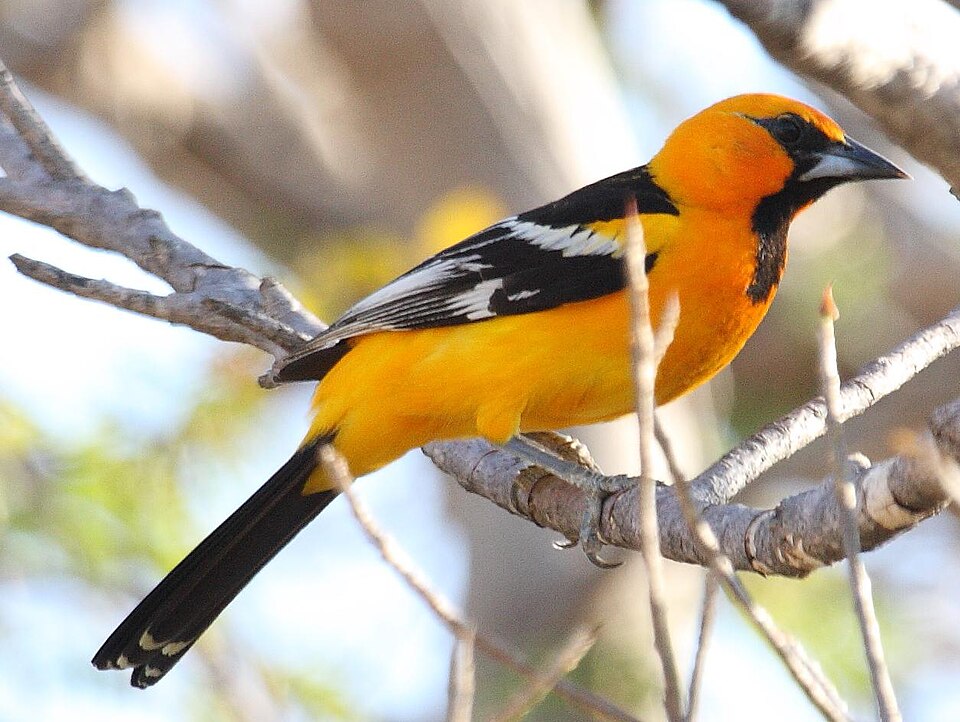
The Streak-backed Oriole is an oriole of the Pacific lowlands of Mexico and Central America, recognisable by the black streaks along an orange back. Within the guide area it reaches the United States only as a vagrant: a handful of birds a year in Arizona and California, mostly in late autumn and winter, with a few breeding records along the San Pedro.
Voice
The song is a series of clear, full whistles in which some elements are repeated; the phrases are longer and slower than those of Hooded Oriole and sound less hurried. Both sexes sing, including in duet, which is more common among lowland orioles. The calls are a harsh rattle or chatter when the bird is uneasy, and a soft, short contact note between partners inside the canopy.
Recording: Étienne Leroy — CC BY-NC-SA 4.0 · La Barra, Santa María Colotepec, Oaxaca, Mexico · xeno-canto
Identification
A medium-sized oriole with a straight, pointed bill with a pale base to the lower mandible. Head and breast are deep orange, with black lores, chin and a limited black bib on the upper breast. The character of the species is on the back: heavy black streaks along an orange mantle; northern forms have broad streaks, other subspecies teardrop-shaped spots or almost nothing. The wings are black with a white panel and white feather edges, the tail largely black with white tips and edges. The female is duller but carries the same back pattern, which separates her from the females of other orioles.
Confusion species
Hooded Oriole is slimmer, longer-tailed and has a clearly curved bill, is paler yellow to orange and keeps a plain unstreaked back; besides, its black runs further up around the base of the bill. Bullock's Oriole has a black crown and a black eyeline and a large white wing panel, and lacks the back streaks. Altamira Oriole is larger and heavier-billed, with a plain back and an orange shoulder patch. Females and young Streak-backed Orioles remain recognisable by the streaked or spotted mantle, where female Hooded and Bullock's have an even grey-green back.
Habitat
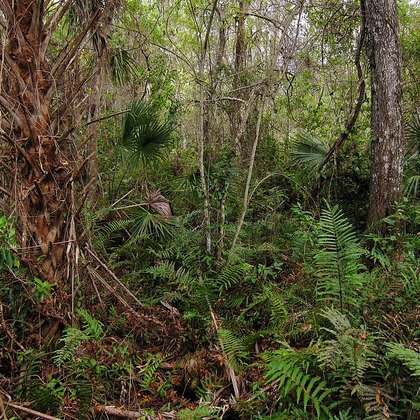
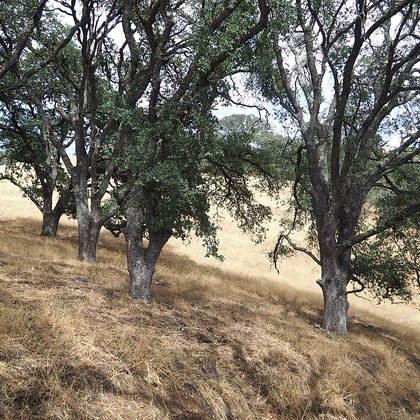
Dry to semi-dry lowland with open tree growth, from sea level to about 1900 metres: tropical deciduous forest that stands bare in the dry season, thorn scrub, savanna with scattered trees, mangrove edge, riverside woodland, and orchards, gardens and village margins. The nest is a long woven bag, often in a thorny tree or acacia; in Arizona the breeding attempts were in cottonwood and in a pecan grove.
Where the bird is most often found, arranged by the USNVC — the vegetation classification of the United States and Canada — and CMECS for sea and coast.





Range and movements
A resident of the western and southern lowlands of Mexico, from Sonora and western Chihuahua south along the Pacific coast to Chiapas, with an arm across the plateau, and on through Guatemala, El Salvador, Honduras and Nicaragua to Costa Rica, which lies outside the guide area. In the United States it is an irregular visitor: since the first record in 1975 it has been reported mainly in winter in Arizona, from Mohave, Santa Cruz and Cochise counties, and further in southern California; there are scattered reports from New Mexico, Texas and even Oregon and Wisconsin. Between 1993 and 2000 up to two pairs bred along the lower San Pedro in Pinal County, in 1994 a pair near Pinal Air Park, and in 2020 a nesting attempt at the Hassayampa River Preserve failed through a Bronzed Cowbird.
- Resident
- Breeding (summer)
- Winter
- dark = core range, pale = thinly spread
Where and when to look
In Arizona, follow up reports of an orange oriole at a feeder garden or a flowering tree between November and March: most United States records concern wintering birds that stay days to weeks in one place. Always check the back before going by head colour; on a bird seen at an angle from behind the black streaks show first.
Conservation
The species is numerous and widespread, with a population of more than five million mature birds and a stable trend; the IUCN lists it as Least Concern (LC). In Mexico it benefits from half-open, farmed landscape as long as trees remain standing for the nest. Nest parasitism by Bronzed Cowbird depresses breeding success locally, as in the failed attempt in Arizona. For the guide area the presence is too small to speak of a population of its own.
Scientific name
Icterus pustulatus | (Wagler, 1829)
Wagler described the species in 1829 as Psarocolius pustulatus; because it later moved to Icterus, author and year stand in parentheses. The genus Icterus is from Greek ikteros, 'jaundice' and at the same time the name of a yellow bird. The species name pustulatus is Latin for 'covered with blisters', after the black spots and streaks on the mantle. The type specimen came from Mexico, without closer locality. The Dutch name refers to that same back character.