All species › Passerines › New World blackbirds, troupials and allies › Bullock's Oriole
Bullock's Oriole | Icterus bullockiorum
Bullocks troepiaal | Turpial de Bullock
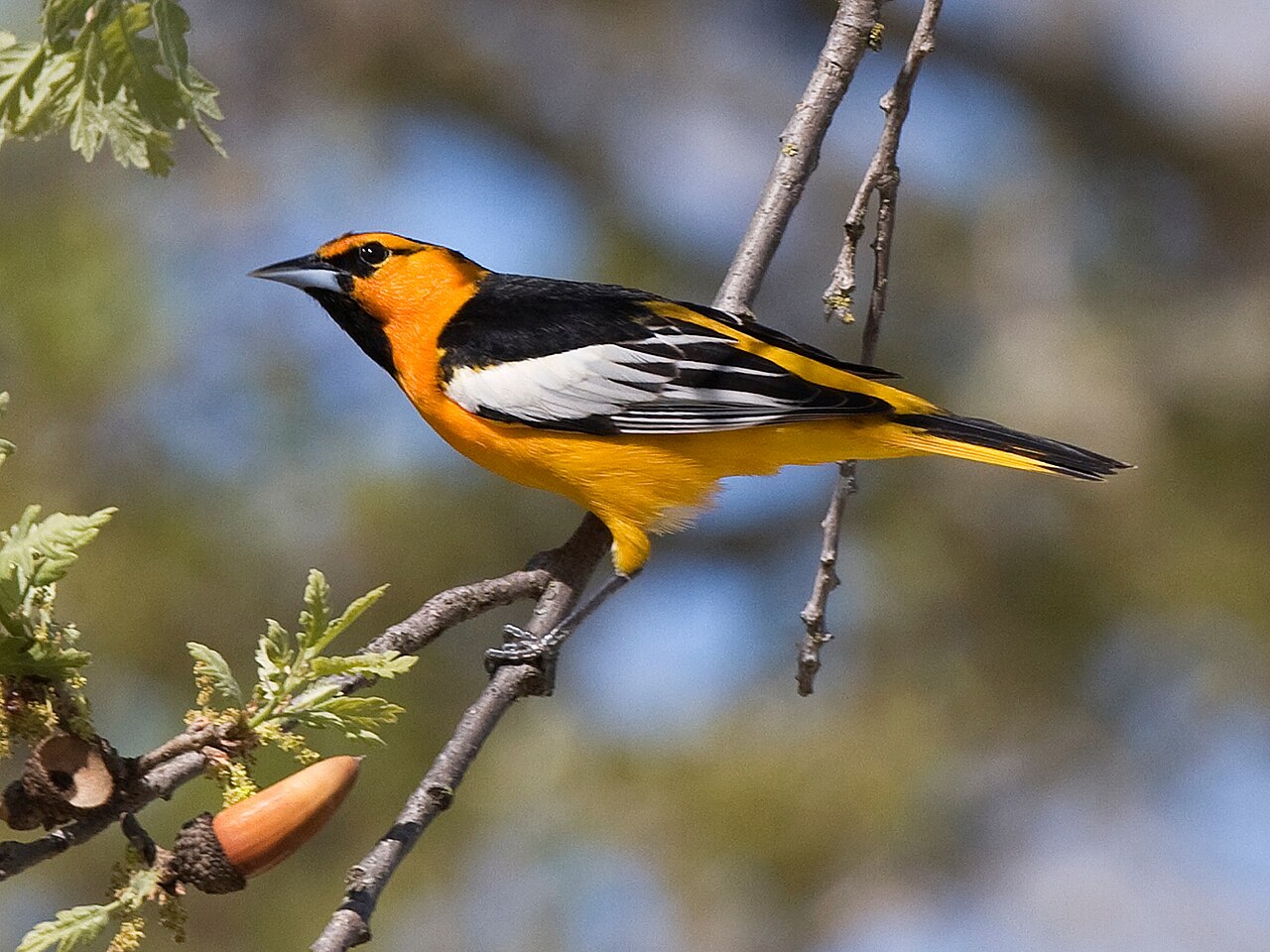
Bullock's Oriole is the oriole of the western half of North America: orange below, with a black crown, a black eye-line and a large white wing patch. It breeds in cottonwoods and willows along rivers from British Columbia to northern Mexico, and meets the Baltimore Oriole on the Great Plains, where the two interbreed.
Voice
The song is a short series of clear whistles with scratchy, rattling notes between them — faster and harsher than the song of the Baltimore Oriole, and less pure in tone. Both sexes sing; the female often sings more frequently than the male, in shorter phrases. Calls include a dry chek and a rattling cher-r-r repeated in long series when the nest is disturbed.
No recording with a suitable Creative Commons licence has been found for this species yet; what to listen for is described below.
Identification
The male is orange on face, breast and belly, with a black crown and nape, a black line through the eye and a narrow black throat stripe that reaches no further than the chin and upper throat. The back is black, and the wing carries one large white panel on the coverts rather than two narrow bars. The tail is orange with black down the centre and across the tip. The female is grey-brown above with an olive crown, yellowish on head, breast and tail and white to grey on the belly; older females may show a limited dark throat patch. First-year males resemble females but add the black throat stripe and eye-line.
Confusion species
A male Baltimore Oriole has a wholly black head and throat with no orange in the face, and only a narrow white wing bar instead of a broad panel; on Bullock's the orange runs up over the eye. Females and first-year birds are more alike: Bullock's has a greyish-white belly that contrasts sharply with the yellow breast, while Baltimore is evenly orange-yellow right through to the undertail. Hooded Oriole is slimmer, with a thinner, slightly curved bill and two narrow white wing bars. In the contact zone on the Great Plains intermediate birds occur that fit neither species exactly.
Habitat
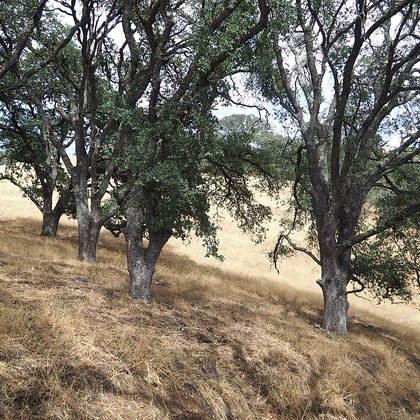
Open deciduous woodland and scrub along water: cottonwood, willow, pecan, alder and mesquite (a thorny pod-bearing shrub of the Southwest that forms dense thickets) in river valleys, and saltcedar in the dry southwest. In towns it nests in eucalyptus, sycamore (American plane trees of stream and river valleys) and street trees in parks and orchards; the hanging nest is slung from a thin outer branch. It avoids closed conifer forest and treeless prairie, needing scattered tall trees and little else.
Where the bird is most often found, arranged by the USNVC — the vegetation classification of the United States and Canada — and CMECS for sea and coast.





Range and movements
It breeds from southern British Columbia, Alberta and Saskatchewan south through the whole of the western United States to Sonora, Chihuahua, Coahuila and Durango, and east to the Dakotas, Kansas and central Texas. Migration starts early: many birds leave in July and August. It winters from Sinaloa and Nayarit south through western and southern Mexico to Guatemala and El Salvador, with a small number staying on the California coast. Along the eastern edge of the range on the Great Plains it overlaps with the Baltimore Oriole; that contact zone is narrow and follows the riverside woodlands. Genetic work shows the zone narrowed and shifted westward over the twentieth century.
- Breeding (summer)
- Winter
- Passage
- dark = core range, pale = thinly spread
Where and when to look
Look in May and June in tall cottonwoods along a river or in a park strip, and check the wing first: the large white panel shows at a distance and against the light, while the exact head pattern needs good light. The hanging nest, a deep pouch of plant fibre on a drooping outer branch, stays visible all winter once the leaves are down.
Conservation
The species is listed as of Least Concern (LC) and the range is large. The North American Breeding Bird Survey shows a slow long-term decline, strongest in California and the southwest; the loss of cottonwood-willow woodland along regulated rivers and its replacement by saltcedar are the causes most often named. Restoration of riparian woodland along rivers such as the Colorado and the Rio Grande produces occupied territories again. Brown-headed Cowbirds lay in the nests, but Bullock's Oriole often removes their eggs.
Scientific name
Icterus bullockiorum | (Swainson, 1827)
Swainson described the species in 1827 as Xanthornus Bullockii, after the English collector William Bullock, who collected in Mexico with his son William Bullock Jr.; because the type material is credited to both Bullocks, the scientific name now reads bullockiorum, the genitive plural: 'of the Bullocks'. Its placement in another genus puts author and year in parentheses. The genus Icterus comes from Greek ikteros, the name of a yellow bird. The described specimen came from the Mexican tableland, later restricted to Temascaltepec.