All species › Passerines › Silky-flycatchers › Phainopepla
Phainopepla | Phainopepla nitens
Zwarte zijdevliegenvanger | Capulinero negro
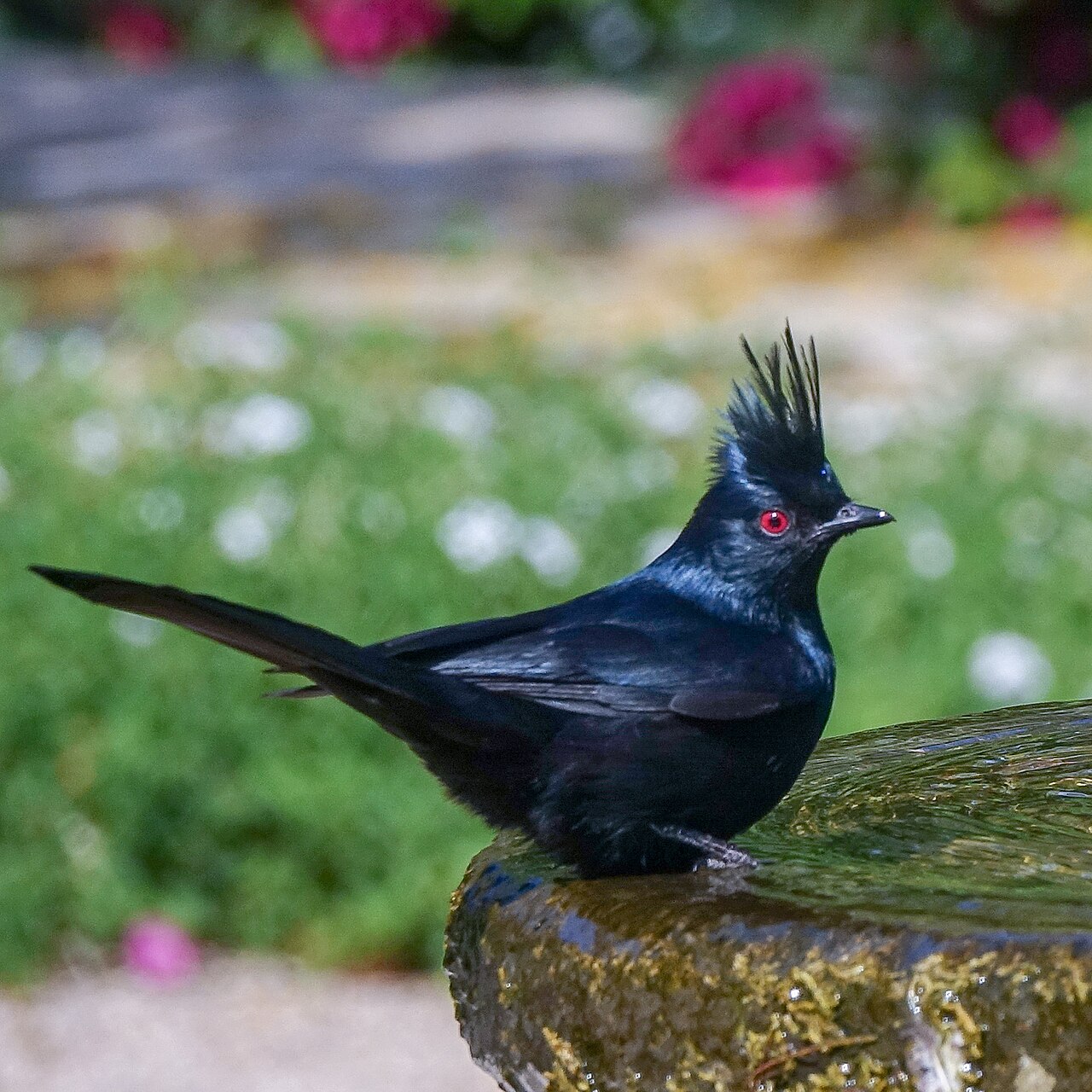
A slim black bird with a thin upright crest and a red eye, sitting motionless on top of a shrub in a desert wash and showing two large white patches in the wing as it goes. It belongs to the dry southwest as mistletoe belongs to mesquite (a thorny pod-bearing shrub of the Southwest that forms dense thickets): where the one grows, the other sits. The female has the same silhouette, but entirely in mouse-grey.
Voice
The ordinary contact note is a short, upward-bending wurp that birds in a wash keep exchanging and that is usually noticed before the bird itself. The song is soft and disjointed, a series of short gurgling and whistled phrases with silences between them, and is heard mainly in early spring. The number of imitations is large: some twelve other species have been recorded from this bird, among them Red-tailed Hawk and Northern Flicker, and they are heard above all when something is amiss. Anyone who hears a screaming raptor a hundred metres off and sees nothing would do well to search the shrub tops.
Recording: Richard E. Webster — CC BY-NC-SA 4.0 · San Bernardino National Wildlife Refuge, Cochise County, Arizona, United States · xeno-canto
Identification
The male is entirely glossy black, with a blue or green sheen in full light; the female and the young birds are plain slate-grey, with paler edges to the wing feathers. Both carry a thin crest curving slightly backwards and a deep red eye, which stands out more on the grey female than on the black male. The tail is long and narrow and the body slender; at rest that gives a different impression from the stocky build of most black birds. Only in flight does the male show the mark that identifies him at a distance: a large white panel in the primaries, which on the female stays dull grey. The flight is light and undulating, with many short sallies after flying insects.
Confusion species
Northern Mockingbird is as grey and also shows white in the wing, but lacks the crest, has white outer tail feathers, a yellow eye and a longer, slightly curved bill. Loggerhead Shrike wears a black mask across a grey head and has a heavy hooked bill, and sits on wires in open country rather than on top of a shrub. Cedar Waxwing also has a crest and also eats berries, but is warm buff with a yellow tail tip and a black mask. A black bird with a crest and a red eye in a desert wash is no other species in this region.
Habitat
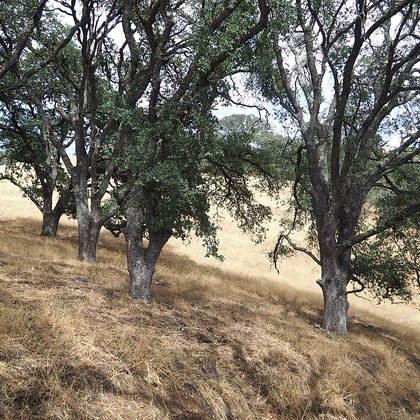
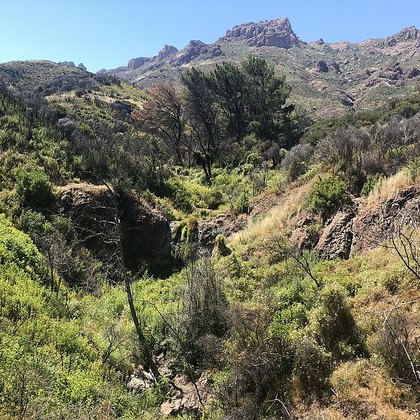
Lowland desert with washes grown up with mesquite, acacia, palo verde and ironwood — the trees that carry desert mistletoe — and beyond that open oak woodland, chaparral (dense, hard-leaved scrub of California's Mediterranean climate), juniper scrub and groves along dry beds. In California it also uses gardens, parks and leafy suburbs, where pepper trees and boxthorn provide food. Above about eighteen hundred metres it is absent, and closed forest and bare open sand are avoided. What makes a place suitable is not the kind of plant but whether there are berries on it.
Where the bird is most often found, arranged by the USNVC — the vegetation classification of the United States and Canada — and CMECS for sea and coast.



Range and movements
The range runs from central California and southern Utah through Arizona, Nevada, New Mexico and western Texas to both Baja Californias and the Mexican plateau. Its movements are still not fully understood: in February and March it breeds in the desert, after which part of the population moves in May to oak and streamside woodland and breeds there a second time. In the north of the range it is therefore largely absent in summer and present in winter; in the south it is the other way round. Strays have reached Canada.
- Resident
- Breeding (summer)
- Winter
- Passage
- dark = core range, pale = thinly spread
Where and when to look
Go in winter or early spring to a desert wash where the mesquite carries thick balls of mistletoe and search the highest bare branches: a black bird sitting there upright and motionless is one. Stand still and wait for a sally after an insect — that is when the white wing panels appear. If a grey bird turns up in the same wash, it is almost certainly the female of the same pair.
Conservation
The world population is estimated at over three million birds and the species counts as Least Concern (LC). Numbers fell by about eight per cent between 1970 and 2016. The main threat is the loss of streamside and mesquite woodland in the desert, cleared for farmland and housing; with the trees goes the mistletoe, and with the mistletoe the winter food.
Scientific name
Phainopepla nitens | (Swainson, 1838)
Swainson described the species in 1838 as Ptilogonys nitens; because it was later placed in another genus, author and year stand in parentheses. The genus Phainopepla was introduced by Baird in 1858 and is made from Greek phainein 'to shine' and peplos 'robe': the gleaming dress of the male. The species name nitens is Latin for 'shining', so the name says the same thing twice. The description gives the type locality simply as Mexico.