All species › Passerines › Waxwings › Bohemian Waxwing
Bohemian Waxwing | Bombycilla garrulus
Pestvogel | Ampelis europeo
The Bohemian Waxwing is a bird of the boreal conifer forest that comes south in flocks in winter and can strip a rowan or a crabapple in a suburban street within hours. On the tips of its secondaries sit red, lacquer-like tabs that look like drops of sealing wax; they consist of the extended shaft of the feather. The name 'Bohemian' refers to that wandering: the flocks turn up in a different place every winter.

Voice
A flock sounds like a continuous rattling buzz: a low trembling sirrrr held by dozens of birds at once, louder and rougher than the thin whistle of the Cedar Waxwing. A single bird gives the same trill on taking off and on the move, so a passing group is usually heard before it is seen. There is no song in the proper sense: the whole repertoire is variations on that one trill, sometimes with a higher, shorter version between. While a flock feeds in a tree it keeps up a soft continuous rattle that at a distance passes for running water.
Recording: Doug Hynes — CC BY-SA 4.0 · Sandringham, Newfoundland and Labrador, Canada · xeno-canto
Identification
A compact bird the size of a starling, with a high crest it lays flat or raises, warm grey with a cream wash, a black throat patch and a black mask through the eye. The undertail coverts are rusty, the belly dull grey, and the tail ends in a broad yellow band. The wing carries a white streak along the primary coverts, yellow and white tips to the primaries that together form a V pattern, and on old birds up to eight red waxy tabs on the secondaries. Male and female look much alike; the female has a smaller, less sharply edged throat patch and usually fewer red tabs. Young birds are duller, streaked below and short-crested, but already carry the yellow tail band. In flight it is short-tailed and sharp-winged, and the flock moves as a dense, angular ball.
Confusion species
Cedar Waxwing is smaller and browner, with a yellow belly, white undertail coverts and no white or yellow in the wing; in northern winters the two sometimes feed in the same tree, and that difference under the tail is the quickest to check. Voice separates them too: Cedar Waxwing whistles thin and high, Bohemian Waxwing rattles low. A distant flock is taken for starlings, but starlings are darker, longer-billed and triangular-winged, and their flock rolls rather than turning as a ball. Phainopepla also has a crest, but is black or grey, longer-tailed, and occurs only in the dry southwest.
Habitat
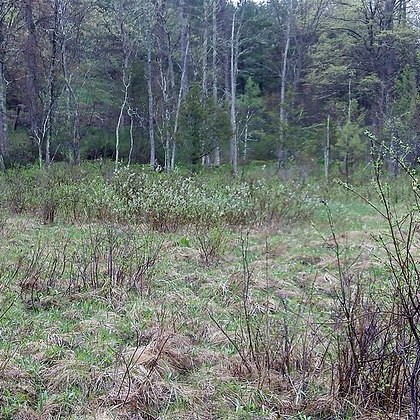
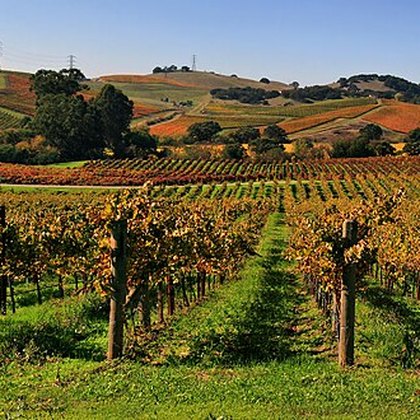
It breeds in open conifer and mixed forest in the north, preferring places where peatland, muskeg or a creek makes clearings and where insects fly over water in summer. Outside the breeding season it is not the forest but the berry crop that decides where it is: it turns up wherever rowan, crabapple, hawthorn, juniper or holly still carries fruit, and in the south of its winter range that usually means gardens, parks, street trees and car parks. A site is eaten bare and then left, so it rarely stays more than a few days. It does not use dense closed forest without understorey, nor open land without shrubs.
Where the bird is most often found, arranged by the USNVC — the vegetation classification of the United States and Canada — and CMECS for sea and coast.



Range and movements
Breeds right across the northern hemisphere in the taiga; in North America from western Alaska through Yukon and the Northwest Territories to Manitoba, with the southern limit in the mountains of British Columbia and Alberta. The winter distribution is unpredictable: in one winter the flocks stay in the northwest, in the next they push on to New England and Colorado. These irruptions follow the northern berry crop — when the rowan fails, the birds come south. Since ornamental crabapples and rowans have been planted on a large scale in northern towns, flocks spend whole winters in places such as Fairbanks, Edmonton and Winnipeg.
- Resident
- Breeding (summer)
- Winter
- Passage
- dark = core range, pale = thinly spread
Where and when to look
In January and February do not look in the forest but in the street: a row of ornamental crabapples in a car park or along a drive, with the fruit still on the branches. If you hear a steady high rattle overhead, look up into the crowns — the flock often sits high in a bare tree for a while before dropping to the berries. When photographing, watch the undertail coverts: that is the quickest feature to check for Cedar Waxwings among the Bohemians.
Conservation
The species is listed as of least concern and the North American population is estimated at several million birds; the wide swings from year to year make a trend hard to establish. The breeding range lies largely in thinly settled boreal forest and is altered mainly by logging and forest fire. Among winter flocks in towns, birds are lost to window strikes and to traffic, and berries that have fermented through frost and thaw produce intoxicated birds that fly into walls.
Scientific name
Bombycilla garrulus | (Linnaeus, 1758)
Linnaeus described the species in 1758 as Lanius garrulus, among the shrikes; because it was later placed in another genus, author and year stand in parentheses. The genus Bombycilla was introduced by Vieillot in 1808: bombyx is Greek for 'silk' and cilla a word intended as Latin for 'tail', together a rendering of the German Seidenschwanz. garrulus is Latin for 'chattering', after the continuous rattle of a flock. Linnaeus gave Europe and northern America as the origin; the type locality was later restricted to Sweden.