All species › Passerines › New World warblers › Pine Warbler
Pine Warbler | Setophaga pinus
Dennenzanger | Bijirita del pinar
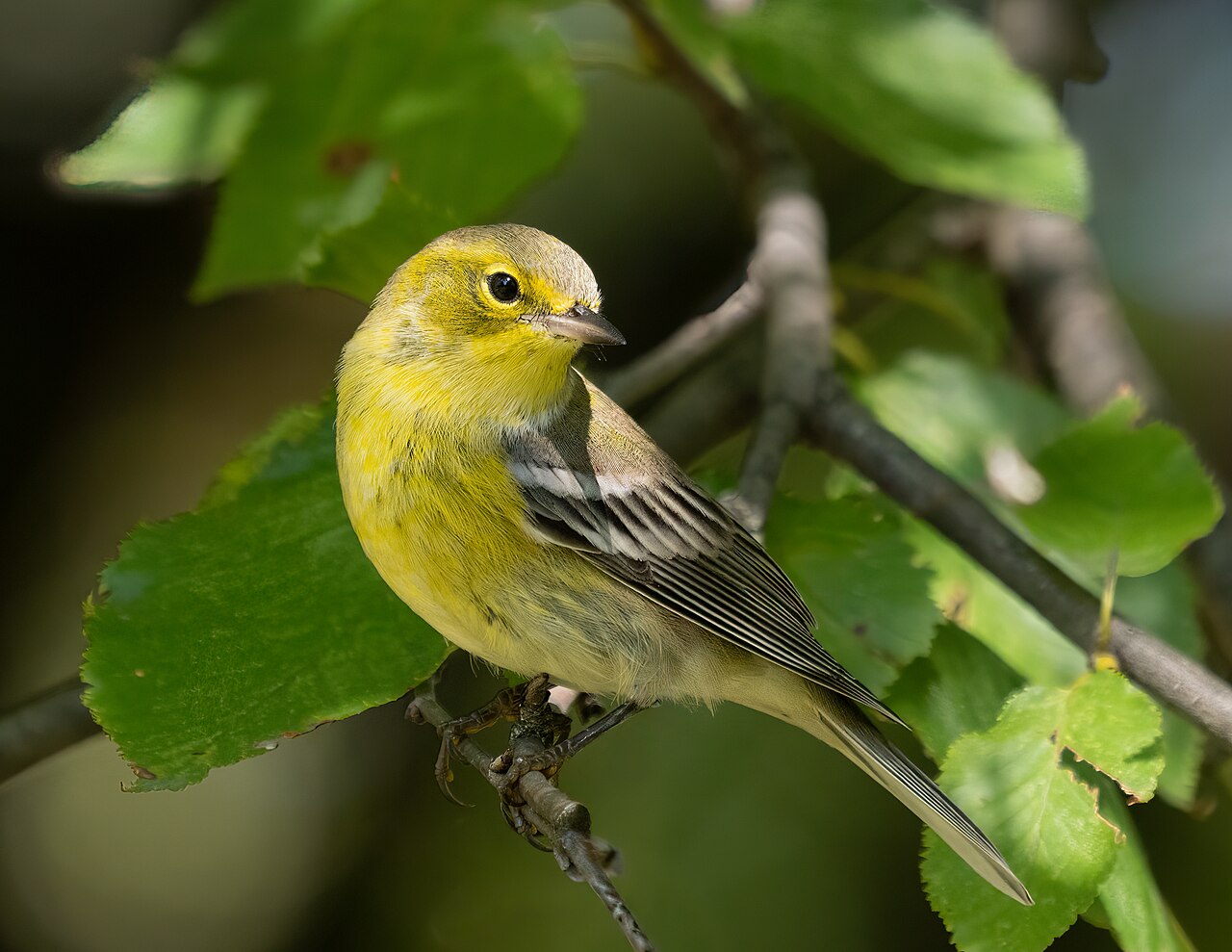
The Pine Warbler is the warbler that is hardly ever found away from pines. It is larger and more heavily built than most of its relatives, has a stout bill, and is the only American warbler that eats large quantities of seed in winter. In the southeastern United States it stays all year; northern breeders move down into that same country for the winter.
Voice
The song is an even, musical trill of two to three seconds, slower and rounder in tone than a Chipping Sparrow's and less dry than a Dark-eyed Junco's, both of which sing in the same pine woods. The difference lies in the pace and a slight wavering: the Pine Warbler's trill swells a little in the middle and loosens at the end. The call is a flat, slightly slurred chip; on migration a thin, high seet.
Recording: Rory Nefdt — CC BY-NC-SA 4.0 · Flag Ponds Nature Park Delaware, United States · xeno-canto
Identification
The male has an olive-green back, a yellow throat and breast with faint dark streaking along the sides, a white belly and two broad white wing bars. A dim yellow spectacle surrounds the eye, with a darker cheek patch behind it. The legs are dark and the bill is thick for a warbler. Females and young birds are much paler, sometimes almost grey-brown with no yellow at all. The tail has white corners that show as the bird turns away. Behaviour helps: it creeps slowly along heavy branches and probes clusters of needles with its bill instead of flitting through foliage.
Confusion species
Yellow-throated Vireo has the same yellow spectacles and yellow breast, but a thicker hooked bill, a thicker neck and a far more deliberate way of moving. Blackburnian and Yellow-throated Warblers are smaller and slimmer with more finely streaked flanks. Pale autumn birds resemble Bay-breasted and Blackpoll Warblers closely; look then at the longer tail with white corners, the heavy bill and the absence of clear streaking on the back. Young birds without yellow are also taken for young Yellow-rumped Warblers, but those always show a yellow rump.
Habitat
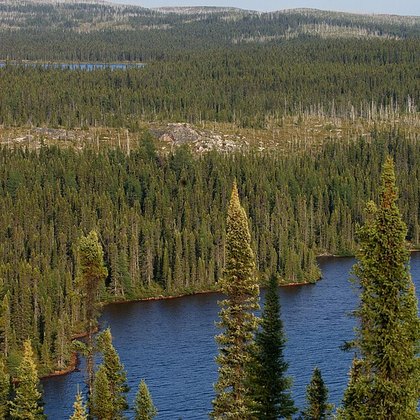
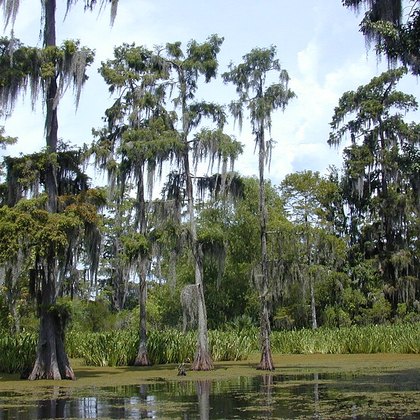
Open pine woodland, from the loblolly and longleaf pines of the coastal plain to the white, red and jack pines of the north. It uses mixed forest only where pines are present, and largely avoids pure hardwoods. In winter it also works pine plantations, woodland edges and gardens in the Southeast, where it comes to feeders for sunflower seed, cracked corn and suet. Along the Gulf coast and in Florida it uses wet pine flatwoods and the margins of swamp forest as well.
Where the bird is most often found, arranged by the USNVC — the vegetation classification of the United States and Canada — and CMECS for sea and coast.



Range and movements
The breeding range covers eastern North America, from southeastern Manitoba and Ontario east to New Brunswick and Nova Scotia, and south across the whole eastern half of the United States to East Texas and Florida. South of roughly Maryland and Kentucky it is resident; northern birds leave their breeding grounds in October and return as early as February, ahead of any other warbler. In winter they gather in the South in flocks of fifty to more than a hundred. Bermuda, the Bahamas, Cuba and Hispaniola hold their own year-round forms.
- Resident
- Breeding (summer)
- Winter
- Passage
- dark = core range, pale = thinly spread
Where and when to look
In March, follow the trill into a pine wood and then look high in the crown for a slow, thickset bird walking along a heavy limb. In winter it visits feeders beside pine woods in Georgia or the Carolinas: it is then the only warbler sitting among the sparrows taking seed.
Conservation
The species is widespread and numerous and is listed as Least Concern (LC). The Breeding Bird Survey shows a stable to slightly rising trend over the past half-century, helped by pine planting in the Southeast keeping the area of suitable forest up. Short-rotation plantation yields fewer old trees than natural pine woodland, and the Bermuda form fell sharply when a scale insect destroyed the island's forest in the 1950s.
Scientific name
Setophaga pinus | (Linnaeus, 1766)
Linnaeus described the species in 1766 as Certhia pinus, placing it at first with the treecreepers; because it was later moved to Setophaga, author and year stand in parentheses. The genus Setophaga was introduced in 1827 by William Swainson, from Greek sēs 'moth' and -phagos 'eating': 'moth-eater'. The species name pinus is Latin for 'pine' and refers to the woodland the bird lives in. The type locality was restricted to Georgia in 1931.