All species › Passerines › Laughingthrushes and allies › Red-billed Leiothrix
Red-billed Leiothrix | Leiothrix lutea
Japanse nachtegaal | Ruiseñor del Japón
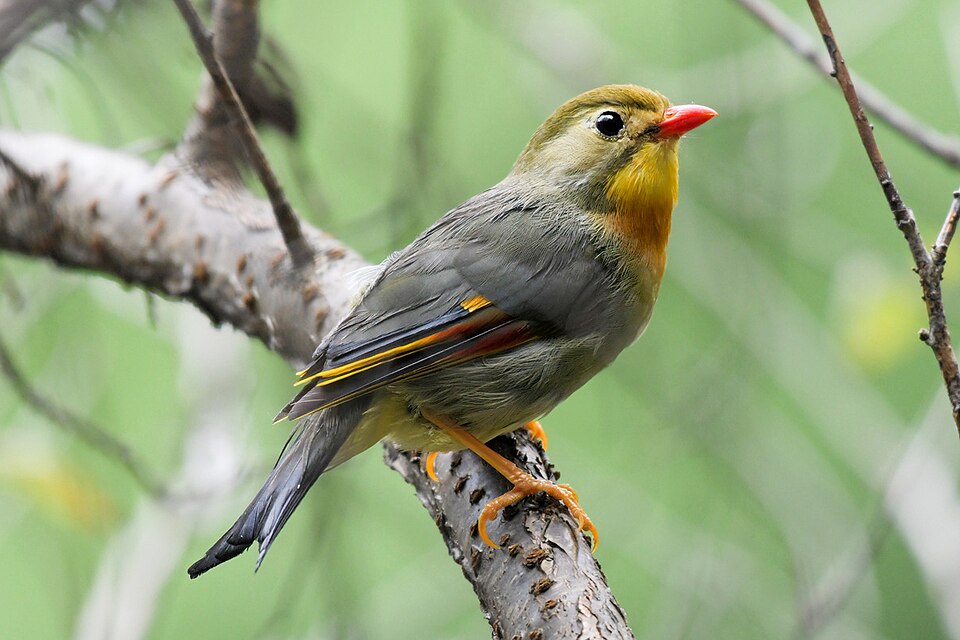
A brightly coloured bird with a coral-red bill and an orange throat that, in the wet mountain forest of Hawaii, almost always stays behind leaves. The English trade name it once carried was wrong on every count: it comes not from Japan but from the Himalaya and China, and it has nothing to do with a nightingale. It was released on the islands in the 1920s and 1930s and now lives on four of them.
Voice
The song is a loud, rolling phrase of three to seven full whistled notes repeated endlessly, with an insistent, almost mechanical beat; it carries down a whole gulch and rarely comes from a visible bird. It sings all year, with a peak between February and June. There is also a hard rattling chak-chak of alarm and a thin tseep with which birds keep contact within a party. It was that full song that made it one of the most heavily traded cage birds in the world.
No recording with a suitable Creative Commons licence has been found for this species yet; what to listen for is described below.
Identification
Fourteen to fifteen centimetres, eighteen to twenty-eight grams, and distinctive at close range. The bill is coral red, the throat clear yellow running into orange on the breast; the upperparts are olive-green, the cheeks and side of the neck blue-grey, the belly dirty yellow-white. The folded wing carries a bright panel of yellow, orange and crimson along the edges of the flight feathers, set against black; the tail is dark and slightly forked. The female is a little duller, with less red in the wing; young birds have a blackish bill. The legs are flesh-coloured and strong, the wings short and rounded.
Confusion species
Seen properly, it is confused with nothing. It is usually seen for half a second: then it resembles the Japanese Bush Warbler, which is the same size and in the same scrub but plain brown with no colour in the wing. The Chinese Hwamei (Garrulax canorus) of the same islands is larger, warm rufous-brown, and has a white spectacle running back from the eye. The Warbling White-eye is far smaller and green. A flash of red bill or yellow-orange throat settles it at once.
Habitat
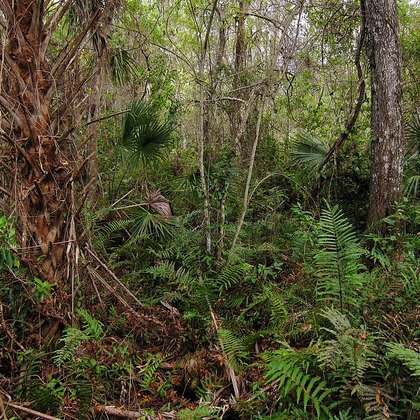
Wet mountain forest with a dense understorey: ohia and koa forest with tree ferns, gulches full of ginger and guava, and run-wild plantings along forest edges. It occurs from sea level to above two thousand five hundred metres but is commonest between four hundred and twelve hundred, where more than a thousand millimetres of rain fall a year. It ignores dry, open plantings of eucalyptus and ironwood, and over time it has withdrawn from the lowest zone. What it asks for is a closed shrub layer with leaf litter beneath it.
Where the bird is most often found, arranged by the USNVC — the vegetation classification of the United States and Canada — and CMECS for sea and coast.


Range and movements
Its own range runs from northern India, Nepal and Bhutan through Burma to southern China, outside this map; only Hawaii appears on it. Between 1911 and 1936 more than forty importations were recorded, some thousand birds in all, with releases on Kauaʻi in 1918 and 1928, about a hundred and sixty-five birds on Oʻahu in 1928, thirty on Maui in 1928, on Molokaʻi in 1929 and a hundred and eighty-four to two hundred and ten on the island of Hawaii between 1929 and 1932. Within ten to twenty years it was locally the commonest songbird; about forty years after release it withdrew from the lower zone on most islands. On Kauaʻi it is gone — the last substantiated record was eleven birds on the Kapaa Christmas count of 1974 — and on Molokaʻi it fell from about eighteen hundred birds in 1980 to a handful per count. On Oʻahu it collapsed in the 1960s and recovered from the 1980s; on Maui (some nineteen thousand eight hundred in 1980) and the island of Hawaii (some ninety-eight thousand in 1979) it has held steady, while it is absent from Lanaʻi, Niʻihau and Kahoolawe.
- Resident
Where and when to look
Walk a forest track in wet mountain forest in the morning and stop at the first rolling phrase; the singer is usually within fifteen metres, low in the scrub. Waiting works better than searching: it comes to the edge of the path of its own accord. Saddle Road and the forests above Hilo on the island of Hawaii, Hosmer Grove on Maui and the Koolau ridges above Honolulu are the best-known places for it.
Conservation
Not threatened (LC). In its own range it is common and is trapped and traded in large numbers for the cage-bird market. On Hawaii it is neither managed nor controlled, and its numbers swing widely without an identified cause. Research on the islands names it as a carrier of avian malaria and a disperser of the seeds of introduced shrubs.
Scientific name
Leiothrix lutea | (Scopoli, 1786)
Scopoli described the species in 1786 as Sylvia (lutea), among the warblers; because it was later placed in another genus, author and year stand in parentheses. The genus Leiothrix was introduced by Swainson in 1832, from Greek leios, 'smooth, plain', and thrix, 'hair', after the soft plumage. lutea is Latin for 'saffron-yellow', after the throat. The described bird came from China by way of Sonnerat; Stresemann restricted the type locality in 1923 to the mountains of Anhui. The trade names 'Japanese Nightingale' and 'Pekin Robin' therefore both point in the wrong direction.