All species › Passerines › Laughingthrushes and allies › Chinese Hwamei (Hwamei)
Chinese Hwamei (Hwamei) | Garrulax canorus
Witbrauwlijstergaai | Charlatán canoro
The Chinese Hwamei is an East Asian laughingthrush kept as a cage bird for centuries on account of its song. Escaped birds established themselves on Oʻahu around 1900 and afterwards on the other main Hawaiian islands, where it is now a common but seldom seen forest bird.

Voice
The song is loud, clear and strongly varied: whistled phrases with regular repetition, laced with imitations of other birds, and it can run on for minutes. There is also a rasping, grating alarm note. In Hawaii the sound is almost always the only evidence of its presence, since the bird sings from cover.
No recording with a suitable Creative Commons licence has been found for this species yet; what to listen for is described below.
Identification
A medium-sized rufous-brown bird with broad, rounded wings and a long, fan-shaped tail. The plumage is warm cinnamon-brown, finely streaked dark on crown, nape and breast, greyer on the belly. Characteristic is the white eye-ring, drawn back as a narrow white stripe — the 'painted eyebrow' from which the species takes its Chinese name. Bill and legs are yellowish. Male and female look alike. It moves chiefly on the ground, scratching in the leaf litter.
Confusion species
Greater Necklaced Laughingthrush, also introduced in Hawaii, is larger and grey-brown, has a dark band across the breast and lacks the white eye-stripe. Thrushes of the genus Turdus have no white eye-stripe and a more upright stance. Within the guide area the combination of a white stripe behind the eye with plain rufous-brown plumage is distinctive; the nearest relative, the Taiwan Hwamei, does not occur here.
Habitat
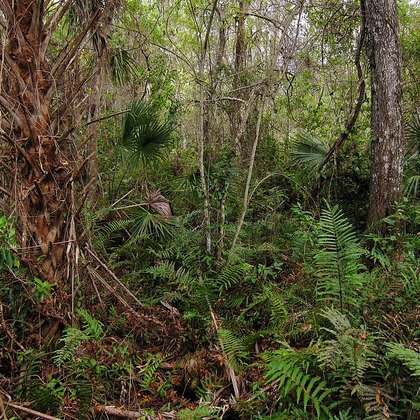
Scrub, open woodland, secondary forest, parks and gardens up to about 1800 metres. In Hawaii in wet and dry forest, in ground with introduced shrubs such as guava and ginger, and along forest edges and trails. It forages in the leaf litter for insects and fruit.
Where the bird is most often found, arranged by the USNVC — the vegetation classification of the United States and Canada — and CMECS for sea and coast.




Range and movements
Native to southeastern and central China, northern Vietnam and Laos. Introduced to Taiwan, Singapore, Japan and Hawaii. In Hawaii establishment began with cage birds freed in the Chinatown fire in Honolulu in 1900; birds were afterwards taken deliberately to the other islands. It now occurs on Kauaʻi, Oʻahu, Molokaʻi, Maui and the island of Hawaii, from the lowlands to montane forest.
- Resident
Where and when to look
Find it by ear rather than with binoculars: along a forest trail on Kauaʻi or at the edge of the Volcanoes area it sings from dense shrubbery. Stand still by such a thicket — it sometimes comes up onto an open branch for a few seconds. It sings most in the early morning and just before sunset.
Conservation
The IUCN places the species in the Least Concern (LC) category. In China trapping for the cage-bird trade is on a large scale and locally presses on numbers. On Taiwan hybridisation with the native Taiwan Hwamei is eroding the genetic distinctness of that species, a consequence of introductions in the 1980s. In Hawaii the population is large and self-sustaining; the effects on native forest birds have been little studied, though competition for food in the leaf litter is conceivable.
Scientific name
Garrulax canorus | (Linnaeus, 1758)
Linnaeus described the species in 1758 as Turdus canorus; its later placement in another genus puts author and year in parentheses. The type locality 'Bengal and China' was restricted in 1928 to Amoy in Fujian. The genus Garrulax was introduced in 1831 by René Lesson, from Latin garrulus 'chattering, noisy'. The species name canorus is Latin for 'melodious'. The name hwamei comes from Chinese huàméi, 'painted eyebrow'; the Dutch name says the same thing.