All species › Passerines › Laughingthrushes and allies › Greater Necklaced Laughingthrush
Greater Necklaced Laughingthrush | Pterorhinus pectoralis
Borstbandlijstergaai | Charlatán acollarado grande
The Greater Necklaced Laughingthrush is a large, long-tailed songbird of Himalayan and Southeast Asian forest that was released on Kauaʻi early in the twentieth century and has held on there. Within the area of this guide it occurs on that single Hawaiian island only, in wet lowland and hill forest along streams.
Voice
The song is a series of loud, clear whistles, shorter and less varied than that of the Hwamei, with which it shares the forest on Kauaʻi. Alongside it comes a rattling, cackling chatter by which the members of a party keep track of one another in dense cover; that sound is usually the first sign the species is near. Alarm calls are loud and strident, several birds calling at once.
No freely licensed recording has been found for this species yet; what to listen for is described below.
Identification
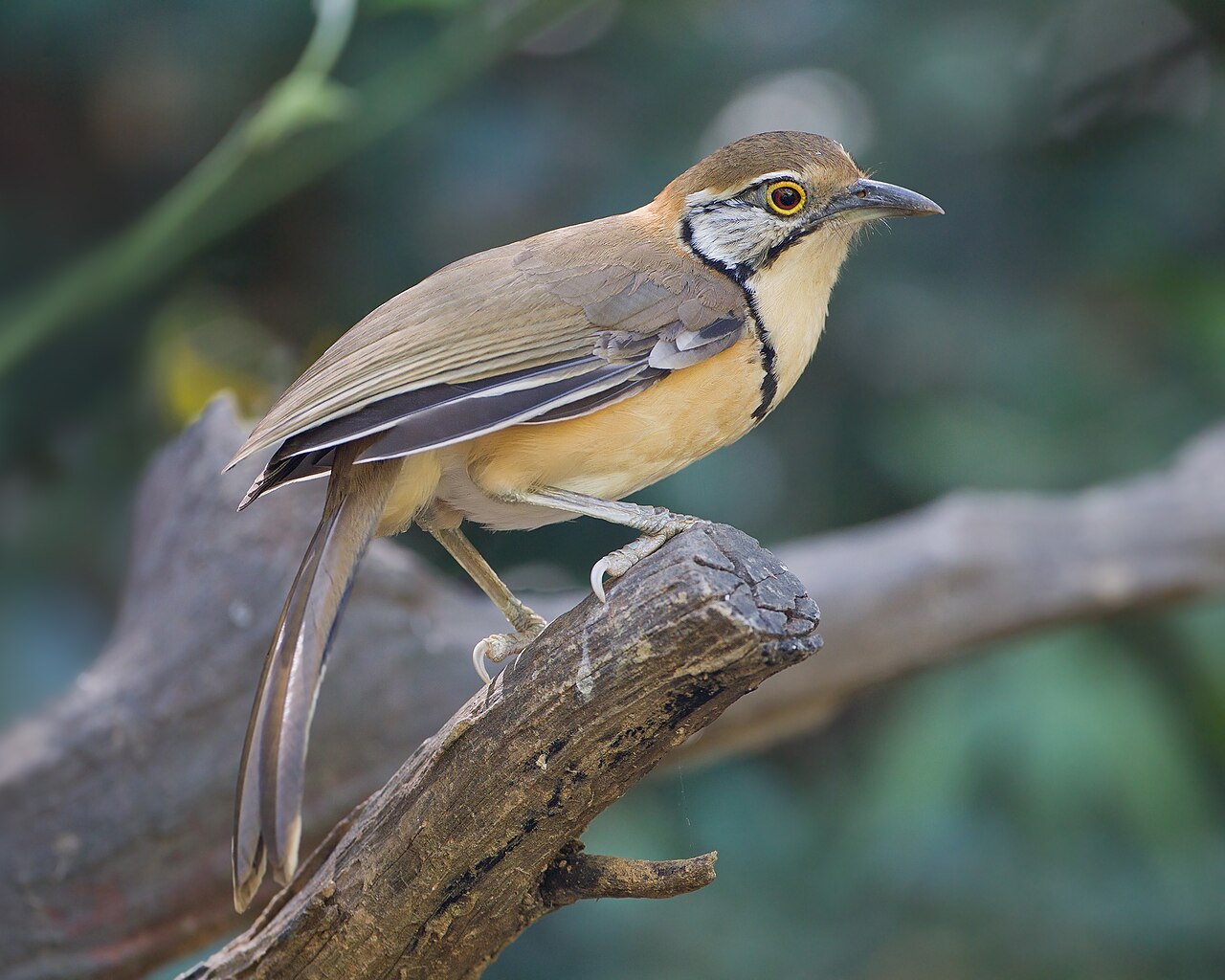
A heavily built bird with brown upperparts, cream-white underparts and a long, rounded tail with a pale band just before the tip. A black band crosses the breast and continues up the sides of the neck like a necklace. The white cheek patch is streaked and completely enclosed by black, which also runs through and behind the eye as a broad stripe. The eye itself is dark, the bill heavy and black, the legs stout. The sexes are alike.
Confusion species
On Kauaʻi the bird to confuse it with is the Hwamei, which is cinnamon-brown, lacks the black breast band and has a white eye-ring drawn out into a line behind the eye. Red-billed Leiothrix is much smaller, with a red bill and yellow throat. In Asia the Lesser Necklaced Laughingthrush is very similar, but has a paler, yellow to white eye and a cheek patch left open below; that species does not occur in North America.
Habitat
Moist forest in the lowlands and hills, often near running water, with a dense understorey in which it spends most of its time. On Kauaʻi this means wooded valleys and gulches of introduced trees and shrubs, forest edge, and the overgrown margins of trails and field boundaries. It forages mainly on and just above the ground, turning leaves and rummaging in litter, usually in parties of a handful of birds.
Where the bird is most often found, arranged by the USNVC — the vegetation classification of the United States and Canada — and CMECS for sea and coast.




Range and movements
The native range runs from Nepal and northeastern India east through Bhutan, Bangladesh, Myanmar, southern China, Thailand, Laos and Vietnam. The Hawaiian population goes back to birds released on Kauaʻi around 1918; they settled in the north and east of the island and have stayed there. The species has not established itself on the other Hawaiian islands, and the Kauaʻi range has barely expanded since.
- Resident
- Winter
- Passage
- dark = core range, pale = thinly spread
Where and when to look
Look for it on Kauaʻi along forest trails such as the Kuilau Ridge Trail or around Hanalei, early in the morning. Go by ear rather than by eye: the birds stay in cover and give themselves away by chattering before they cross. Stand still at a gap in the trail — a party normally crosses low, one bird at a time.
Conservation
In Asia the species is widespread and numerous and is listed as of least concern, though it is trapped for the cagebird trade in parts of China and Indochina. The Kauaʻi population is small and local and is not separately counted or managed. Little is known of its effect on the native Hawaiian birds; it feeds mainly on invertebrates and the fruit of introduced plants and lives at lower elevations than the remaining native forest birds.
Scientific name
Pterorhinus pectoralis | (Gould, 1836)
Gould described the species in 1836 as Ianthocincla pectoralis, from a specimen taken in Nepal; because it was later moved to another genus, author and year stand in parentheses. The genus Pterorhinus was introduced in 1868 by Robert Swinhoe, from Greek pteron 'feather' and rhis, rhinos 'nose': in these birds the nostrils are hidden under bristly feathers. The species name pectoralis is Latin for 'of the breast', after the black breast band, which the English name also records.