All species › Waterfowl › Ducks, swans and geese › Red-breasted Merganser
Red-breasted Merganser | Mergus serrator
Middelste zaagbek | Serreta mediana
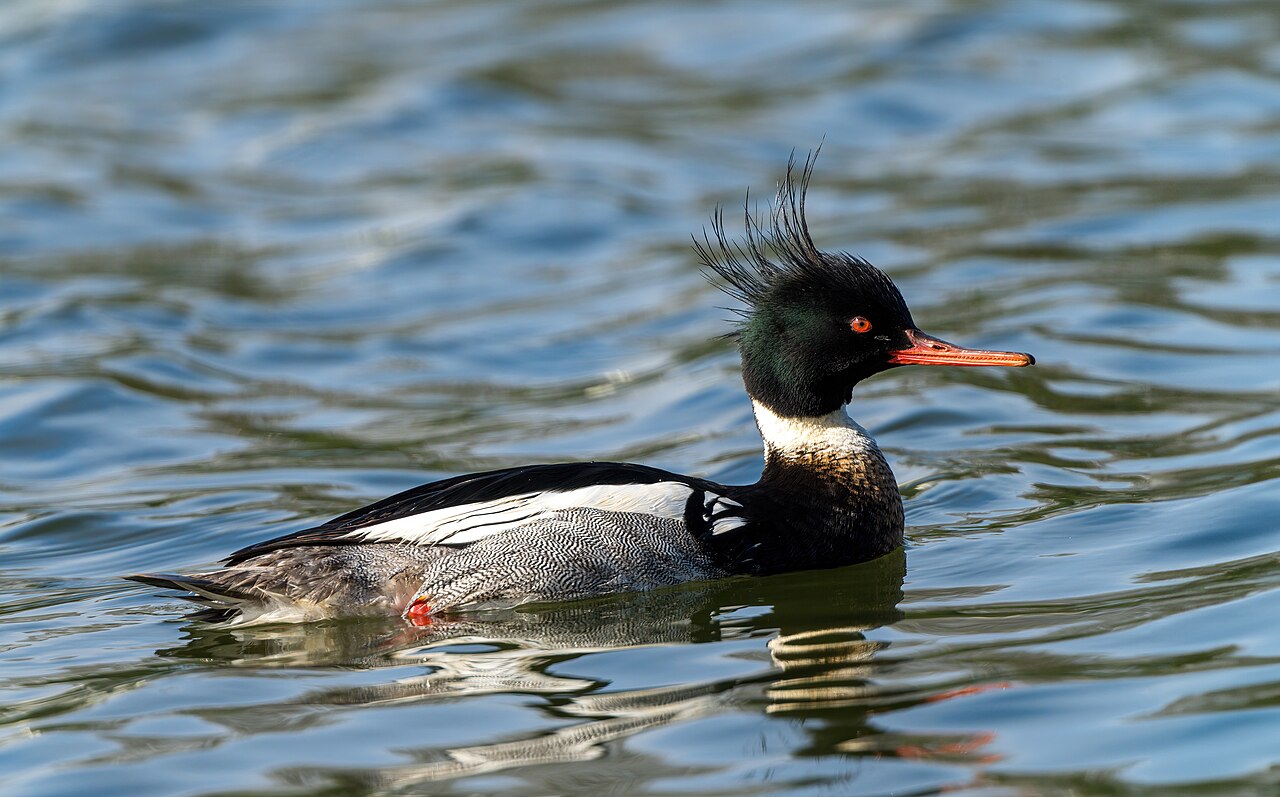
The Red-breasted Merganser is the most coastal of the three mergansers in this guide: it breeds closer to the sea than the other two and winters almost entirely on salt water. The male carries a glossy dark green head with a shaggy, double-pointed crest that streams backward, a white neck collar, and a long, thin, orange-red bill with an obviously serrated edge. Of the three mergansers it breeds furthest north and winters furthest south.
Voice
Outside courtship, Red-breasted Merganser is largely silent. Displaying males give a catlike meow, while females give a raspy, croaking call during display. In flight the female's call is a harsh gruk. Beyond that there is little to hear; most communication between pairs runs through posture and movement rather than sound.
Recording: Stanislas Wroza — CC BY-NC-SA 4.0 · Soppavann, Finland · xeno-canto
Identification
The male has a glossy dark green head with a shaggy, double-pointed crest, a white neck collar, a speckled rust-brown breast and greyish flanks with fine wavy markings, with a black back and red eyes. The female is grey-brown with a rust-brown head that shades gradually into a pale throat, with no sharp border — an important difference from Common Merganser. Both sexes have a long, thin, orange-red bill with an obviously serrated edge, built to hold slippery fish. In flight the shaggy, untidy crest stands out, along with a long thin neck and a fast, low flight close over the water.
Confusion species
The female is most often confused with that of Common Merganser (Mergus merganser): in Common Merganser the rust-brown head meets a clean white throat patch along a sharp line, while in Red-breasted Merganser that border fades gradually, with no sharp edge. Red-breasted Merganser is also slimmer, with a thinner neck. Hooded Merganser (Lophodytes cucullatus) is considerably smaller and has a short, dark bill lacking the obvious serrated edge of the other two mergansers.
Habitat
He breeds in the boreal forest on fresh, brackish and salt water, usually close to the coast, and further north also on open, wet tundra along the shoreline. In winter he is the most saltwater-bound of the three mergansers: sheltered bays, river mouths and open coastal sea, with a smaller number on large inland lakes. He hunts small fish ten to fifteen centimetres long, tracked down while swimming, sometimes in groups that herd fish together into shallow water.
Where the bird is most often found, arranged by the USNVC — the vegetation classification of the United States and Canada — and CMECS for sea and coast.





Range and movements
Breeds across nearly the whole boreal and Arctic reach of North America, from Alaska to Newfoundland and Greenland, further north than the other two mergansers. Winters along both coasts of the United States, on the Great Lakes and along the coast of Mexico, and reaches Cuba in smaller numbers. Migrants follow the coastline rather than any fixed inland corridor, so they appear earliest and in the greatest numbers at coastal sites.
- Resident
- Breeding (summer)
- Winter
- Passage
- dark = core range, pale = thinly spread
Where and when to look
Look for him in winter along open coastal water, harbours and river mouths, where he dives for fish in small groups; the shaggy, backswept crest is visible from a distance. In summer he is found mainly along northern coastlines, where pairs usually nest alone but sometimes near tern colonies.
Conservation
Partners in Flight estimates the world population at roughly 370,000 breeding birds; numbers are considered stable and the species is listed as Least Concern (LC). Because it breeds largely beyond the reach of people, in the boreal and Arctic north, it faces little direct pressure from habitat loss.
Scientific name
Mergus serrator | Linnaeus, 1758
Linnaeus described the species in 1758 as Mergus Serrator, in the same genus it still occupies, hence no parentheses around author and year. Mergus is Latin for 'diver', a name already used by the Roman writer Pliny for a diving waterbird. serrator is Latin for 'sawyer', after the sharp, saw-like serrated edge of the bill — a feature that gave the mergansers their English nickname, 'sawbill'. The type locality lies in Europe, restricted by Linnaeus himself to Sweden in 1761.