All species › Waterfowl › Ducks, swans and geese › Hooded Merganser
Hooded Merganser | Lophodytes cucullatus
Kokardezaagbek | Serreta capuchona
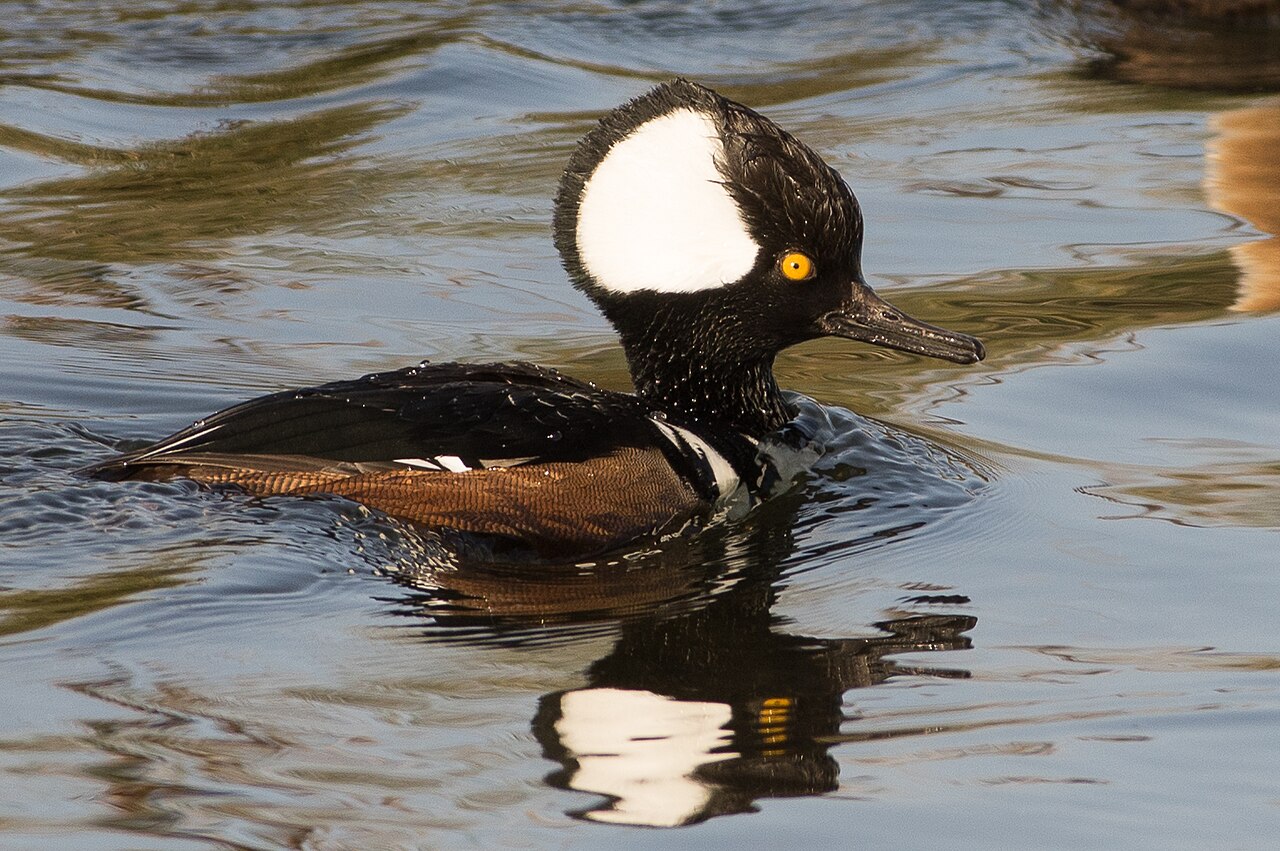
The Hooded Merganser is the smallest of the three mergansers in this guide, and the only one that breeds exclusively in North America. The male carries a large, fan-shaped crest that he can raise into a round white shield edged in black, or flatten to a thin stripe. He nests in tree cavities above wooded ponds, sharing that habit with the Wood Duck, with which he also shares much of his habitat.
Voice
Outside the courtship season the Hooded Merganser is a quiet bird. Displaying males give a deep, rolling sound closely resembling the call of a frog — in the swamps of Georgia this earned them the nickname 'frog-duck'. The female answers with a hoarse gack, and gives a rough croo-croo-crook in flight or when calling ducklings together, much as many sea ducks do. When flushed the wings also produce a loud whirring sound, often the first sign of the bird before any call is heard.
Recording: Dan Lane — CC BY-NC-SA 4.0 · New York (near Lansing), Tompkins County, New York, United States · xeno-canto
Identification
The breeding male has a black head with a large, fan-shaped white patch edged in black, chestnut flanks crossed by two vertical black-and-white bars in front of the wing, a black back and a thin, dark bill. The eyes are bright golden yellow. The female is grey-brown with a broader, shaggy crest in dull cinnamon and a grey bill with a yellow-orange edge to the lower mandible. Juveniles closely resemble the female. In flight the Hooded Merganser is recognisable by its fast, direct wingbeats and compact, boxy silhouette, the crest held flat against the head.
Confusion species
The female is most often confused with the female Wood Duck (Aix sponsa), which is also crested and close in size but has a shorter, broader bill and a white, teardrop-shaped eye-ring that Hooded Merganser lacks. Of the two other mergansers in this guide, Hooded Merganser is always the smallest and most compact: both Red-breasted Merganser (Mergus serrator) and Common Merganser (Mergus merganser) have a long, thin, orange-red bill with an obvious serrated edge, against the short, dark bill of Hooded Merganser. At a distance the three females can be told apart by size alone: Hooded Merganser is barely larger than a teal, Red-breasted Merganser noticeably bigger, and Common Merganser the largest of the three.
Habitat
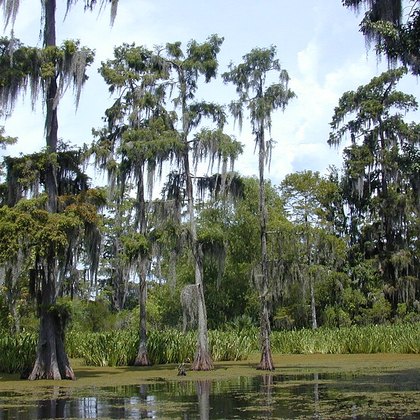
He breeds on wooded ponds, slow streams and beaver ponds with clear, shallow water, hunting by sight for small fish, aquatic insects and crayfish — a broader diet than the other two mergansers take. In winter he seeks shallow fresh and brackish bays, tidal creeks and sheltered river mouths, often right along the edge of the ice. He avoids open, rough water; what he needs is cover from trees or bankside vegetation and water clear enough to see his prey. A nest cavity requires a tree, dead or alive, usually three to fifteen metres up with an opening eight to thirteen centimetres wide.
Where the bird is most often found, arranged by the USNVC — the vegetation classification of the United States and Canada — and CMECS for sea and coast.




Range and movements
Breeds in two separate regions: in eastern North America from Nova Scotia and Ontario south through the Great Lakes to the forested swamps of the southeast, and separately in the northwest from Washington and British Columbia to Idaho. Across the southeast and along the west coast he is largely resident; northern breeders move south in winter to the ice-free southeastern states and the California coast. Since the early twentieth century the species has greatly expanded its range and numbers, helped by forest recovery and the large-scale use of nest boxes.
- Resident
- Breeding (summer)
- Winter
- Passage
- dark = core range, pale = thinly spread
Where and when to look
Look for him in winter on small, sheltered wooded ponds and beaver marshes, where he often sits tucked among overhanging branches until you are right in front of him. A displaying male is identifiable by his behaviour: he pumps his head, spreads the crest into a full fan and gives his rolling, frog-like call.
Conservation
Partners in Flight estimates the world population at well over 1.1 million birds, growing steadily at around five per cent a year between 1966 and 2019 — Hooded Merganser is listed as Least Concern (LC) and is rated a species of low conservation concern. Roughly 95,000 birds are shot each year by hunters in the United States, with no noticeable effect on numbers. His dependence on tree cavities and nest boxes remains a concern if forest loss continues.
Scientific name
Lophodytes cucullatus | (Linnaeus, 1758)
Linnaeus described the species in 1758 as Mergus cucullatus, among the mergansers; since Reichenbach placed it in a new genus in 1853, author and year stand in parentheses. The genus Lophodytes is Greek for 'crested diver', from lophos ('crest') and dytes ('diver'). cucullatus is Latin for 'hooded' or 'wearing a hood', after the raisable crest; the Dutch name refers to a kokarde, the round rosette-shaped badge the male's raised crest resembles. The type locality is 'Virginia and Carolina'.