All species › Waterfowl › Ducks, swans and geese › Smew
Smew | Mergellus albellus
Nonnetje | Serreta chica
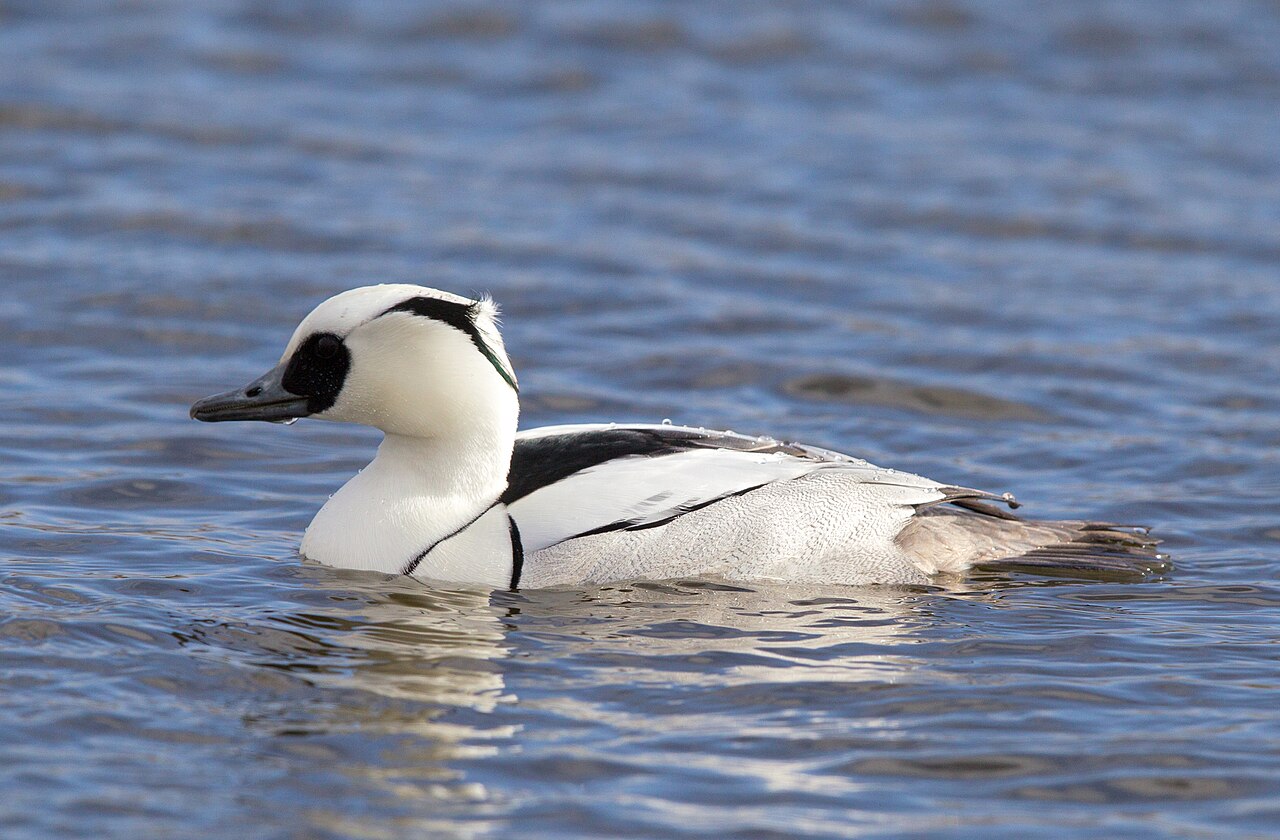
The Smew is the smallest merganser in the world and the only one that is mostly white from head to tail: at a distance the male looks almost entirely white, with only a black mask around the eye and fine black lines on the flanks. It is originally a Eurasian breeding bird, and in North America it is known only as a scarce but regularly returning winter visitor to the western Aleutians. Elsewhere on the continent it turns up only exceptionally.
Voice
The Smew is a quiet duck, barely heard outside courtship. In courtship the male gives a soft, crackling rattle, often paired with a short, low whistled note, while the female answers with a hoarse, rasping croak. At the North American wintering sites, where the birds rarely or never display, the species is almost entirely silent, and only a flock lifting off gives away its presence.
Recording: Stanislas Wroza — CC BY-NC-SA 4.0 · Kaamanen, Finland · xeno-canto
Identification
The male is mostly white with a small black mask around the eye, a black nape and back, and a few narrow, curved black lines on an otherwise white flank. The female and the male in eclipse plumage are grey-bodied with a chestnut head and crown and a sharply contrasting white cheek and throat. Both sexes have a short, thin, serrated bill, typical of the mergansers, and a small crest that can be raised. In flight what stands out most is how small and compact the species is, with quick wingbeats, much lighter built than the larger mergansers.
Confusion species
The female and eclipse male are most quickly confused with females of the far larger Hooded Merganser, but Smew is smaller and more lightly built, with a cleaner white cheek patch against the chestnut head and a less conspicuous crest. From a distance a male Smew's mostly white plumage can suggest a male Bufflehead, but the pattern is entirely different: Smew has a narrow black eye mask rather than a large solid head patch, and entirely lacks Bufflehead's glossy green-and-purple head colour. It cannot be confused with any of the other sea ducks covered in this region.
Habitat
On its Eurasian breeding grounds the Smew nests in cavities in old trees by clear lakes and slow rivers in the boreal conifer forest, like the goldeneyes to which it is closely related. In North America the species is known only as a winter visitor, where on the western Aleutians it uses sheltered bays and inter-island coastal waters. No settled habitat has been established on the mainland of the continent: scattered records come from both coastal waters and inland lakes and ponds.
Where the bird is most often found, arranged by the USNVC — the vegetation classification of the United States and Canada — and CMECS for sea and coast.


Range and movements
Breeds from Scandinavia across Siberia to the Pacific and winters in North Africa, South and East Asia, and parts of western Europe. In North America it reaches the western Aleutian Islands of Alaska annually in small, fluctuating numbers, the nearest stepping stone from Asia; further east and south across the continent it is known only from scattered, irregular records, from the Great Lakes to the northeast coast, too sparse to count as an established range.
Where and when to look
The best and almost only regular chance in North America is in winter on the western Aleutians, among flocks of Buffleheads and other small diving ducks in a sheltered bay. The almost entirely white male cannot then be confused with any other North American duck; females need closer attention and are best recognised by the combination of a chestnut head and a sharply white cheek.
Conservation
Least Concern (LC) worldwide, with a large Eurasian population thought to be stable. In North America the species is a vagrant with no breeding population of its own, so its conservation here depends entirely on the health of its Asian breeding and staging grounds, not on conditions on the continent itself.
Scientific name
Mergellus albellus | (Linnaeus, 1758)
Linnaeus described the species in 1758 as Mergus Albellus, among the mergansers; because it was later placed in another genus, author and year stand in parentheses. The genus Mergellus was introduced in 1840 by Prideaux John Selby, as a diminutive of Mergus, Latin for 'diver' — so the genus name means 'little merganser', after its smaller size compared with the larger species in that genus. The species name albellus is itself also a diminutive, of Latin albus, 'white' — 'little white one'. As type locality Linnaeus gave 'Europe', later restricted to the Mediterranean near Smyrna, based on the travel account of Fredrik Hasselquist.