All species › Passerines › Finches, euphonias and allies › Red Crossbill
Red Crossbill | Loxia curvirostra
Kruisbek | Piquituerto común
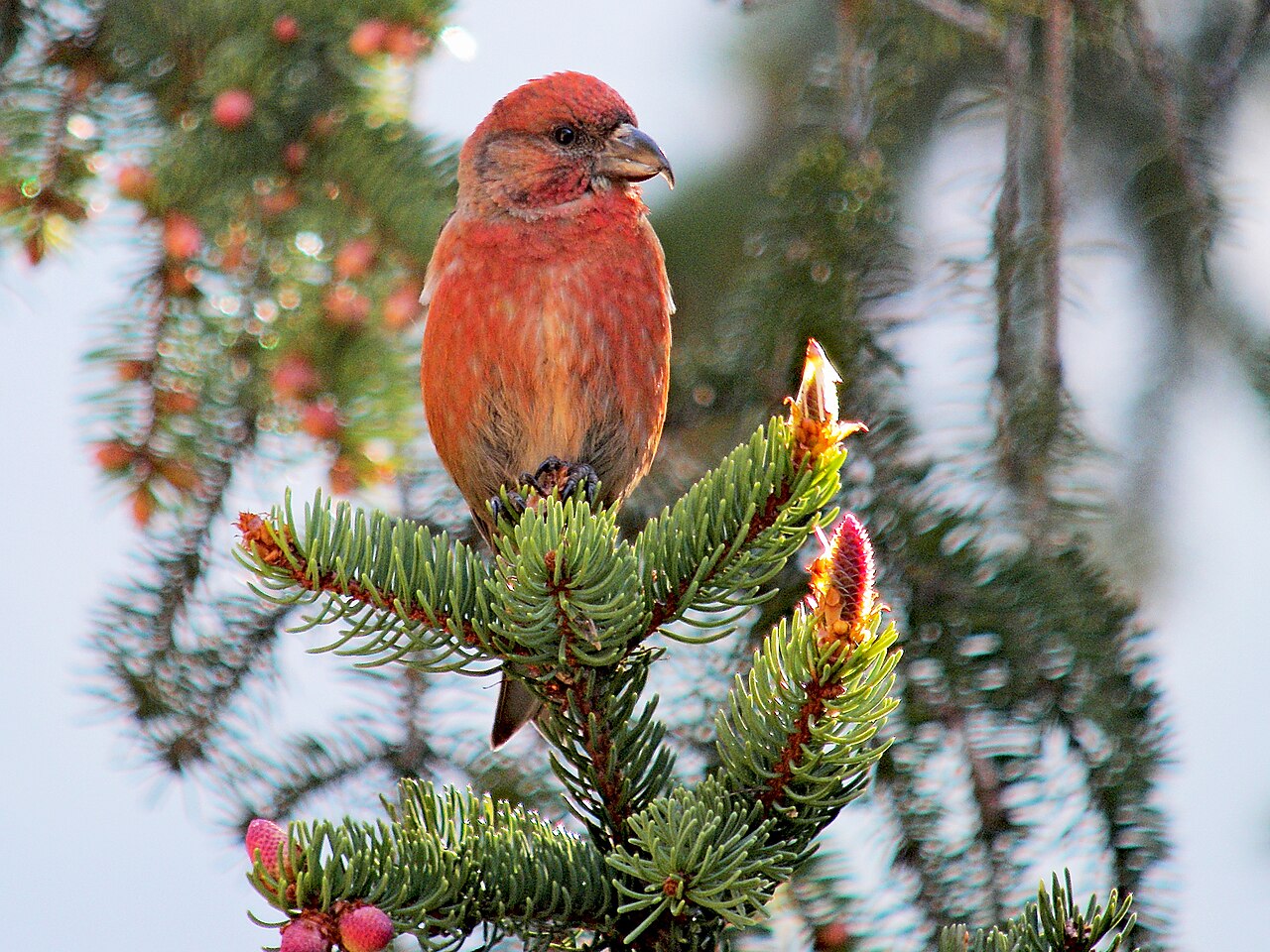
The Red Crossbill is a heavy conifer finch whose bill tips cross each other: with them it prises cone scales apart and lifts out the seed. In North America it is not one uniform bird but a set of call types, each with its own bill size, its own flight call and its own preferred cone.
Voice
The flight call is a hard, low kip-kip or jip-jip, given in twos or threes, and sounds heavier and fuller than the thin call of White-winged Crossbill. Its exact quality differs by call type and separates better on a sonogram than by ear; ten types have been described in North America. The song strings those same call notes together with rattles, trills and short squeaks, from the top of a conifer or in a slow song flight.
Recording: Stanislas Wroza — CC BY-NC-SA 4.0 · Plateau de Beille, France · xeno-canto
Identification
The male is brick red to orange-red over head, breast and rump, with dark brown wings and tail and no wingbars. The female is olive-green to green-yellow, darkest on the back and yellowest on the rump. Juveniles are greyish brown with heavy streaking on breast and flanks. The bill is thick and short, its tips overlapping; the tail is short and forked, the body stocky, the head large. Across call types bill size in particular, and body size to a lesser degree, varies considerably.
Confusion species
White-winged Crossbill has two broad white wingbars on a black wing and a slimmer bill; young Red Crossbills may show narrow buff wingbars, but the wing stays brown. Cassia Crossbill of southern Idaho cannot be separated on plumage and is told only by its lower, drier call and heavier bill. Pine Grosbeak is larger and longer-tailed, with a short rounded bill that does not cross. Rosefinches have a conical, uncrossed bill and streaked underparts.
Habitat
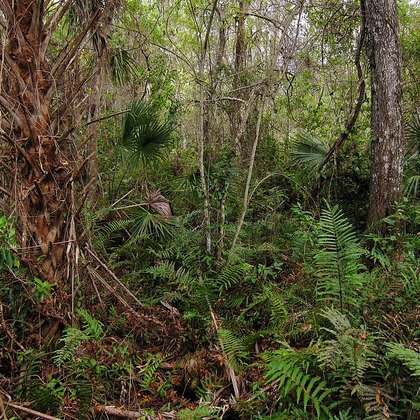
Conifer forest with a good cone crop: spruce forest in the boreal zone, Douglas-fir, hemlock and pine in the west, pinyon (a low-growing pine of the dry southwestern foothills)-juniper and dry pine woodland in the Great Basin and Southwest, and pine-oak forest into the mountains of Mexico and Central America. The cone species present decides which call type occurs. Outside the breeding season it also visits planted conifers in parks and gardens, and comes to roadsides and road salt to take grit and minerals.
Where the bird is most often found, arranged by the USNVC — the vegetation classification of the United States and Canada — and CMECS for sea and coast.





Range and movements
Resident in Alaska and across boreal Canada, in the coastal ranges and Rocky Mountains, in the Appalachians and the Northeast, and in the montane forests of Mexico south through Guatemala and Honduras to Nicaragua. A resident population also holds the Sierra San Pedro Mártir of Baja California. There is no migration in the ordinary sense; when a crop fails, flocks move hundreds to thousands of kilometres and appear in winter in the Midwest, the Great Plains and the southeastern states. Nesting may occur in almost any month, concentrated from late winter to late summer.
- Resident
- Breeding (summer)
- Winter
- Passage
- dark = core range, pale = thinly spread
Where and when to look
Go by sound first: flocks pass high overhead calling continuously, so you hear them before you see them. A recording makes the call type determinable afterwards, which tells you more in this species than a photograph does. Then look under cone-bearing conifers for freshly bitten cones and loose scales, and check road verges and salted spots, where flocks sit low on the ground.
Conservation
The species is listed as Least Concern (LC) and its range is vast, but numbers swing so widely that trends by region can barely be measured. The individual call types are another matter: some have small ranges and are tied to a single cone species, so logging, fire and bark beetle outbreaks can hit them hard. The South Hills call type is now recognised as a separate species; for several other types the status is insufficiently known.
Scientific name
Loxia curvirostra | Linnaeus, 1758
Linnaeus described the species in 1758 as Loxia curvirostra; author and year stand without parentheses because it is still in the genus he used. Loxia comes from Greek loxos 'slanting, crosswise'. Curvirostra is Latin for 'curve-billed', from curvus 'curved' and rostrum 'bill'. The Dutch name names the same feature: the two halves of the bill cross at the tip, in some birds to the left and in others to the right.