All species › Parrots › African and New World parrots › Red-crowned Amazon
Red-crowned Amazon | Amazona viridigenalis
Groenwangamazone | Amazona Tamaulipeca
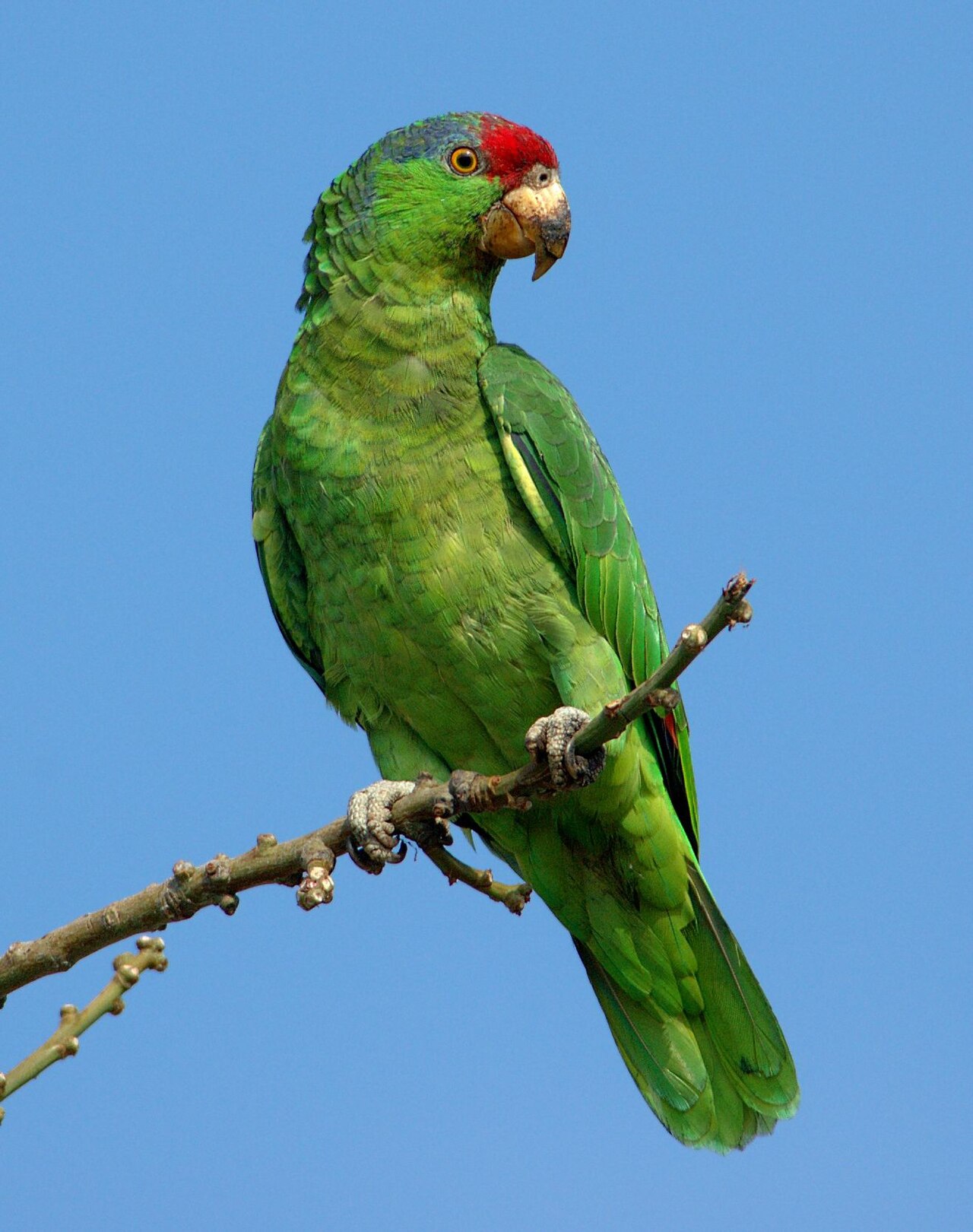
The Red-crowned Amazon is a stocky, mostly green parrot with a bright red forehead and crown and a dark blue streak behind the eye. Native to the lowland forests of northeastern Mexico, it is threatened there by trapping and logging, while cage birds that escaped from that same trade have built solid populations in this region, chiefly around Los Angeles and in the Rio Grande Valley of Texas.
Voice
A harsh, far-carrying screech, loudest in the morning and evening as a flock moves to a new feeding site. Birds call to each other continuously in flight; feeding in a fruiting tree the group turns quiet, with only soft, mumbling notes.
Recording: Paul Marvin — CC BY-NC-SA 4.0 · Eagle Rock neighborhood, Los Angeles, Los Angeles County, California, United States · xeno-canto
Identification
Mostly green with a bright red forehead and crown, a dark blue streak behind the eye and pale green cheeks; red and blue patches under the wing show only in flight, and the tail carries a pale yellow tip. The bill is horn-coloured, and the eye is ringed with white. The iris is bright yellow to deep red in adults, grey in young birds. Male and female do not differ visibly.
Confusion species
Lilac-crowned Amazon (Amazona finschi), which shares the same southern California neighbourhoods and often flies in mixed flocks, has a maroon forehead with a pale blue, not green, crown and nape. Mitred Parakeet and its Psittacara relatives are clearly smaller and slimmer, with a long tail the amazons lack. By voice the two amazon species are barely told apart; crown colour settles it.
Habitat
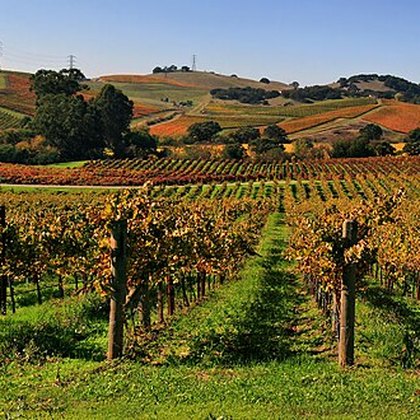
Lowland forest in its native range; in this region mainly cities and suburbs with tall old shade trees, palms and fruiting species. For the nest it chooses tree cavities, in town often in old palms or large street trees.
Where the bird is most often found, arranged by the USNVC — the vegetation classification of the United States and Canada — and CMECS for sea and coast.


Range and movements
Its original and only natural range lies in the lowlands of northeastern Mexico, in the states of Tamaulipas and Nuevo León; that falls outside the guide area. In North America it is naturalised from escaped and released cage birds: around Los Angeles and San Diego about three thousand birds have lived since the 1960s, about seven hundred in the Rio Grande Valley of Texas, and smaller breeding groups have been recorded in south Florida and on Oʻahu, Hawaii. It does not migrate: the birds stay in the same area all year.
- Resident
- Breeding (summer)
- Winter
- Passage
- dark = core range, pale = thinly spread
Where and when to look
At dawn or dusk, look for a flock screeching its way to a regular feeding or roost tree; at that moment the red crown shows well against the light. During the day, feeding in a fruiting tree, the species is far quieter.
Conservation
In its native range in Mexico the species is classed as Endangered (EN), with a declining population from illegal trapping for the cage-bird trade and continued logging of the lowland forest where it breeds. The naturalised populations in California, Texas, Florida and Hawaii fall outside that assessment and are increasing there; they now make up a substantial share of the species' total numbers worldwide.
Scientific name
Amazona viridigenalis | (Cassin, 1853)
Cassin described the species in 1853; because it was later moved to another genus, author and year stand in parentheses. The genus Amazona was introduced by Lesson in 1830, a Latinised form of the name Buffon gave these parrots in the eighteenth century in the mistaken belief that they all came from the Amazon region — this species in fact does not. viridigenalis is Latin for 'green-cheeked', after the pale green cheek feathers.