All species › Woodpeckers and allies › Woodpeckers › Red-naped Sapsucker
Red-naped Sapsucker | Sphyrapicus nuchalis
Roodneksapspecht | Chupasavia nuquirrojo
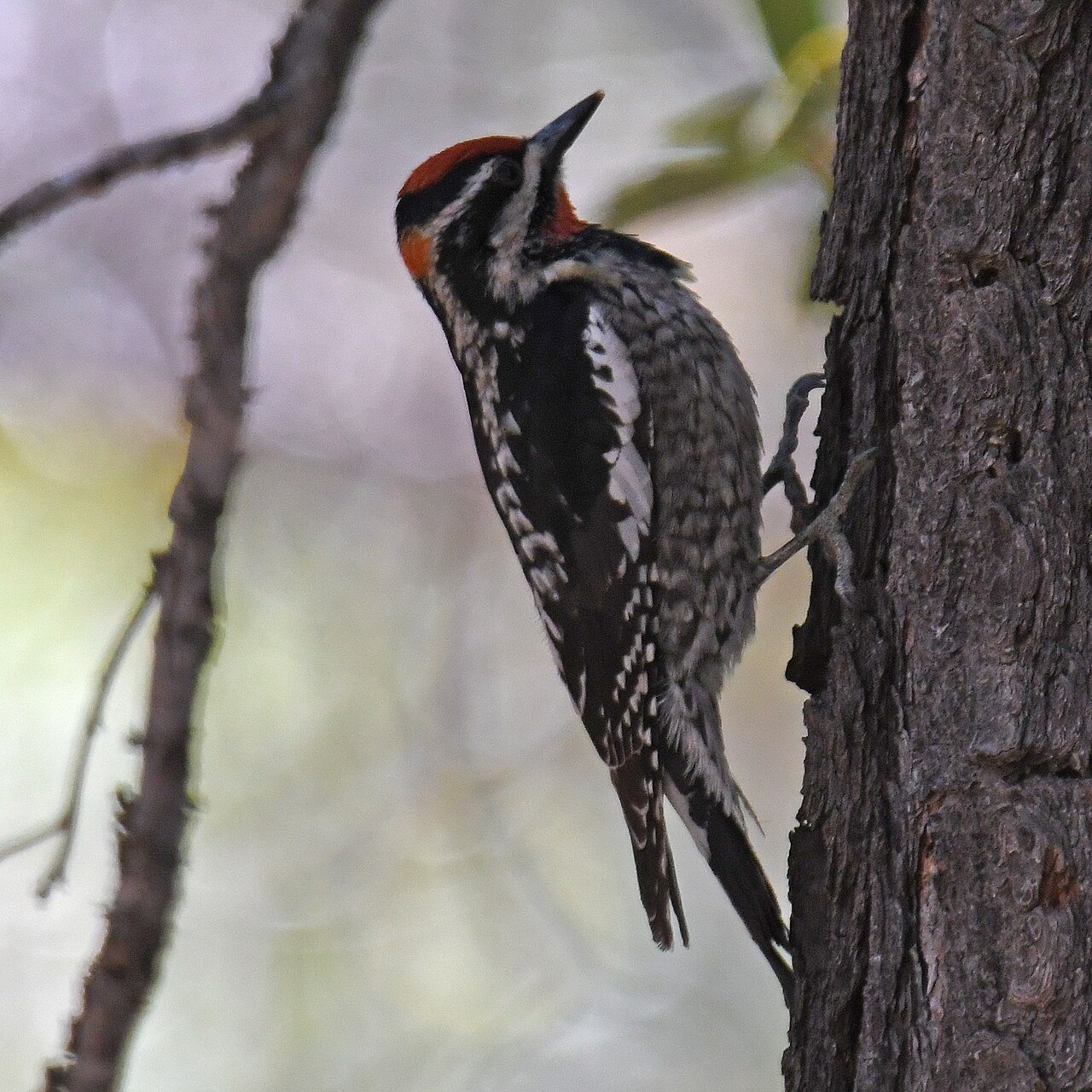
The Red-naped Sapsucker replaces the Yellow-bellied Sapsucker in the interior mountains of the west, sharing a similar pattern but with a red rather than white nape patch and more red bleeding into the black head stripes.
Voice
The call is a nasal, mewing note similar to that of the Yellow-bellied Sapsucker; drumming follows the same stuttering rhythm, with a short introduction followed by irregular strikes.
No freely licensed recording has been found for this species yet; what to listen for is described below.
Identification
Black-and-white barred back, a red forecrown and a red nape patch, a broad white wing stripe and a pale yellow belly. The male has an entirely red throat, the female a white throat edged with red.
Confusion species
Confusion arises mainly with the Yellow-bellied Sapsucker (white rather than red nape) and the Red-breasted Sapsucker (entirely red head and breast); intergrades occur where the two ranges meet.
Habitat
Aspen woodland and mixed conifer forest in the mountains and Great Basin of the interior west.
Where the bird is most often found, arranged by the USNVC — the vegetation classification of the United States and Canada — and CMECS for sea and coast.


Range and movements
Breeds in the Rocky Mountains and the Great Basin, from southern Canada to the south-western United States; winters in the south-western US and Mexico.
- Resident
- Breeding (summer)
- Winter
- Passage
- dark = core range, pale = thinly spread
Where and when to look
Look for rows of sap wells in high-elevation aspen stands; the red nape immediately separates it from the Yellow-bellied Sapsucker where the two ranges could otherwise touch.
Conservation
Not threatened; dependent on aspen stands, which are locally under pressure from changing forest management and climate.
Scientific name
Sphyrapicus nuchalis | Baird, 1858
Baird described the species in 1858 directly within the genus Sphyrapicus, so author and year stand without parentheses. Nuchalis is Latin for 'of the nape', after the red nape patch.