All species › Woodpeckers and allies › Woodpeckers › Red-breasted Sapsucker
Red-breasted Sapsucker | Sphyrapicus ruber
Roodborstsapspecht | Chupasavia pechirrojo
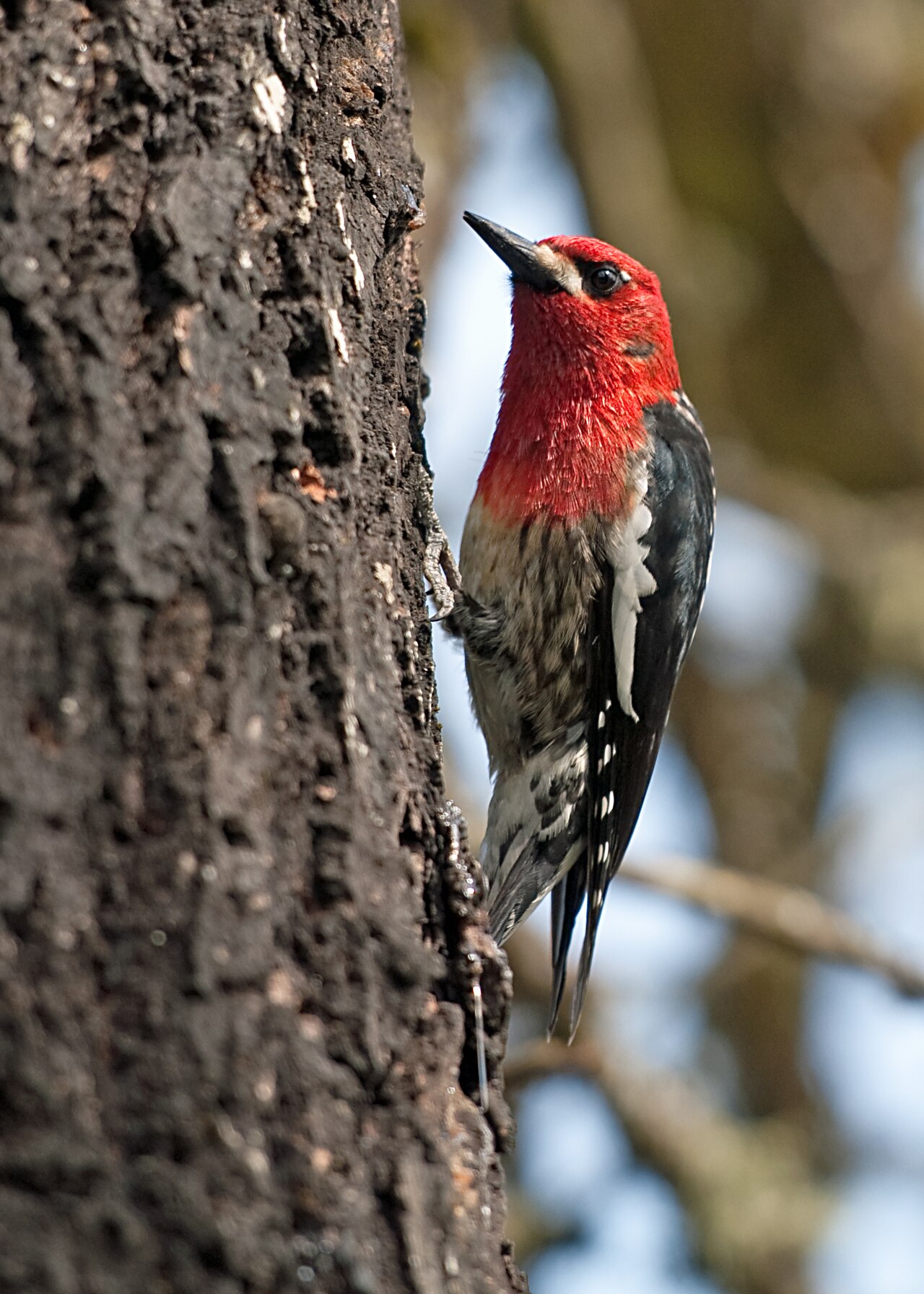
The Red-breasted Sapsucker is the sapsucker of the wet conifer forests along the Pacific coast, from south-eastern Alaska to California: a woodpecker with an entirely red head, throat and breast that contrasts sharply with the black back and long white wing patch. Like all sapsuckers it drills neat rows of holes in bark and keeps returning to lap up the welling sap — and the insects it attracts. These sap wells are used heavily by other animals, from hummingbirds to squirrels.
Voice
It is not a conspicuous singer. The most frequently heard call is a nasal, mewing wee-ah or cheer, reminiscent of a complaining cat; encounters around the sap wells and courtship bring chattering series and shrill squeals. Its drumming has the pattern typical of sapsuckers: first a short, rapid roll, then a few separate, slowing taps, like a message in Morse code. In spring it likes to drum on hollow branches, road signs or gutters that carry far.
Recording: Denise Wight — CC BY-NC-SA 4.0 · Westwood, Plumas County, California, United States · xeno-canto
Identification
A medium-sized woodpecker with the head, throat and breast uniformly dark red, with only a pale smudge at the base of the bill. Back and wings are black with pale spots or bars on the back, and on the closed wing a long white stripe formed by the white coverts stands out; in flight the white rump is also obvious. The belly is yellowish to off-white, the flanks lightly spotted. Male and female are virtually alike. In their first summer young birds are brownish-black on the head without red, but already show the white wing patch that marks all sapsuckers.
Confusion species
Red-naped Sapsucker has a black-and-white striped head with red only on the forehead, nape and throat, and a black breast band; where the two species meet, in the Cascades, the Sierra Nevada and interior British Columbia, hybrids regularly occur with a red head through which faint white and black stripes still show. Such birds cannot always be assigned with certainty. Southern Red-breasted Sapsuckers also show the head stripes faintly. Hybrids with Yellow-bellied Sapsucker are rare. Red-headed Woodpecker, which occurs in the west only as a vagrant, has a white belly and large white secondaries.
Habitat
Moist conifer forest of pine, hemlock, Douglas-fir, fir and spruce, both old growth and younger second growth, preferably with broadleaved trees such as alder, willow and aspen mixed in, in which it drills its sap wells. It breeds from sea level to about 2,650 metres and excavates its nest cavity in dead trees or in the dead parts of living trees. It also uses orchards and open strips beneath power lines. In winter it moves to mixed woodland, parks, gardens and orchards in the milder coastal lowlands.
Where the bird is most often found, arranged by the USNVC — the vegetation classification of the United States and Canada — and CMECS for sea and coast.

Range and movements
It breeds from south-eastern Alaska south along the coast of British Columbia, including Vancouver Island and Haida Gwaii, and through western Washington and Oregon to California, where it inhabits the Coast Ranges and the Sierra Nevada. The northern subspecies ruber lives from Alaska to Oregon, the southern daggetti from southern Oregon through California. Northern birds and those from higher breeding areas move south or down to the lowlands in winter; a few reach northern Baja California.
- Resident
- Breeding (summer)
- Winter
- Passage
- dark = core range, pale = thinly spread
Where and when to look
Look for neat horizontal rows of small holes in the bark of alders, willows or conifers: anyone waiting by such a tree will sooner or later see the bird return to keep the holes open and lap up the sap. At the same time watch for Rufous Hummingbird, which often hangs around such trees and in spring lives partly on the sap. In winter it is most often seen in Californian gardens and orchards, where it can sit quietly and inconspicuously on a trunk.
Conservation
The IUCN rates the species as Least Concern (LC). Partners in Flight estimates the breeding population at about 2.8 million birds, and according to the Breeding Bird Survey numbers remained stable or increased slightly between 1968 and 2015. It was once regarded as a pest in orchards and shot, but legal protection has put an end to that. Locally, the removal of dead trees in forest management can limit the number of suitable nest sites.
Scientific name
Sphyrapicus ruber | (Gmelin, 1788)
Johann Friedrich Gmelin described the species in 1788 as Picus ruber; because it has since been moved to another genus, author and year stand in parentheses. Gmelin wrongly gave Cayenne in French Guiana as its origin; the type locality was later corrected to Nootka Sound on Vancouver Island, where James Cook's expedition collected birds. Sphyrapicus, introduced by Spencer Baird in 1858, combines the Greek sphura 'hammer' with picus 'woodpecker'; ruber is Latin for 'red', after the head and breast.