All species › Passerines › Bulbuls › Red-whiskered Bulbul
Red-whiskered Bulbul | Pycnonotus jocosus
Roodoorbuulbuul | Bulbul orfeo
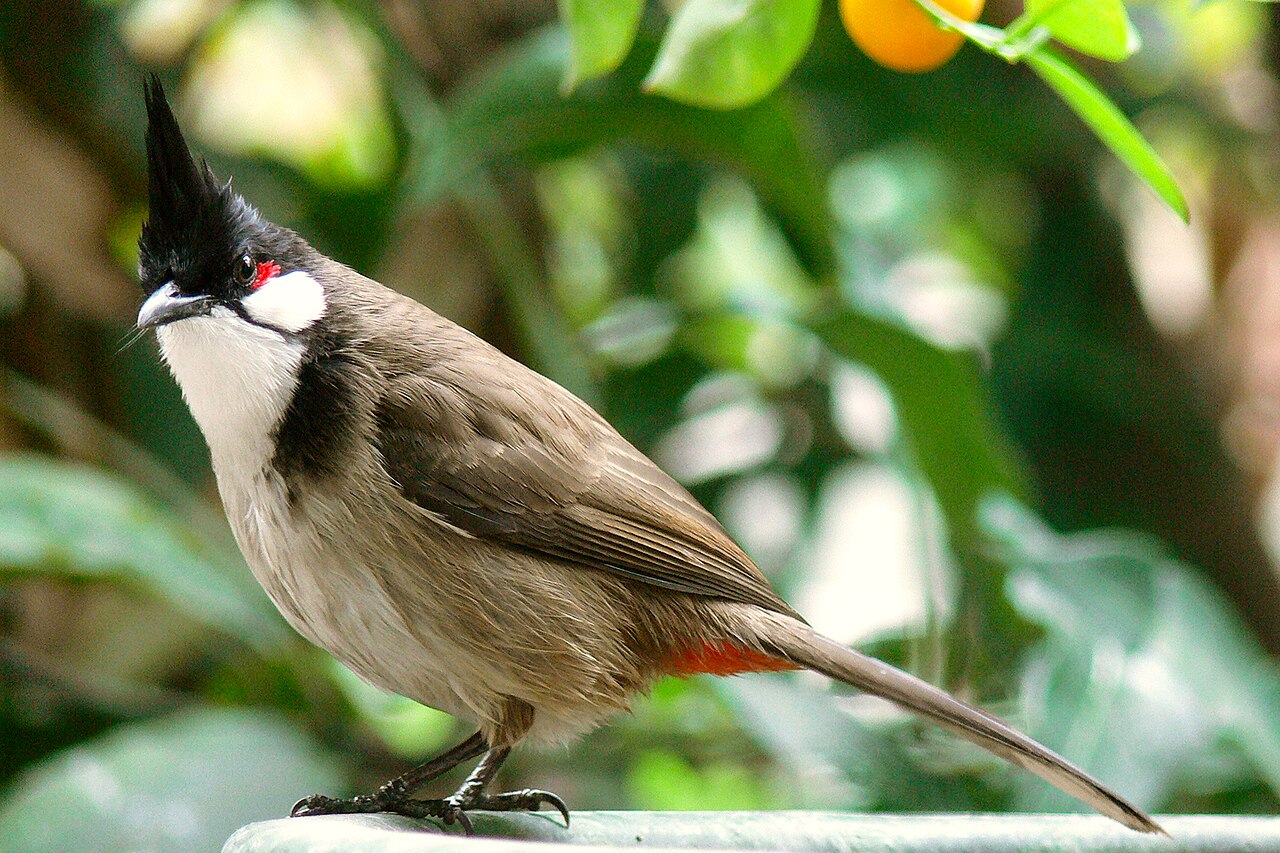
The Red-whiskered Bulbul is recognisable at once: brown and white, with a pointed black crest, a white cheek with a black stripe below it and a small crimson streak behind the eye — the red whisker of its name. Under the tail sits a second patch of red. It comes from South and Southeast Asia and here lives only where people do: on Oʻahu and in a handful of neighbourhoods south of Miami.
Voice
A loud, cheerful chatter of clear phrases of three to five notes, written in English as kink-a-joo or pettigrew, repeated from a wire or a treetop from first light onward. The contact call is a short, sharp pit; at any alarm a harsh, blaring rattle follows. Parties answer each other from garden to garden, so that a street rings all morning. In parts of its own range males are caught for precisely this voice and entered against one another in singing contests.
Recording: JJSUN — CC BY-NC-SA 4.0 · 三门江森林公园,Sanmenjiang National Forest Park (Southeast Gate) (near Liu Zhou Shi), Guang Xi Zhuang Zu Zi Zhi Qu, China · xeno-canto
Identification
Seventeen to twenty-three centimetres, slim, with a long white-tipped tail. Brown above, white below; the head is black with a tall pointed crest usually held erect, and beneath it lies a white cheek patch closed off by a black moustache stripe that continues onto the side of the breast as a black bar. The red streak behind the eye is small and visible only at close range; the feathers under the tail are crimson. Male and female are alike. Young birds lack the red streak, have a lower crest and buff rather than red feathering under the tail.
Confusion species
On Oʻahu the Red-vented Bulbul (Pycnonotus cafer) is far more numerous: darker and scaly, with a black head without a white cheek, a white rump and the same red vent — the head pattern decides. In Florida the confusion is rather with the Northern Mockingbird, which is grey, has no crest and shows white wing patches in flight. The Cedar Waxwing also has a crest, but is silky grey-brown with a black mask and a yellow tail band, and in winter it sits silently in flocks in the trees instead of calling loudly from a wire.
Habitat
Gardens, parks, hedges, orchards, roadsides and the edges of secondary scrub — anywhere something is in fruit the year round. On Oʻahu it lives from the city districts up into the valleys and the foothills of the Waianae range. Closed native forest and open country without cover it avoids. Where it lives, it lives close to people: in both areas it has never moved beyond the settled and planted zone.
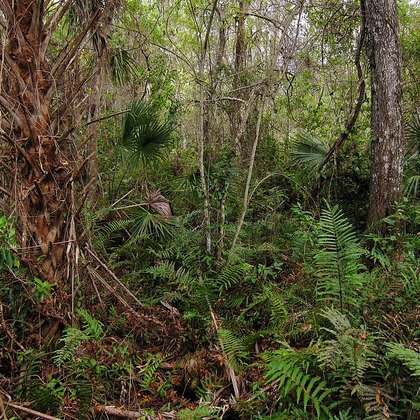
Where the bird is most often found, arranged by the USNVC — the vegetation classification of the United States and Canada — and CMECS for sea and coast.




Range and movements
Its own range runs from India and Sri Lanka through southern China to Indochina and lies outside this map. In North America there are two settled populations, both out of the cage-bird trade: in 1960 a small group escaped from an aviary at Kendall, south of Miami, and that population has stayed within an area of a few square kilometres ever since. On Oʻahu the first birds were seen on 9 July 1965 in Makiki Heights above Honolulu; from there it has slowly filled the island — first the Manoa and Nuuanu valleys, then east to Kailua and Kaneohe and northwest to Wahiawa and Haleiwa. From the other Hawaiian islands there are no reports.
- Resident
Where and when to look
Look for it where it shows itself: on top of a wire, a lamp post or the crown of a tree, early in the morning, or at a fruiting fig, papaya or Brazilian pepper. Unlike most of the birds around it, it perches in the open and calls without stopping. In Florida that means the streets of Kendall and Pinecrest, on Oʻahu Makiki and Manoa.
Conservation
Least Concern (LC). It is common in its own range, though it has fallen sharply in parts of Southeast Asia because many are trapped for singing contests. The two North American populations are small: the one on Oʻahu is slowly expanding but stays thinner than the Red-vented Bulbul, and the one near Miami has hardly moved from its spot in sixty-five years.
Scientific name
Pycnonotus jocosus | (Linnaeus, 1758)
Linnaeus described the species in 1758 as Lanius jocosus, among the shrikes; because it was later placed in another genus, author and year stand in parentheses. The genus Pycnonotus was introduced by Boie in 1826, from Greek puknos, 'dense', and noton, 'back', after the dense hair-like feathers of the back and nape. jocosus is Latin for 'merry, jesting', after the voice. Linnaeus gave only 'China' as the source; Deignan restricted the type locality in 1948 to Canton, now Guangzhou.