All species › Swifts › Hummingbirds › Rivoli's Hummingbird
Rivoli's Hummingbird | Eugenes fulgens
Rivoli's kolibrie | Colibrí magnífico
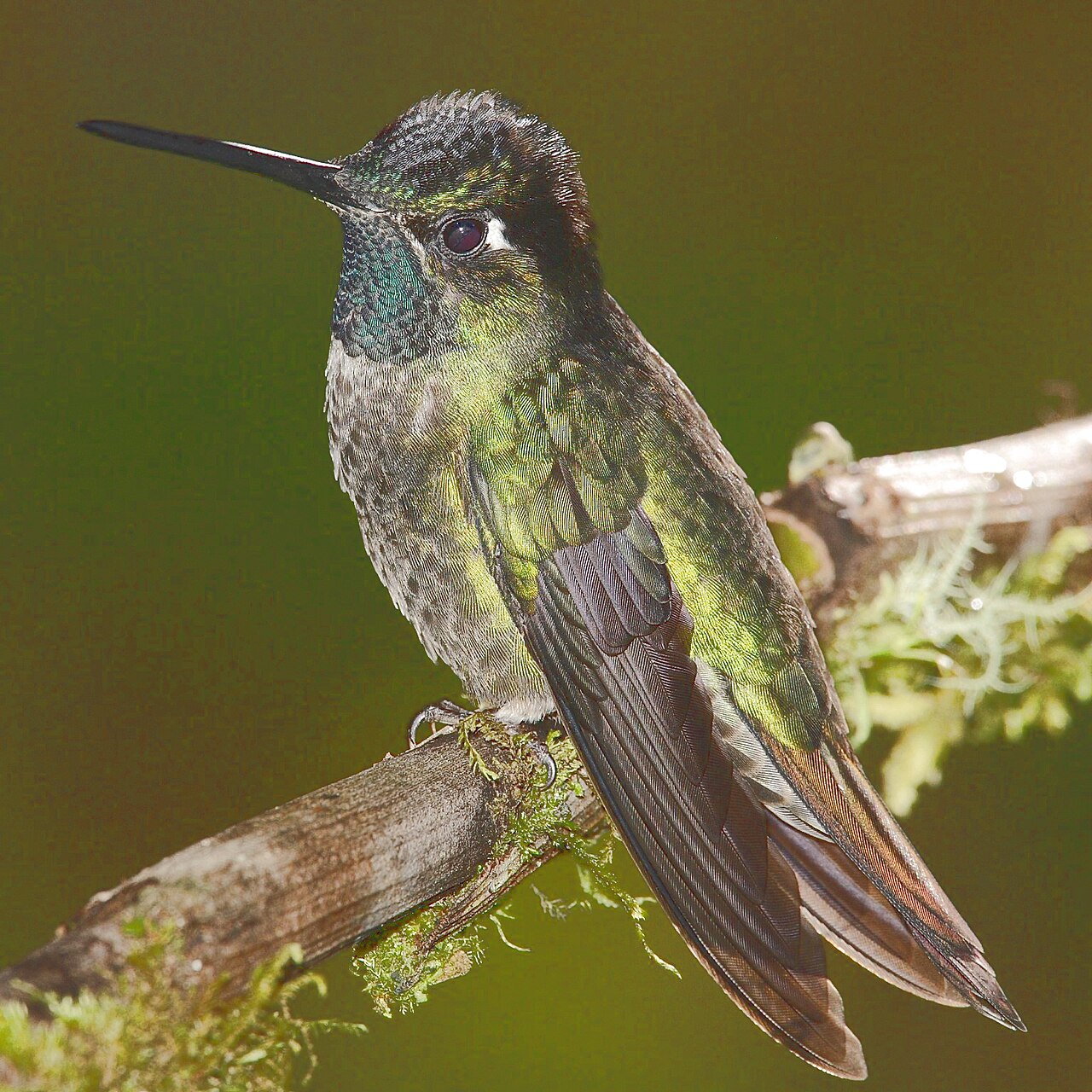
Rivoli's Hummingbird is, after the Blue-throated Mountain-gem, the second-largest hummingbird breeding in the United States: a dark bird of mountain forest that only lights up when the sun catches its purple crown and emerald throat square on. Until 2017 it was treated as one species, the Magnificent Hummingbird, together with a closely related bird from Central America.
Voice
The call is a loud, sharp chik or cheep, repeated from a perch or in flight and speeding into a rapid series when the bird is excited or aggressive. A shorter chatter of rising and falling notes has also been described, but the male has no distinct song flight or song of the kind some other hummingbirds give.
Recording: Richard E. Webster — CC BY-NC-SA 4.0 · Portal, Arizona, United States · xeno-canto
Identification
It is a large hummingbird with a long, almost straight bill, long wings and a broad, shallowly forked tail. At a distance the male looks dark and plain, but in good light shows a violet crown and a brilliant green throat patch above an otherwise blackish head with a white stripe behind the eye. The female is bronze-green above with dull grey underparts and the same white eye-stripe. Young birds resemble the female but are darker and browner.
Confusion species
The Blue-throated Mountain-gem shares the same mountain canyons but has a blue rather than green throat, a double rather than single facial stripe, and greyer underparts. The much smaller Black-chinned Hummingbird occurs in the same gardens but weighs less than a quarter as much and has a purple-black rather than green throat in the male. Females and young birds of the two large species are told apart mainly by size and by bill thickness, which is noticeably heavier in Rivoli's Hummingbird.
Habitat
It occupies mountain interiors: pine-oak woodland and cloud forest between roughly 1,500 metres and timberline, with clearings and edges, plus secondary forest and grassland. Feeders at mountain lodges and gardens in mountain villages are readily visited, especially in late summer.
Where the bird is most often found, arranged by the USNVC — the vegetation classification of the United States and Canada — and CMECS for sea and coast.




Range and movements
It breeds in southeastern Arizona and possibly the extreme southwest of New Mexico, from May to July, but does not overwinter in the United States. In the Chisos Mountains of west Texas there are summer records, though breeding has not been confirmed there. Further south, from northern Mexico to Nicaragua, with records also from El Salvador, Guatemala and Honduras, the species is resident.
- Resident
- Breeding (summer)
- Winter
- Passage
- dark = core range, pale = thinly spread
Where and when to look
Look for it in July and August at feeders in the mountains of southeastern Arizona, where males keep a fixed 'trapline' between scattered flower patches and so return regularly to the same spot. Against the light, look for shape — the long bill, the long wings — rather than colour, which barely shows then.
Conservation
Least Concern (LC), with a large and reportedly stable range. Forest fires and logging in southern Mexico and Central America are a possible longer-term threat, but no firm population estimate exists.
Scientific name
Eugenes fulgens | (Swainson, 1827)
Swainson described the species in 1827 as Trochilus fulgens, in the same publication and from the same type locality as the Mexican Violetear; it has since been moved to another genus, hence the parentheses. The genus Eugenes, introduced by Gould in 1856, is Greek for 'well-born' or 'noble'. fulgens is Latin for 'shining, glittering'. The English and Dutch names honour the Duke of Rivoli, the French nobleman and collector after whom Anna's Hummingbird is also named; until 2017 the species was combined with the Talamanca Hummingbird under the single name Magnificent Hummingbird.