All species › Swifts › Hummingbirds › Plain-capped Starthroat
Plain-capped Starthroat | Heliomaster constantii
Vonkkeelkolibrie | Colibrí pochotero
The Plain-capped Starthroat is a large, long-billed hummingbird of dry to semi-arid forest in Mexico and Central America, with a throat patch in the male that flips from dull purple to fiery carmine red the instant the light shifts. Since 1969 it has turned up almost every year in southern Arizona, without ever having bred there.
Voice
The song is a series of sharp, varied chip-like notes. The call is a high, melodious, somewhat drawn-out note, and during chases between rivals it gives a high, piercing twitter.
Recording: Richard E. Webster — CC BY-NC-SA 4.0 · Alamos, Sonora, Mexico · xeno-canto
Identification
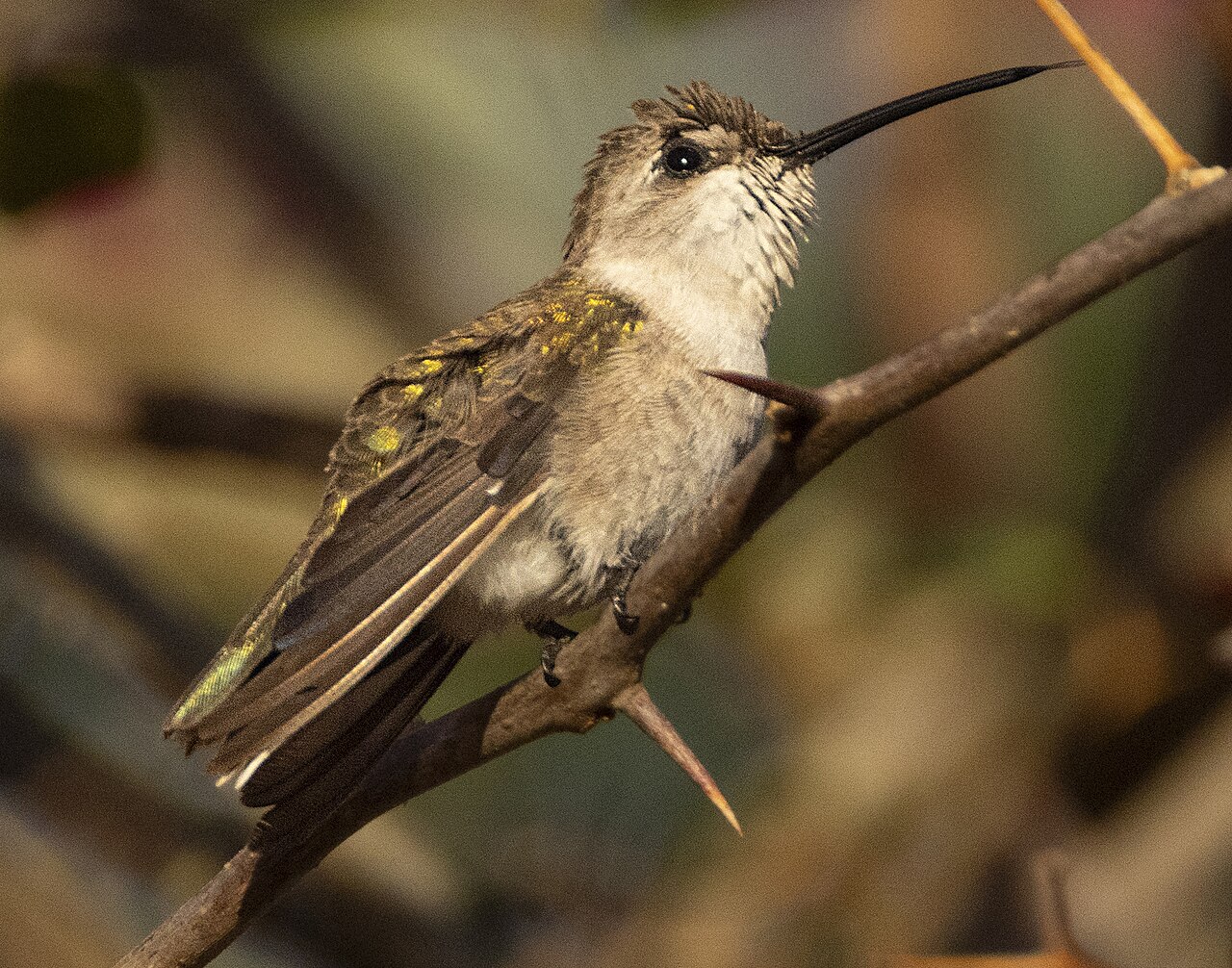
It is a large hummingbird with a long, nearly straight black bill, a white eye-stripe and a white 'moustache' below the eye. The upperparts are metallic bronze-green with a white rump band, the underparts brownish-grey with a white belly and a tuft of white feathers on the flanks. The male shows a throat patch that can flash from dull to bright metallic red or purplish-red depending on the angle of light; females closely resemble males but lack that coloured throat.
Confusion species
In the same southeastern Arizona canyons, female Rivoli's Hummingbirds and Blue-throated Mountain-gems can be mistaken for the Plain-capped Starthroat, since all three are greyish below; but the white rump band, the white moustache mark and the long, nearly straight bill of the starthroat are entirely absent on those two. The male, with its flashing red throat, can be told apart in good light from the other two large species, which have blue or green throats.
Habitat
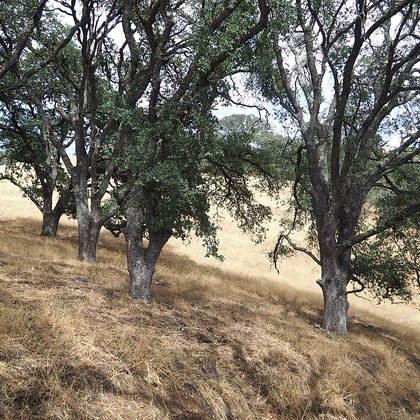
It occupies dry to semi-arid country: the edge and interior of mature forest, thorn forest, scrubland, gallery forest along watercourses, and open country with scattered trees. It ranges from the lowlands to the foot of the mountains, generally in areas with seasonal rains where the vegetation looks dry for much of the year.
Where the bird is most often found, arranged by the USNVC — the vegetation classification of the United States and Canada — and CMECS for sea and coast.




Range and movements
It is a resident of northwestern Mexico, from Sonora to Jalisco, and further south through Mexico and Guatemala to El Salvador, Honduras and Nicaragua. Since the first record in 1969, it has been seen almost every year between May and October in the extreme south of Arizona, as a summer wanderer with no established population; there is no evidence of breeding in the United States.
- Resident
- Breeding (summer)
- Winter
- Passage
- dark = core range, pale = thinly spread
Where and when to look
Look for it between May and October at feeders and flowering agaves in the border canyons of southeastern Arizona, where it can stay in the same spot for weeks. Watch for the long, straight bill and the white rump band, which stand out at a distance before the colour of the throat becomes visible.
Conservation
Least Concern (LC), with a large range and an estimated population of fifty thousand to five hundred thousand mature individuals. Numbers are reportedly declining, though no direct cause is given.
Scientific name
Heliomaster constantii | (Delattre, 1843)
Delattre described the species in 1843 as Ornismya constantii; because it was later moved to another genus, author and year stand in parentheses. The genus Heliomaster is of Greek origin, from helios (sun) and aster (star), referring to the sparkling throat patch — hence also the English name 'starthroat'. Exactly who 'constantii' honours is not reliably established. The type locality was initially given as Guatemala, which proved to be an error; the American ornithologist Ludlow Griscom later substituted Bolsón in Costa Rica.