All species › Swifts › Hummingbirds › Ruby-throated Hummingbird
Ruby-throated Hummingbird | Archilochus colubris
Robijnkeelkolibrie | Colibrí gorjirrubí
The Ruby-throated Hummingbird is the only hummingbird that breeds east of the Great Plains, and so for millions of Americans and Canadians it is simply the hummingbird. A bird of three grams that crosses the Gulf of Mexico in a single flight, twice a year.
Voice
No song in the usual sense: the repertoire is dry, squeaky chee-chee-chee series, fast and sharp, with which birds drive one another off a flower or a feeder. The instrumental sound matters more — the male's wings produce a high, bee-like hum while hovering, and in the dive display he rattles a tik-tik tik-tik with the wings while the outer tail feathers give a thin whine. Anyone who knows a garden with hummingbirds hears them before seeing them.
Recording: Jonathon Jongsma — CC BY-SA 3.0 · Minnesota Valley NWR, Old Cedar Ave Bridge, Hennepin, Minnesota, United States · xeno-canto
Identification
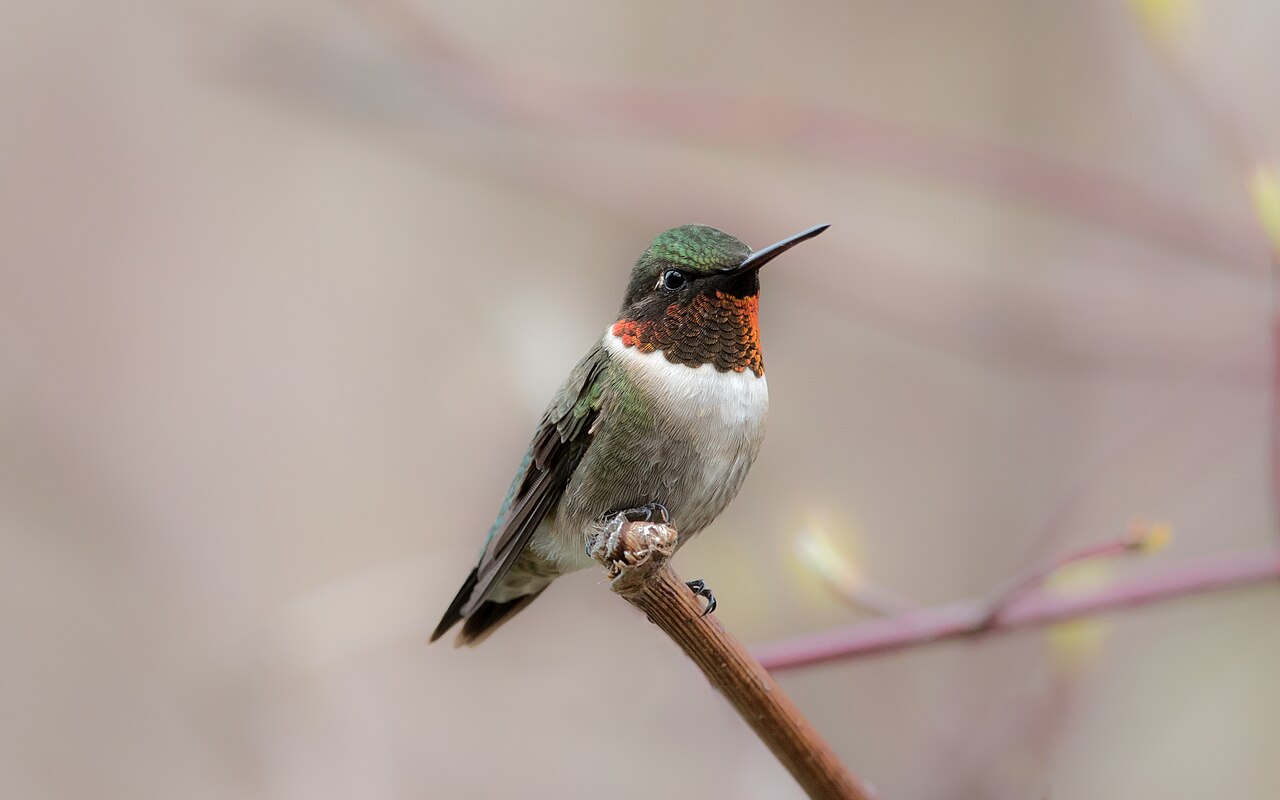
Metallic green above, greyish white below, with a long straight needle bill and a short forked tail. The male has a jet-black chin and a throat patch that flares ruby only in the right light and otherwise looks dull black — wait for the bird to turn its head. The female lacks the gorget, has a white throat at most finely streaked grey, a rounded tail with white tips and a faint dusky mask. Juveniles resemble the female but are more heavily streaked on the throat; young males show their first red feathers from late summer.
Confusion species
Black-chinned Hummingbird (Archilochus alexandri) overlaps in central Texas and on the western Great Plains; the male has a black throat with a narrow violet lower border, a longer and slightly decurved bill and a duller green crown. Females are barely separable: Black-chinned pumps its tail constantly while hovering and has a broad, blunt-tipped outermost primary where that of Ruby-throated is narrow and pointed. Almost every hummingbird at a feeder in the southeastern states in winter is a Rufous Hummingbird (Selasphorus rufus), rufous on the flanks and tail base. Hummingbird clearwing moths (Hemaris) at flowers are taken for hummingbirds as well.
Habitat
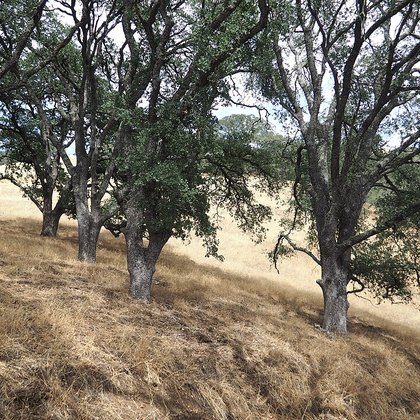
Deciduous and mixed woodland with clearings, woodland edges, old hedgerows, orchards and above all flower-rich gardens and parks. It needs two things at once: nectar-rich tubular flowers — trumpet creeper, cardinal flower, wild bergamot — and a stand of trees where the female can build her walnut-sized nest of plant down and spider silk on a thin horizontal branch. In winter quarters it occupies dry tropical forest, shade coffee and forest edges.
Where the bird is most often found, arranged by the USNVC — the vegetation classification of the United States and Canada — and CMECS for sea and coast.



Range and movements
Breeds across the whole of the eastern United States and southern Canada, from Nova Scotia and southern Quebec west to Alberta, the western limit running roughly along the Great Plains; of all North American hummingbirds it has the largest breeding range. It winters from southern Mexico to Panama and in the Greater Antilles, with growing numbers along the Gulf coast of Louisiana, Texas and Florida. Part of the migration runs around the Gulf of Mexico along the Texas coast, but many birds double their fat mass and cross in one flight: some eight hundred kilometres of open water in about twenty hours, burning the whole reserve.
- Resident
- Breeding (summer)
- Winter
- Passage
- dark = core range, pale = thinly spread
Where and when to look
Sit down by a flowering trumpet creeper or a red feeder and wait: the birds come most in the morning and in the last hour of light. Watch the aggression — a male defends his patch of flowers and gives himself away in the criss-cross chases above the garden. In late summer, when birds are laying down fat for the Gulf, numbers at a feeder are two to three times those of June; leave the feeders up into October, they hold back no bird that means to go.
Conservation
Least Concern, with an estimated 34 to 36 million birds: the most numerous hummingbird in North America. Numbers rose from 1970 into the early years of this century, but recent counts point to a decline of about seventeen per cent. The heaviest direct mortality comes from window strikes and cats; more serious in the long run is the risk that the flowering of its nectar plants and the arrival of the birds drift apart.
Scientific name
Archilochus colubris | (Linnaeus, 1758)
Linnaeus described the species in 1758 as Trochilus colubris, among the hummingbirds in the broad sense; because it was later moved to Archilochus, author and year stand in parentheses. The genus Archilochus was introduced by Reichenbach in 1854, with the Black-chinned Hummingbird as its type species; the name is that of Archilochus of Paros, the Greek poet of the seventh century BC. colubris is a Latinisation of Spanish colibrí, itself borrowed from a Caribbean language, and simply means 'hummingbird'. Linnaeus gave 'North America' as the locality and worked from Mark Catesby's plate; that bird came from South Carolina, to which the type locality was later restricted.