All species › Passerines › Tyrant flycatchers and allies › Scissor-tailed Flycatcher
Scissor-tailed Flycatcher | Tyrannus forficatus
Zwaluwstaartkoningstiran | Tijereta Rosada
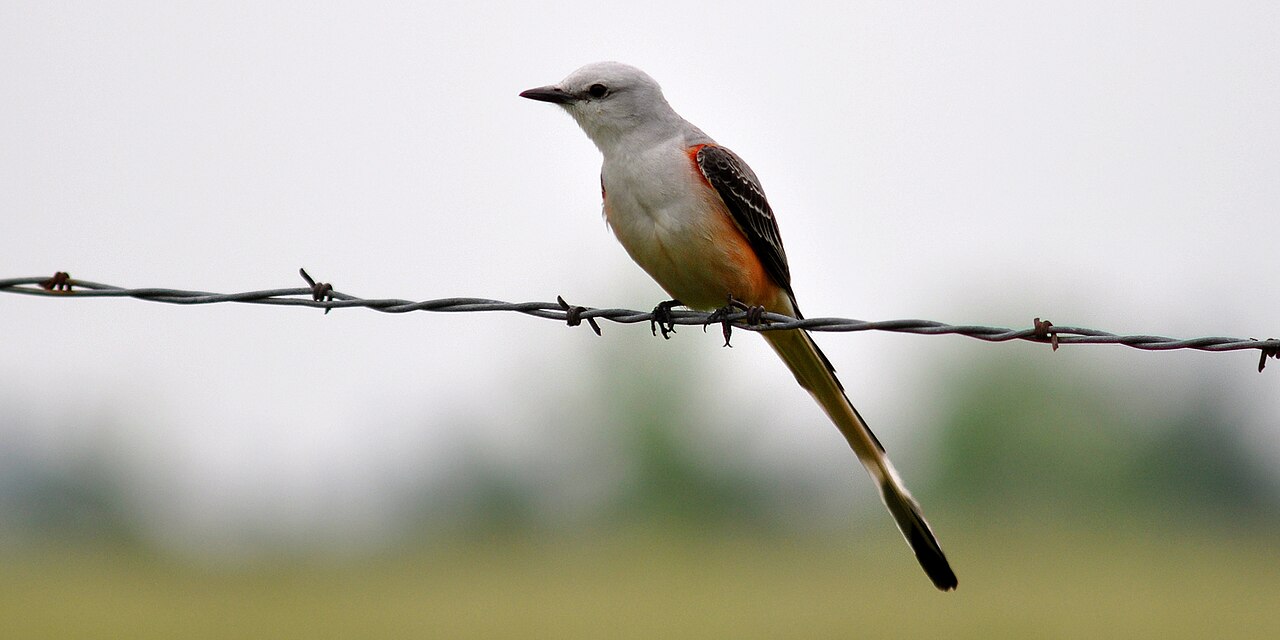
The Scissor-tailed Flycatcher is recognised by its pale grey head, salmon-pink flanks and above all by its long, deeply forked tail. It breeds on the open plains of the southern Great Plains, perching on wires and fence posts, and winters from southern Mexico into Central America. It is the state bird of Oklahoma.
Voice
The voice is a series of sharp, high kek and pik notes that run together into a fast rattling chatter when the bird is excited — the same hard register as in the other kingbirds. In the display flight the male climbs tens of metres, drops in a zigzag and tumbles over, keeping up a rapid chatter throughout. At autumn roosts dozens of birds call at once.
Recording: Terry Davis — CC BY-NC-SA 4.0 · 10 (near Bossier City), Bossier Parish, Louisiana, United States · xeno-canto
Identification
Head, neck and back are pale grey, the underparts white with a salmon-pink wash on the flanks, lower belly and undertail coverts; the underwing carries a red to salmon patch that flashes in flight. The wings are dark grey. The tail is black with white outer webs, long and deeply forked: in adult males it makes up about two thirds of the total length, in females up to a third shorter. A concealed red crown patch shows only in excitement. Young birds have a much shorter tail and lack the pink wash.
Confusion species
Western Kingbird has the same grey head and black tail with white outer edges, but a short square tail and a yellow belly instead of pink flanks. Short-tailed juvenile Scissor-taileds therefore most resemble other species: look then at the white rather than yellow underparts and at the salmon underwing. Fork-tailed Flycatcher (Tyrannus savana), a vagrant from the tropics, has an equally long tail but a black cap and a white throat without any pink.
Habitat
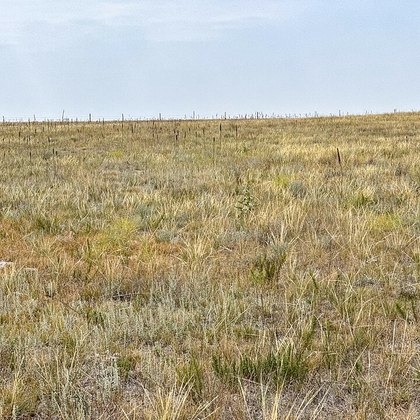
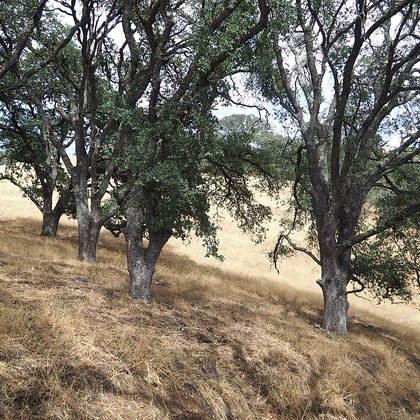
Open country with scattered trees and shrubs: prairie, savanna, grazed pasture, field edges, roadsides, golf courses and parks. It needs high lookouts — wires, fence posts, treetops — and an isolated tree or tall shrub for the nest, which is also placed on utility poles and other structures. It does not use closed forest. In winter it occupies open landscapes, pasture and plantations.
Where the bird is most often found, arranged by the USNVC — the vegetation classification of the United States and Canada — and CMECS for sea and coast.





Range and movements
The breeding range lies in the south-central United States: Texas, Oklahoma, Kansas, Arkansas, western Louisiana, Missouri, Nebraska and north-eastern New Mexico. Migration runs through Texas and eastern Mexico; the winter range extends from southern Mexico through Guatemala and Honduras into Nicaragua and further south. A small group winters in southern Florida. Outside the range the species turns up regularly north to southern Canada and the north-eastern United States.
- Resident
- Breeding (summer)
- Winter
- Passage
- dark = core range, pale = thinly spread
Where and when to look
Drive back roads in Oklahoma and north Texas in May or June and watch the wires: the bird usually sits singly or in pairs at eye level beside the road. In August and September flocks of hundreds gather at communal roosts — then the last hour before sunset gives the best chance.
Conservation
Partners in Flight puts the breeding population at about 9.5 million birds, more than ninety per cent of them in the United States. The Breeding Bird Survey shows a decline of roughly 31 per cent between 1966 and 2014; the species is on no watch list and the IUCN lists it as Least Concern (LC). Conversion of pasture and savanna to continuous row crops and the loss of isolated trees reduce the supply of nest sites; planting along roads and around farmsteads works the other way locally.
Scientific name
Tyrannus forficatus | (Gmelin, 1789)
Gmelin described the species in 1789 as Muscicapa forficata; because it was later moved to Tyrannus, author and year stand in parentheses. Tyrannus is Latin for 'absolute ruler', after the driving of much larger birds out of the breeding territory. The species name forficatus comes from forfex, 'scissors', after the shape of the tail — the same image as in the English Scissor-tailed Flycatcher and the Spanish Tijereta. The specimen described came from Nova Hispania, present-day Mexico.