All species › Passerines › Cardinals and allies › Summer Tanager
Summer Tanager | Piranga rubra
Zomertangare | Piranga roja
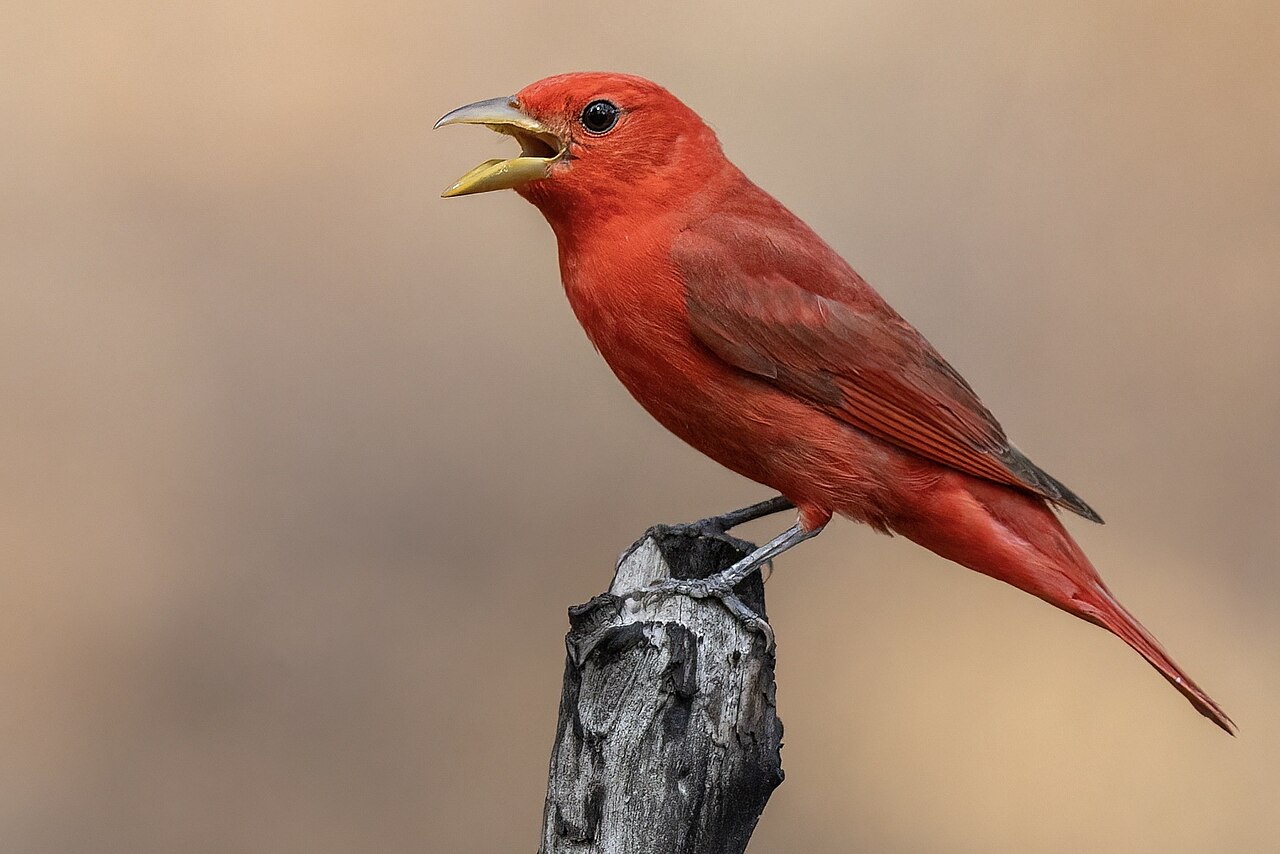
The Summer Tanager is one of the few birds in North America in which the adult male is red over the whole body, wings and tail included. It breeds in open deciduous and pine-oak woodland of the southern United States and winters from Mexico into South America. It feeds largely on bees and wasps, which it catches in flight.
Voice
The call is the most usable feature: a dry, chuckling pit-ti-tuck or pik-tuck-i-tuck, given by no other tanager in this way. The male's song is a series of clear, flowing whistled phrases with a round tone, strung together longer and less burry than the song of the Scarlet Tanager, and closer to that of an American Robin. He sings from high in the canopy, often hidden in the leaves.
Recording: Mario Reyes Jr — CC BY-NC-SA 4.0 · Raven Run, Fayette County, Kentucky, United States · xeno-canto
Identification
The adult male is strawberry red over the whole body, with no black in wing or tail; the red is duller and pinker than the fiery red of a Scarlet Tanager. The female is yellow-green above and deeper yellow to mustard below. The bill in both sexes is large, thick, blunt and pale horn-coloured — a clear difference from the smaller, darker bill of the related species. Moulting young males are a patchwork of yellow and red. The head is large and the bird looks chunky.
Confusion species
A male Scarlet Tanager has black wings and tail against bright scarlet; that contrast is entirely absent here. Hepatic Tanager is brick to rusty red rather than pink-red, has a grey wash on the cheeks and flanks and a dark bill. Western Tanager has clear wingbars. Northern Cardinal has a crest, a black face and a red bill. Females are separated mainly on bill colour and shape: pale and heavy in Summer Tanager, darker and finer in the others.
Habitat
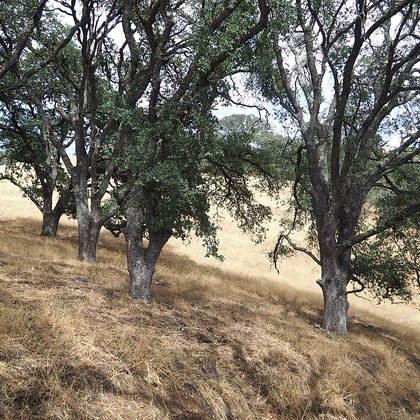
Open deciduous woodland with gaps and edges, above all oak and pine-oak woodland in the southeast; also mature plantings and spacious parks. In the southwest it is almost confined to gallery woodland along rivers, with willow, cottonwood and saltcedar — a narrow strip of green in dry country. It uses closed, unbroken forest less than Scarlet Tanager does. It winters in tropical forest, forest edge and shade-coffee plantations.
Where the bird is most often found, arranged by the USNVC — the vegetation classification of the United States and Canada — and CMECS for sea and coast.





Range and movements
The breeding range covers the southern two-thirds of the United States, from southern California, Arizona and New Mexico east across Texas and the Gulf states to New Jersey and southern New England, with the northern limit around the Great Lakes. The western population in the river woodlands stands apart from the eastern range. Migration in the east crosses the Gulf of Mexico and the Caribbean, in the west it runs overland through Mexico. It winters from northwestern Mexico and the Gulf Coast south through Central America into the middle of South America; within the guide area that means the coastal lowlands of Mexico and the countries as far as Nicaragua.
- Resident
- Breeding (summer)
- Winter
- Passage
- dark = core range, pale = thinly spread
Where and when to look
The chuckling call is more reliable in the field than colour: learn the pit-ti-tuck and you will hear the bird before you see it. In the southwest, search the river woodlands of the San Pedro or the Rio Grande in May and June. With any red-looking tanager, check wing and tail first: if the red runs on through them, this is the species.
Conservation
Partners in Flight puts the breeding population at about twelve million birds; the trend has been slightly upward since 1966 and the IUCN lists the species as Least Concern (LC). The west differs from the east: gallery woodland along rivers has declined sharply through water abstraction, dams and grazing, leaving the western population on a thin and fragmented base. On the wintering grounds shade coffee is usable habitat for this species.
Scientific name
Piranga rubra | (Linnaeus, 1758)
Linnaeus described the species in 1758 as Fringilla rubra, from a specimen taken in what is now South Carolina; because it later moved to another genus, author and year stand in parentheses. The genus Piranga was introduced in 1808 by Vieillot and goes back to the Tupi word tijepiranga, the name of a small bird in Brazil. The species name rubra is Latin for 'red'. The Dutch and English names refer to the season in which the species is present in North America.