All species › Swifts › Swifts › Vaux's Swift
Vaux's Swift | Chaetura vauxi
Vaux' gierzwaluw | Vencejo de Vaux
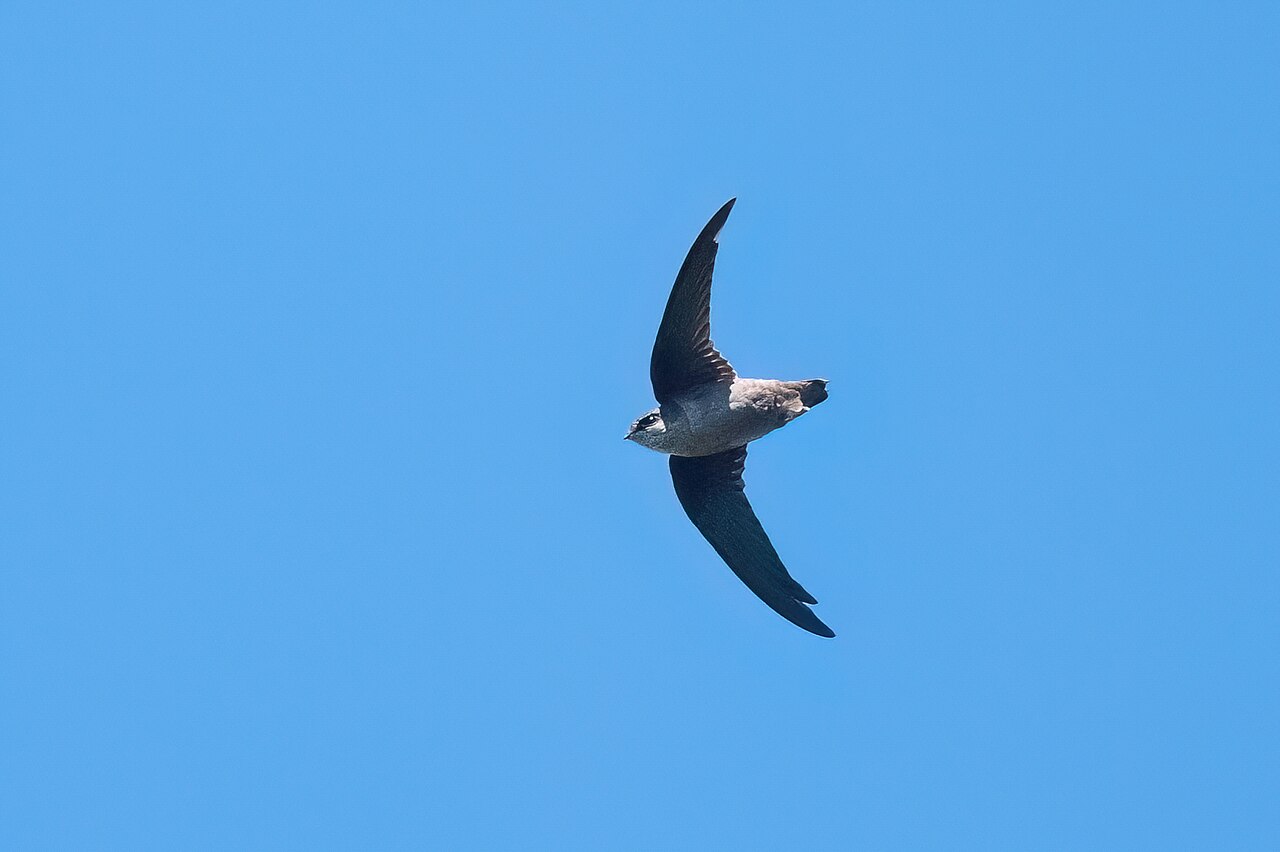
Vaux's Swift is the smallest swift in North America, a dark little cigar with short, rounded wings that spends almost the entire day airborne and settles at dusk by the hundred or thousand into a single hollow tree or chimney. Northern birds nest in old-growth conifer forest along the Pacific coast and withdraw completely to Mexico and Central America each autumn; farther south, from Chiapas to Nicaragua, the species stays put all year.
Voice
The voice is a mixture of chattering, rattling and squeaking notes, more varied than in most other American swifts. Around a communal roost, just before dark, a steady chittering rises from hundreds of throats at once as the birds spiral in ever-tighter circles around the chimney or hollow tree. At the nest mostly the soft peeping of the chicks can be heard.
Recording: Elias Aristides Elias — CC BY-NC-SA 4.0 · Arcata, Humboldt County, California, United States · xeno-canto
Identification
A small, cigar-shaped bird with short, half-round wings and a short, blunt tail whose spiny tips brace it against the wall of a cavity. The head, back and wings are dark sooty brown, while the throat, rump and undertail are paler grey-brown; northern birds have a noticeably paler, almost whitish throat. Flight is a rapid, fluttering beat broken by short glides, and unlike a swallow's the silhouette stays stiff and straight throughout.
Confusion species
Chimney Swift, in the east, is slightly larger, with relatively longer wings and tail, a slower wingbeat and a greater tendency to glide; the two overlap only on migration in the Midwest. Black Swift is considerably larger and uniformly dark, without the pale throat; White-throated Swift has sharply contrasting white on the chest and belly, which Vaux's Swift entirely lacks. From hummingbirds, to which it is sometimes compared in size, it is instantly told by its straight, fast flight and total lack of bright colour.
Habitat
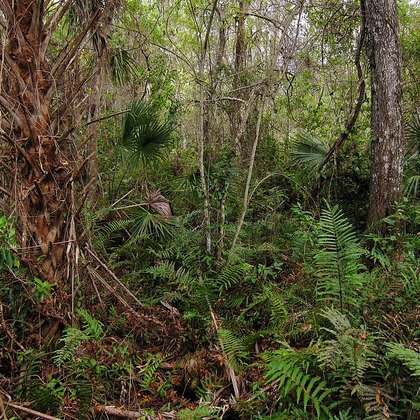
Older, closed conifer and mixed forest with large dead or hollow trees for nesting and roosting, from lowlands into the mid-elevation mountains of the west coast. It forages over forest openings, clear-cuts, burned areas and riverbanks with plenty of flying insects; chimneys are used mainly where hollow trees are scarce. Farther south, in Mexico and Central America, it also enters tropical deciduous and montane forest.
Where the bird is most often found, arranged by the USNVC — the vegetation classification of the United States and Canada — and CMECS for sea and coast.



Range and movements
Breeds from southeastern Alaska through British Columbia to Washington, Oregon and northern California. The entire northern population migrates away to Mexico and Central America; little is known of exactly where it winters. Separately, the species is present year-round from Chiapas to Nicaragua, part of a chain of non-migratory subspecies extending from Mexico into South America.
- Resident
- Breeding (summer)
- Winter
- Passage
- dark = core range, pale = thinly spread
Where and when to look
In summer, look at dusk near an old factory chimney or a Pacific Northwest forest edge for small, cigar-shaped silhouettes flying with a fluttering beat as they catch insects; at a communal roost, thousands of birds sometimes gather in late summer, spiralling down into the chimney just before dark.
Conservation
Between 1968 and 2015 the population fell by roughly 1.8 per cent a year, some 58 per cent in total, mainly through logging of old conifer forest with enough hollow trees and a decline in flying insects. The species is listed for that reason on the American Watch List of birds of concern, even though its global status is still Least Concern (LC).
Scientific name
Chaetura vauxi | (Townsend, 1839)
Townsend described the species in 1839 as Cypcelus Vauxi, while staying at Fort Vancouver on the Columbia River, where as physician and collector he had joined Wyeth's second expedition to the Pacific; it has since been moved to another genus, hence the parentheses around author and year. Stephens introduced the genus Chaetura in 1826, from the Greek khaitē, 'hair', and oura, 'tail', after the spiny, hair-like tips of the tail feathers. The epithet vauxi honours William Sansom Vaux, a friend of Townsend's in Philadelphia. The type locality is the Columbia River, equated with Fort Vancouver in the state of Washington.