All species › Swifts › Swifts › Chimney Swift
Chimney Swift | Chaetura pelagica
Schoorsteengierzwaluw | Vencejo de chimenea
A sooty cigar on sickle wings, without a single field mark to hold on to, sweeping over town from first light until dusk and never once perching where anyone can see it. It moved its nest from hollow trees in old-growth forest into the chimneys of the settled world, and it is now going out with those chimneys: close to three quarters of the birds have gone in barely fifty years.
Voice
A dry, high chattering: a fast series of hard chip notes that accelerates at the end and runs together, often from two or three birds at once. It has no song in the proper sense; this chatter serves as a contact call and sounds over streets and roofs all day. You almost always hear it before you see it, because the sound comes straight down from above. At a roosting chimney it swells towards sunset into a continuous rushing from hundreds of birds together.
Recording: Stanislas Wroza — CC BY-NC-SA 4.0 · Portneuf (near Grondines), Capitale-Nationale, Québec, Canada · xeno-canto
Identification
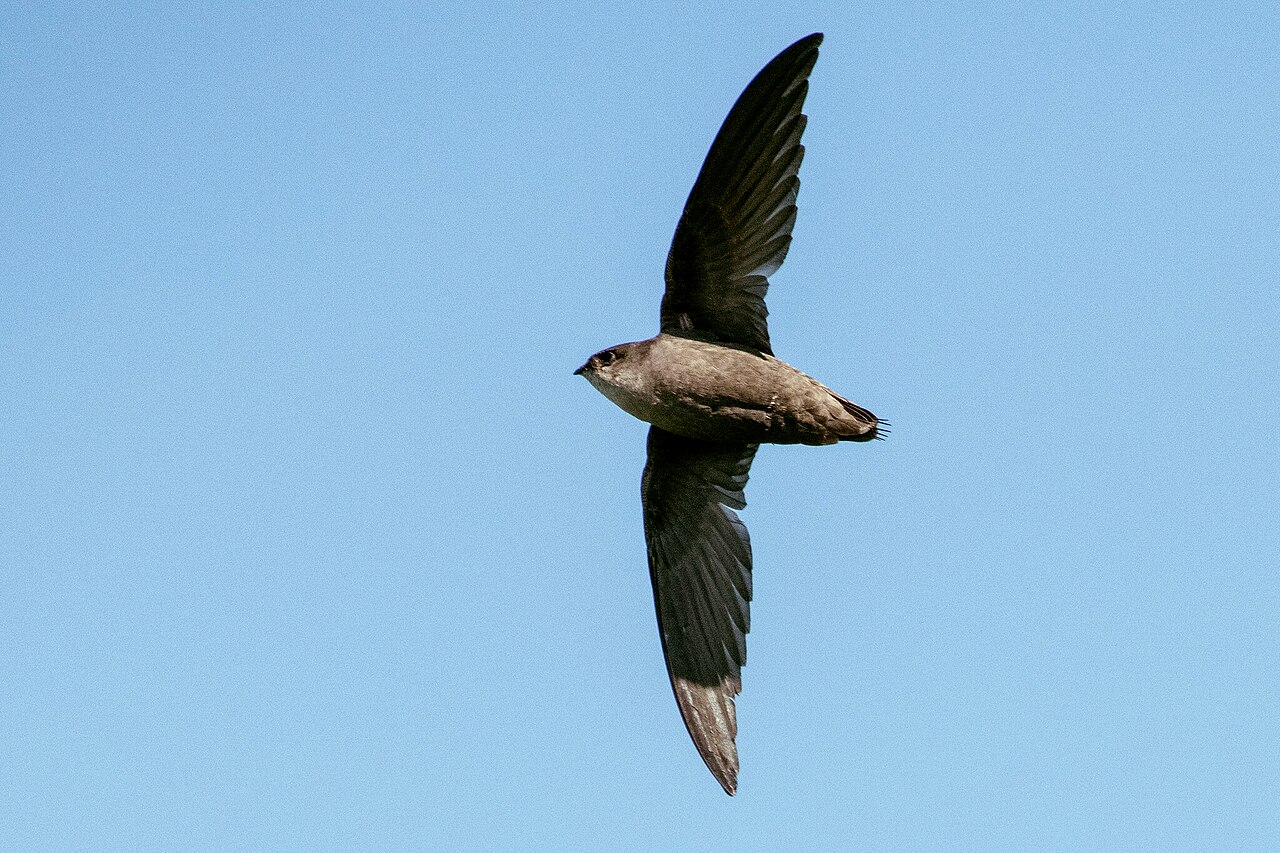
Sooty brown to dark grey all over, with a slightly paler throat that shows only in good light; male, female and juvenile look alike. The silhouette is a cigar with a pair of long, narrow, curved wings; the tail is short and square-cut and spreads only in a turn. The wingbeat is stiff, rapid and flickering, broken by short glides on flat wings, and the wings appear to beat alternately — an illusion. It never settles on a branch or a wire but hangs vertically against a rough wall, gripping with four toes that all point forward and propped on tail feathers whose shafts project as spines.
Confusion species
Vaux's Swift (Chaetura vauxi) of the west is smaller and paler, especially on throat and rump, and the breeding ranges barely meet. Black Swift (Cypseloides niger) is much larger, with a slower beat and a slightly forked tail; White-throated Swift (Aeronautes saxatalis) is black and white and distinctive once properly seen. Swallows fly differently: Purple Martin and Barn Swallow have a more fluid beat, hold the wings slightly raised in a glide, and carry a clearly forked or notched tail. When only the outline is left, the rule is that a swift has no tail worth mentioning and a swallow does.
Habitat
It breeds where there are chimneys: in old town districts, villages, school buildings and factories across eastern North America. It hunts higher up and over everything without distinction — roofs, parks, woodland, rivers and lakes — because its food is whatever happens to be drifting in the air. Before masonry chimneys it nested in hollow, dead giants in old-growth forest, and in the south of its range it still does so occasionally. What it needs is a dark vertical shaft with a rough wall and an open top.
Where the bird is most often found, arranged by the USNVC — the vegetation classification of the United States and Canada — and CMECS for sea and coast.





Range and movements
A summer bird of eastern North America, from the Gulf Coast and Florida north into southern Canada, with its western edge at roughly the hundredth meridian. It winters in the Amazon basin of Peru and the countries around it — far outside the guide area, so the southern half of its year does not appear on the map. Where it spent those months was unknown until 1944, when thirteen rings surfaced that people living on the Yanayacu in eastern Peru had collected. Migration runs over the Gulf Coast, eastern Mexico, Central America, Cuba and the Bahamas, and in autumn coincides with the great roosting gatherings in chimneys.
- Breeding (summer)
- Passage
- dark = core range, pale = thinly spread
Where and when to look
In the last week of September or the first of October, go at sunset to an old, tall, brick chimney — a school, a church, a disused factory — and wait until the light has almost gone. The birds gather high in a loose cloud, circle tighter and tighter, and finally pour in as a vortex, sometimes several thousand within a quarter of an hour. By day the quickest way to find one is the chatter overhead: look straight up.
Conservation
Vulnerable (VU). The species numbers an estimated 8.8 million birds and has been falling by about 2.3 per cent a year since 1966, close to three quarters of the population in all; in Canada it is listed as threatened. The cause lies in the nest site: old masonry chimneys are demolished, new ones are smooth metal or too narrow, and unused ones are capped to keep birds out. Sweeping during the breeding season destroys nests and young as well. Artificial nesting towers and keeping existing chimneys open are the usual remedies.
Scientific name
Chaetura pelagica | (Linnaeus, 1758)
Linnaeus described the bird in 1758 as Hirundo pelagica, among the swallows; because it was later moved to another genus, author and year stand in parentheses. The genus Chaetura was introduced in 1826 by Stephens, from the Greek khaite, 'long hair', and oura, 'tail', for the spines in which the tail feathers end. pelagica is Latin for 'of the open sea', a name that does not fit the bird and whose reason is unclear. The type locality is given as America, narrowed to South Carolina.