All species › Swifts › Swifts › Black Swift
Black Swift | Cypseloides niger
Zwarte gierzwaluw | Vencejo negro
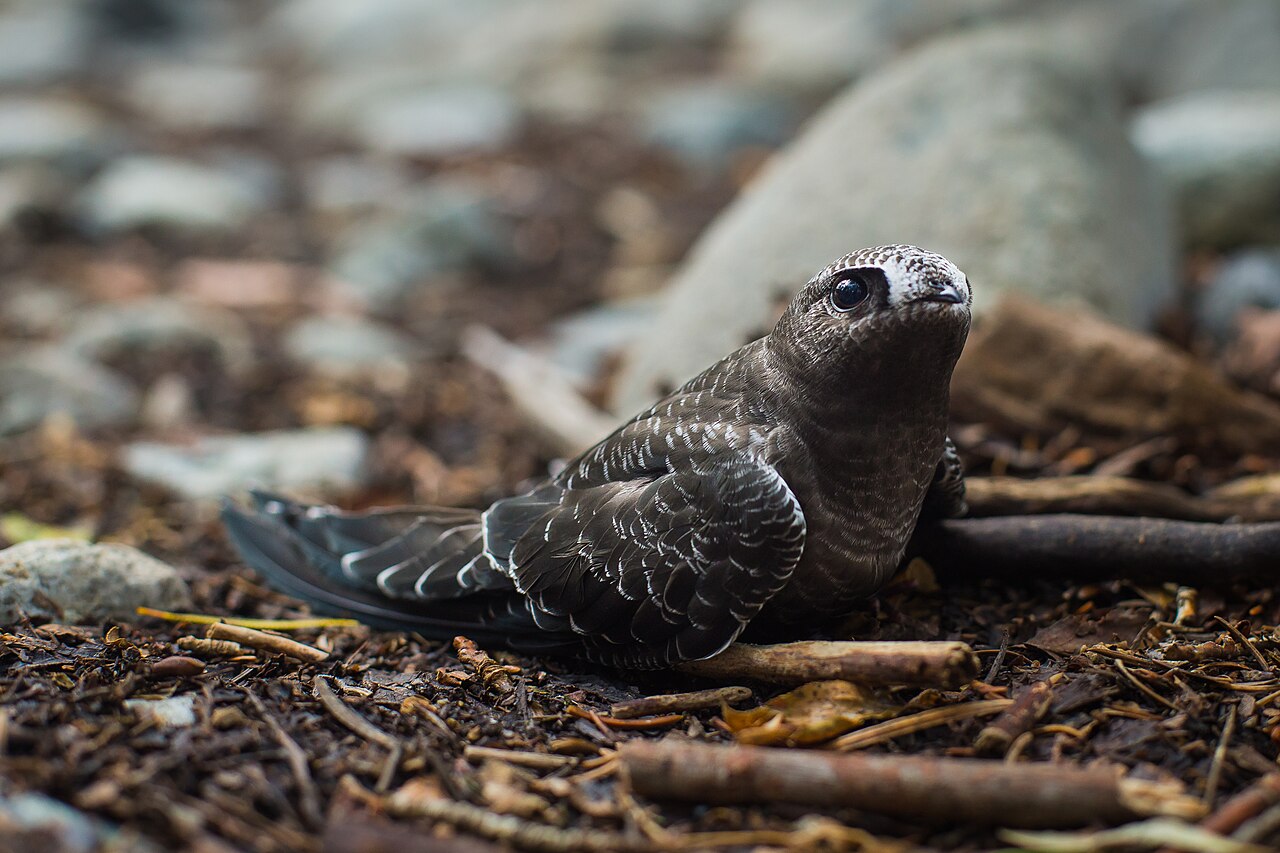
Black Swift is the largest and darkest swift in North America, a uniformly sooty bird with long, sickle-shaped wings that circles so high it is often reduced to a distant speck. It nests in some of the most inaccessible places there are: rock ledges behind waterfalls and inside dark sea caves, safe from every predator. Few North American birds have declined as sharply over the past fifty years, and the cause is still not fully understood.
Voice
In flight, Black Swift gives a fast series of high, twittering notes, often barely audible against the wind at the cliffs where it breeds. At the nest, tucked deep behind a waterfall's curtain, it is rarely heard; its presence is given away more by the bird itself, flying in and out of the rock face on stiff, steady wingbeats. There is no true song of the kind songbirds produce.
No freely licensed recording has been found for this species yet; what to listen for is described below.
Identification
A large, entirely sooty-black swift with long, curved, pointed wings and a slightly forked tail that often looks square from below. The bill is barely visible and the feet are so small the bird can hardly move on the ground. Up close a paler forehead can be made out, but at the great heights it usually flies this is rarely useful; larger than a Vaux's Swift and slightly smaller than a Purple Martin is a better guide. Flight is a stiff, continuous beat broken by short glides, high in the air in search of swarming insects.
Confusion species
Vaux's Swift is considerably smaller and has a pale throat; Black Swift is uniformly dark from head to tail. White-throated Swift has sharply contrasting white on the throat, chest and flanks, entirely lacking in Black Swift. At a distance the species is sometimes mistaken for a Purple Martin, but that bird has a much more direct, less sickle-shaped wingbeat and lacks the long, curved wingtip.
Habitat
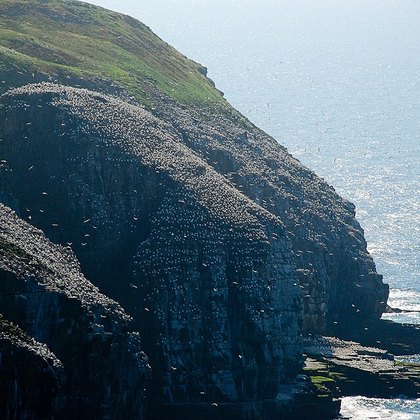
Only rock faces completely out of reach of predators: ledges behind or beside mountain waterfalls, and dark sea caves and cliffs along the Pacific coast. It forages at great height over forest and open country, sometimes climbing hundreds of metres on clear days and staying low over the ground on cloudy days, chasing swarms of flying ants. A suitable nest site is scarce and is reoccupied by the same birds year after year.
Where the bird is most often found, arranged by the USNVC — the vegetation classification of the United States and Canada — and CMECS for sea and coast.



Range and movements
Breeds scattered and locally from British Columbia and Alberta south through the mountains of Washington, Oregon, California, Idaho, Utah, Colorado and New Mexico, with a second, coastal population in sea caves along the California coast; a separate subspecies breeds from Mexico to Costa Rica. Around a hundred and fifty breeding sites are known in the United States and Canada, more than a hundred of them in Colorado alone. The entire North American population migrates away in autumn; only in 2012 did light-level geolocators on four birds show that they winter in the lowland rainforest of the western Brazilian Amazon.
- Resident
- Breeding (summer)
- Winter
- Passage
- dark = core range, pale = thinly spread
Where and when to look
Find a well-known waterfall in the western mountains on a summer afternoon and look up: on clear days the bird is often visible only as a moving speck at great height, while on overcast days it flies much lower and is easier to identify. At the nest site itself, as the bird flies in or out of the rock face, the uniform black colour and sickle-shaped wing are clear at close range.
Conservation
The North American population has fallen by more than half over the past fifty years, one of the steepest declines of any North American bird, with a total estimate of around a hundred and seventy thousand birds. The cause has not been established; climate change and a decline in flying insects on the Amazonian wintering grounds are seen as the most likely explanations. Loss or disturbance of the few suitable nest sites is an added risk for a species that already breeds at only a handful of places.
Scientific name
Cypseloides niger | (Gmelin, 1789)
Gmelin described the species in 1789 as Hirundo nigra, in the genus of swallows; it has since been moved to another genus, hence the parentheses around author and year. Streubel introduced the current genus Cypseloides in 1848, formed from the older genus Cypselus with the Greek suffix -oides, 'resembling' — literally 'resembling Cypselus'. niger is Latin for 'black', after the uniform plumage. The type locality is Hispaniola, where a West Indian subspecies also occurs.