All species › Tubenoses › Southern storm petrels
Southern storm petrels | Oceanitidae
Zuidelijke stormvogeltjes | Paíños del sur
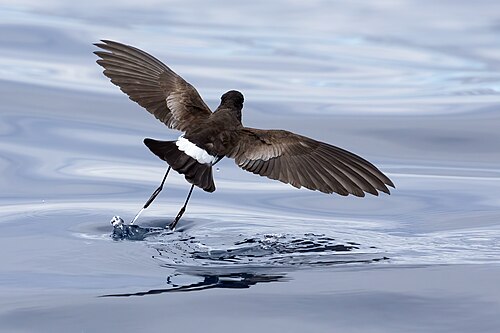
The legs are so long that in flight they project beyond the short, square tail — the clearest difference from the northern family, whose feet stay within the tail. The wings are short and rounded at the tip, and the flight is fluttering and irregular, low over the water, without the shearing arcs of the other tubenoses. While feeding, the bird hangs almost motionless into the wind with its wings raised in a V and patters over the surface with both feet, pushing off with its toes to stay in place among the waves; the prey is mainly small crustaceans, taken near feeding whales and along the edge of the continental shelf. Breeding takes place in the southern summer, on islands around Antarctica and in the southern oceans, in crevices under boulders. Outside that season the birds move north across the equator, so that here they turn up off the coast in midsummer: not as breeders, but as visitors between two breeding seasons.
Native species 1 species
Species that occur here by nature: breeding birds, winter visitors and passage migrants. They are arranged by genus, in the sequence of the list.
Oceanites 1 species


Vagrants 1 species
Birds blown in from other continents, or from far outside their usual range.
