All species › Tubenoses › Southern storm petrels › White-faced Storm-Petrel
White-faced Storm-Petrel | Pelagodroma marina
Bont stormvogeltje | Paíño pechialbo
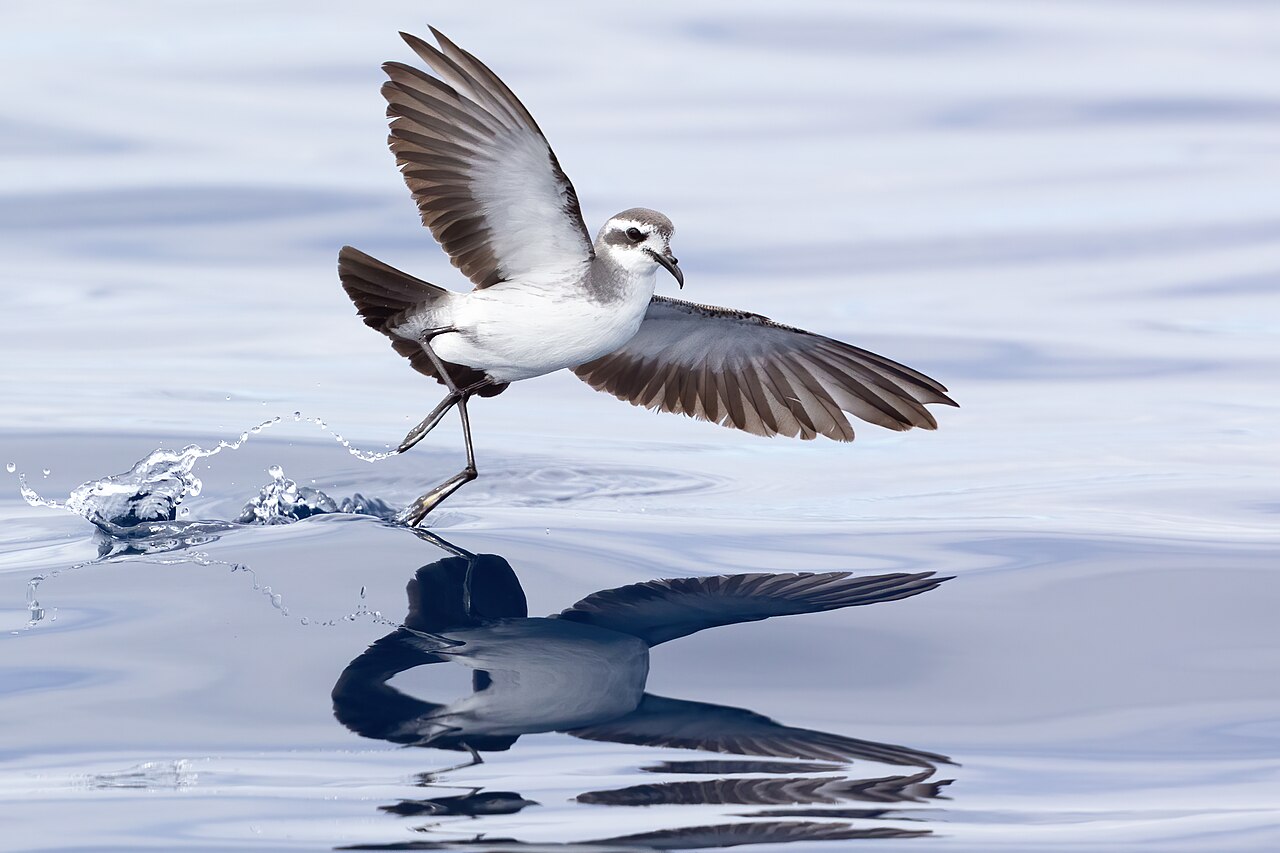
White-faced Storm-Petrel is the only storm-petrel with a white face and a black eye-mask, which gives it something of the look of a miniature phalarope. It breeds on dozens of small, mostly uninhabited islands scattered across the Atlantic, Indian and Pacific Oceans and the Southern Ocean, and only rarely strays far enough north to be seen off North America.
Voice
At sea, where almost every North American record comes from, White-faced Storm-Petrel is silent. It comes ashore at its colonies only in darkness, when a shrill, chattering call carries out of the burrows across the colony. Over open water it is recognised by its way of flying long before it is heard.
Recording: Rinse van der Vliet — CC BY-NC-SA 4.0 · Selvagem Grande, Ilhas Selvagens, Portugal · xeno-canto
Identification
Above it is grey-brown with a paler, greyer rump, and clean white below; a distinctive feature is the white face crossed by a sharply defined black eye-mask. The legs are long, with yellowish, partly webbed feet that project well past the tail while it forages. In flight it bounces across the surface with its legs dangling, in short springy hops recalling a leaping kid goat — a flight action no other storm-petrel in this area shares. The sexes look alike, and the juvenile plumage barely differs from the adult's.
Confusion species
In the waters off the American east coast where White-faced Storm-Petrel occasionally turns up, it is mostly compared with Band-rumped Storm-Petrel (Hydrobates castro) and Wilson's Storm-Petrel (Oceanites oceanicus), but neither shows the white face and black eye-stripe. More useful still is the flight action: while White-faced Storm-Petrel bounces over the water on dangling legs, the other two flutter and patter low over the surface without those distinct hops. At long range, against bright light, the pale underside can still cause confusion.
Habitat
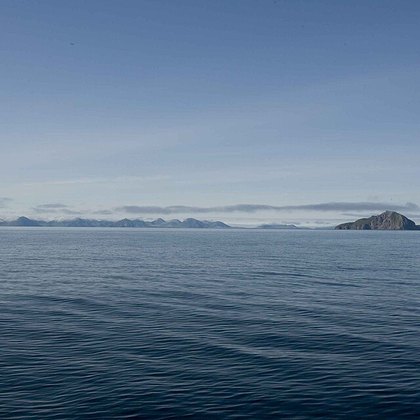
It spends nearly its whole life on the open ocean, far from any coast, picking mostly small mesopelagic fish and squid from the surface. It breeds only on remote, mostly bare or sparsely vegetated islands well outside this guide's area, where it digs a burrow in the soil. It does not occur close to the North American coast; only on boat trips well offshore is it seen at all, and then only rarely.
Where the bird is most often found, arranged by the USNVC — the vegetation classification of the United States and Canada — and CMECS for sea and coast.
Range and movements
The species breeds on islands scattered across nearly every ocean: from Cape Verde, the Canary Islands and the Selvagens in the Atlantic to islands off Australia, New Zealand, the Kermadec group and the Tristan da Cunha group in the south. Within this guide's area it is known only from a handful of records in the cooler waters off North Carolina, concentrated between late July and early October with a peak in August; despite numerous pelagic trips since 2000, reports remain scarce. There is no evidence of any regular passage.
Where and when to look
To see one, skip the usual warm Gulf Stream trips off North Carolina and instead join one of the few trips a year that deliberately push into the cooler water beyond it, in late summer. Watch for a small, bouncing storm-petrel with a white face over the wake.
Conservation
The world population is estimated at over 2.7 million birds, and the IUCN lists the species as Least Concern (LC). On islands where cats, rats or other introduced predators have arrived, colonies have in the past disappeared or shrunk sharply; on predator-free islands the species remains numerous and stable.
Scientific name
Pelagodroma marina | (Latham, 1790)
Latham described the species in 1790 as Procellaria marina; because it has since been moved to another genus, author and year stand in parentheses. The genus Pelagodroma, 'sea runner', was not introduced until 1855, by Reichenbach, and refers to its running, bouncing flight over the water. The type locality was originally given vaguely as 'the southern oceans'; in 1924 Murphy restricted it to waters off the mouth of the Río de la Plata, between 35° and 37° south.