All species › Tubenoses › Northern storm petrels › European Storm-petrel
European Storm-petrel | Hydrobates pelagicus
Stormvogeltje | Paíño europeo
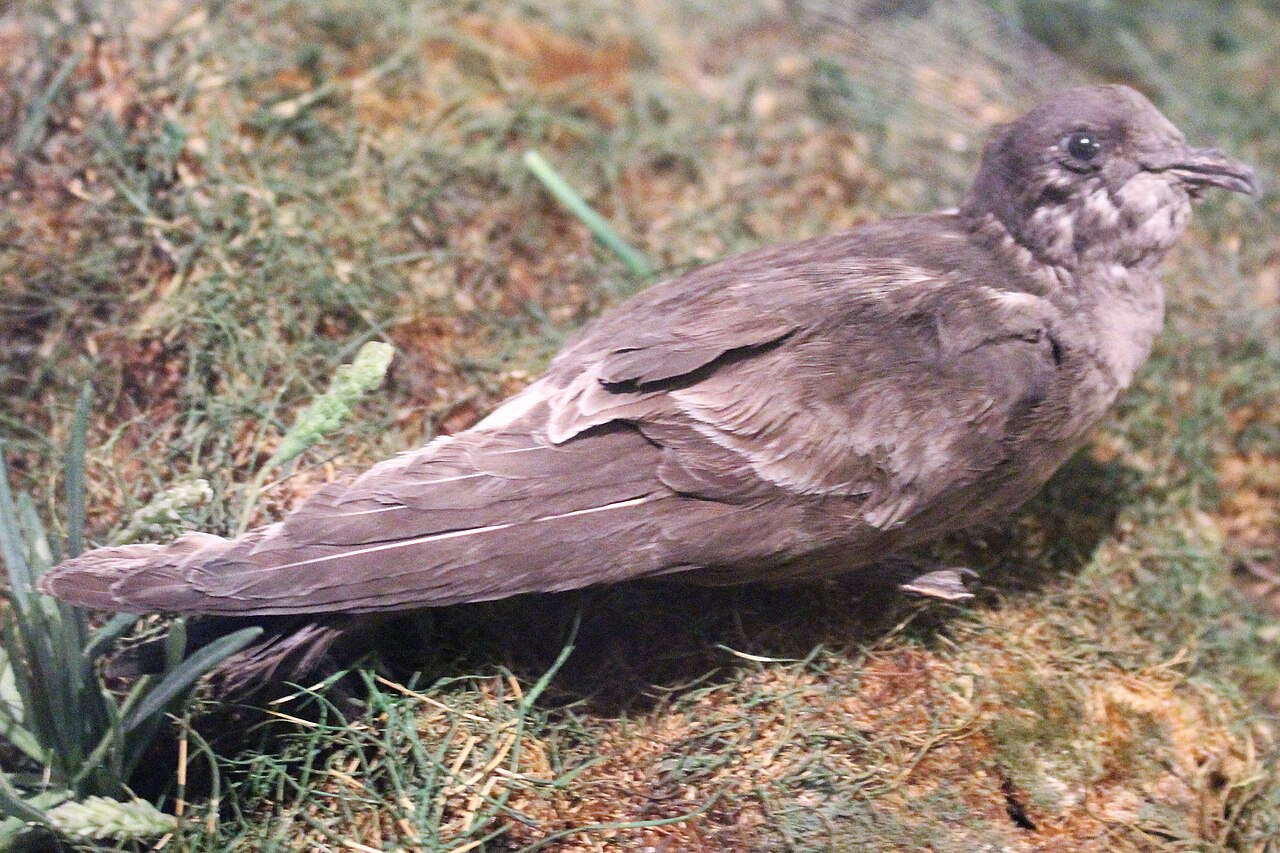
European Storm-Petrel is the smallest seabird in the Atlantic: sooty black all over with a sharply defined white band across the rump, barely bigger than a House Martin. It breeds in rock crevices on islands off the European coast and is a rare vagrant in North America, reported in small numbers almost every year since 2003.
Voice
At sea it is silent, but at night in the burrows of its European colonies it gives a continuous, purring rattle that ends in a hiccupping note — a sound males use to hold the burrow and attract a mate. In flight over the colony it gives a short, rattling ter-chick. Within this guide's area it is almost never heard calling: the few birds that turn up here drift silently among the waves.
No freely licensed recording has been found for this species yet; what to listen for is described below.
Identification
The plumage is nearly uniform sooty black, apart from a broad, sharply bordered white band across the rump; seen from below, a narrow diagonal white bar crosses the underwing, more distinct here than in any other North American species. The tail is square-cut, not forked, and the legs do not project past the tail tip in flight. Males, females and juveniles look almost alike. The flight is fluttering and erratic, with brief glides low over the wave tops, recalling a bat skimming the sea.
Confusion species
In North American waters it is most often confused with Wilson's Storm-Petrel (Oceanites oceanicus): that species has longer legs with yellow-webbed feet that clearly project beyond the tail, a more direct, purposeful flight with pattering over the water, and lacks the white underwing bar. Band-rumped Storm-Petrel (Hydrobates castro) is larger, with a broader, less sharply defined rump band and a less forked tail than Leach's Storm-Petrel (H. leucorhous), which is in turn considerably larger, with a deeply forked tail and a jerky, bounding flight. Of all these, European Storm-Petrel is the smallest and the most uniformly black.
Habitat
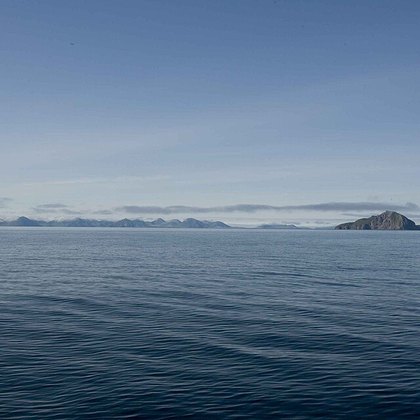
It spends most of the year on the open sea, picking plankton, small fish and offal from the surface while pattering over the waves. It breeds in rock crevices and rabbit burrows on bare or sparsely vegetated islands, far from this guide's area. Within North America there is no fixed site where it occurs; the odd bird seen here drifts at random among other seabirds well offshore.
Where the bird is most often found, arranged by the USNVC — the vegetation classification of the United States and Canada — and CMECS for sea and coast.
Range and movements
The species breeds on islands off the Atlantic and Mediterranean coasts of Europe, with the largest colonies in the Faroe Islands, the United Kingdom, Ireland and Iceland. Outside the breeding season it moves south as far as the coast of southern Africa. The first North American record dates from 1970; thirty years without a single report followed, until the species has been reported in small numbers almost every year since 2003 — too few and too scattered to speak of any regular passage.
Where and when to look
The best chance of seeing one is on a specialised pelagic trip well offshore in late summer, when most recent American reports fall; check every small, uniformly black storm-petrel carefully against the far commoner Wilson's Storm-Petrel beside it. Above all, watch the legs: if they don't project past the tail, that's the best evidence.
Conservation
The world population numbers several million birds and the IUCN lists the species as Least Concern; the Faroe Islands alone hold 150,000 to 400,000 breeding pairs. On breeding islands reached by rats or other introduced predators, colonies have disappeared, and coastal artificial light disorients fledglings leaving the nest.
Scientific name
Hydrobates pelagicus | (Linnaeus, 1758)
Linnaeus described the species in 1758 as Procellaria pelagica; because it has since been moved to another genus, author and year stand in parentheses. The genus Hydrobates was introduced by Boie in 1822 specifically for this species; recent molecular work has also returned most other northern storm-petrels, previously placed in Oceanodroma, to this original genus. The name pelagicus is Latin for 'of the open sea'. The type locality was later restricted to the coast of Sweden.