All species › Tubenoses › Northern storm petrels › Fork-tailed Storm-Petrel
Fork-tailed Storm-Petrel | Hydrobates furcatus
Parelgrijs stormvogeltje | Paíño rabihorcado
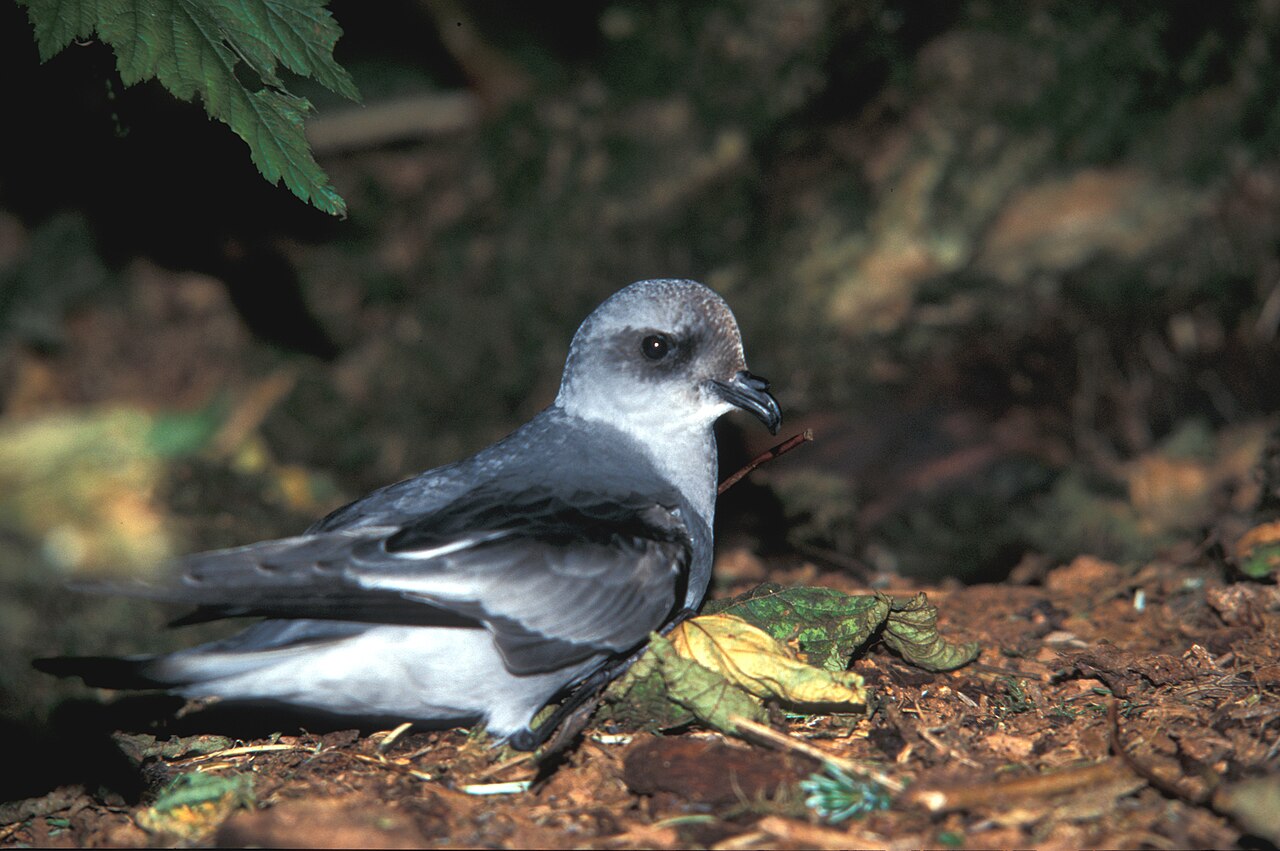
Fork-tailed Storm-Petrel is the only storm-petrel in the world that is mostly pearl-grey rather than sooty black, with a heavy, somewhat stocky body for a storm-petrel. It breeds in rock crevices and burrows on islands the length of the North Pacific, from Alaska to northern California and the Kamchatka coast, making it one of the few tubenoses that actually breeds within this guide's area.
Voice
At the colony, which it visits only in darkness, both sexes give a hoarse, repeated ana-ana-ana; the male adds a higher, single note used to attract or hold a mate. On the open sea, where it spends most of the year, it stays silent. Even at the nest it is heard only at night: by day the birds leave the colony and hide at sea or in their burrows.
Recording: Luke Halpin; Gwaii Haanas National Park Reserve and Haida Heritage Site Seabird Research Group — CC BY-NC-SA 3.0 · Skeena-Queen Charlotte E, Skeena-Queen Charlotte, British Columbia, Canada · xeno-canto
Identification
It is a stocky, sturdily built storm-petrel, uniformly blue-grey with a darker, rather ill-defined shoulder patch and a dark smudge around the eye. The forked tail and pointed wings are obvious in flight, along with the pale, almost silvery overall impression no other storm-petrel in this area shares. Male, female and juvenile look almost alike. It flies low over the water on stiff, fluttering wingbeats and repeatedly stalls to pat the surface with its feet and seize prey.
Confusion species
The only species it can genuinely be confused with in this part of the Pacific is Leach's Storm-Petrel (Hydrobates leucorhous): that species is sooty blackish-brown with a sharply defined white rump band, against the uniform, unbanded pearl-grey plumage of Fork-tailed Storm-Petrel. At long range, against a grey sky, the pale grey can sometimes fade into an impression recalling a gull, but the small size and fluttering flight quickly rule that out. Juveniles of both species differ little from the adults, so age plays no part in telling them apart.
Habitat
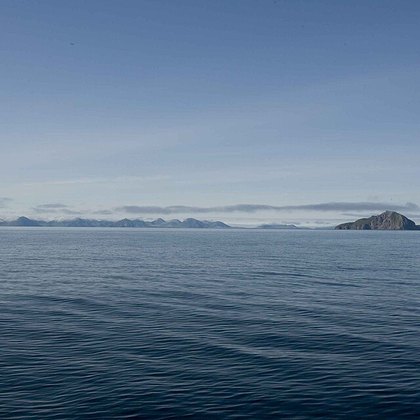
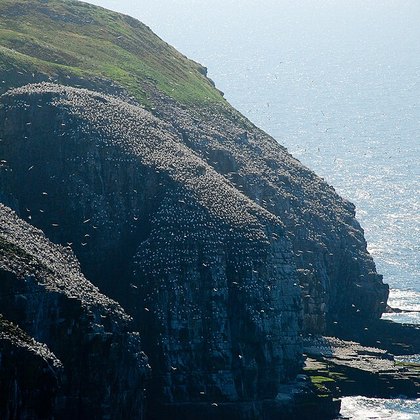
Outside the breeding season it lives on open, cold ocean water, usually north of the fortieth parallel and well offshore, taking crustaceans, squid and small fish such as capelin and rockfish from the surface. It breeds in rock crevices, among talus or in self-dug burrows on bare or sparsely vegetated islands, often alongside puffin colonies. It almost never occurs on the beach or in shallow coastal water; even its colonies sit on steep, hard-to-reach rocky islands.
Where the bird is most often found, arranged by the USNVC — the vegetation classification of the United States and Canada — and CMECS for sea and coast.
Range and movements
Breeding colonies are scattered the length of the North Pacific: numerous in Alaska and the Aleutians, smaller in British Columbia, Washington and Oregon, and with a small, isolated colony of a few hundred birds at Little River Rock in northern California marking the southern edge of the range. On the Asian side it breeds as far as Kamchatka. Outside the breeding season it spreads across much of the North Pacific, well offshore; there is no distinct southward migration, and records away from the colonies remain largely confined to this same northern part of the ocean.
- Resident
- Breeding (summer)
- Passage
- dark = core range, pale = thinly spread
Where and when to look
A boat trip off Alaska, British Columbia or northern Washington and Oregon during the breeding season gives the best chance; look for a small, pale grey storm-petrel fluttering low over the swell. The colonies themselves are active only at night and are not accessible to visitors.
Conservation
The world population is estimated at over six million birds, the second-largest of any storm-petrel, and the IUCN lists the species as Least Concern (LC). Introduced foxes once wiped out colonies on some islands; on most breeding islands today that threat has been removed. Oil pollution and plastic ingestion remain the main risks at sea.
Scientific name
Hydrobates furcatus | (Gmelin, 1789)
Gmelin described the species in 1789 as Procellaria furcata, from specimens taken in the 'icy seas between America and Asia' — the Bering Sea and surrounding waters; because it has since been moved to another genus, author and year stand in parentheses. For a long time it stood in the genus Oceanodroma, along with most other northern storm-petrels; recent molecular work returned that group to the older genus Hydrobates. The species name furcata is Latin for 'forked', after the tail.